Daily Summary, May 26
The news digest for May 26, 2026
—
## 📊 Macroeconomics & Markets
### 🇷🇺 MOEX index hits multi-month low
The Russian stock market continued its decline on Tuesday. The MOEX index fell 0.7% to close at 2,580 points — its lowest since November 18, 2025. The RTS index lost 0.6% to 1,134 points.
The main pressure came from geopolitical tensions. After evening statements by the Russian Foreign Ministry about plans to strike decision-making centers and news of US strikes on southern Iran, investor hopes for a quick de-escalation faded.
The biggest losers were Yuzhuralzoloto (UGLD), which plunged 10.5% due to a failed auction for a state stake in the company, as well as VTB shares.
### 🇷🇺 VTB plunges 6–8.5% on dividend and secondary offering news
VTB shares collapsed more than 6% in the main session on news of recommended dividends and a planned secondary offering. In the evening session, the decline continued, reaching nearly 8.5%.
VTB’s Supervisory Board recommended allocating 25% of its IFRS net profit for 2025 to dividends, amounting to 125.5 billion rubles (9.71 rubles per share). Additionally, the bank plans a new SPO to finance its partnership with the Wildberries-Russ (RWB) group, issuing up to 6.29 billion additional shares at 87 rubles per share.
Analysis: Many investors saw this as dilution of existing shareholders and took profits after recent gains. Modest dividends (only a quarter of profits) also disappointed the market.
### 🇷🇺 Business price expectations fall, but household inflation expectations rise
The Bank of Russia released its May enterprise survey: business price expectations declined for the fourth consecutive month. At the same time, household inflation expectations in May rose to 13.0%, up 0.1 percentage point from April.
### 🇺🇸 Nasdaq gains 1.07%: tech sector back in favour
US stock indices continued to rise. The S&P 500 gained 0.67% to 7,523.82, while the Nasdaq Composite rose 1.07% to 26,625.31. The main driver — the technology sector.
JPMorgan warns: the US stock market is overestimating rate hike risks, favouring defensive sectors at the expense of growth potential.
### 🇪🇺 European markets down on geopolitics
Western European stock markets mostly fell on Tuesday, except for the UK, where trading was closed on Monday. Investors continue to monitor geopolitical news.
### 🇨🇳 Chinese indices fall, Hong Kong rises on Huawei chip breakthrough
Chinese indices mostly fell about 1%, correcting after previous gains. Hong Kong’s Hang Seng, returning from a long weekend, rose 0.4%, driven by news of Huawei’s breakthrough in chip development.
### 🛢 Oil: from collapse back above $100
Oil prices fell sharply on Monday on expectations of a quick US-Iran deal. However, overnight news of US strikes on southern Iran dampened optimism. On Tuesday morning, oil began to recover: Brent rose 1.9% to $95.19.
Iran threatened: negotiations are pointless under these circumstances, and the US and Western countries should prepare for oil prices to rise to $200 per barrel. By evening, Brent had surpassed $100 per barrel.
Analysis: Geopolitical fog is thickening — oil prices are swinging 10% up and down within hours.
### 🇷🇺 Ruble: mixed dynamics
The official dollar rate for May 27 was raised by 12 kopecks to 71.668 rubles. The euro rate was lowered by 2.15 rubles to 83.30 rubles. The yuan on the Moscow Exchange fell noticeably to 10.47 rubles (14 kopecks below the previous close). On Monday, the ruble was pressured by falling oil prices and geopolitics.
### 📉 US inflation expectations hit 12-year high
According to a University of Michigan survey, consumers expect prices to rise at an average annual rate of 4.2% over the next 5–10 years — the highest level since 2014 — driven by concerns over US tariff policy and geopolitical risks.
### 📈 US optimism: Iran conflict resolution “within reach”
US Secretary of State Marco Rubio said talks with Iran in Qatar continue, though finalising language may take several days. “The consensus view remains that some sort of de-escalation will be formally reached in the next several days,” said Adam Crisafulli of Vital Knowledge.
—
## 🤖 Technology & AI
### 🌾 China creates AI for plant protection
On May 26, China unveiled its first open-source large language model, Green Shield, designed for plant protection. Developed by Nanjing Agricultural University, the model was trained on a corpus of 2.5 billion tokens, including scientific papers and patents. Before giving pesticide recommendations, the model checks against a national database, blocking inappropriate suggestions.
### 🚀 Amazon, Google, Meta, Microsoft to invest $725 billion in AI infrastructure
The four tech giants will spend up to $725 billion in 2026 on AI infrastructure — 77% more than the previous year. The arms race is shifting from models to “hardware”: thousands of AI accelerators cannot work in unison without specialised communication infrastructure. Next beneficiaries — energy, transformers, cooling systems, and data centre operators. The main risk: capex is being locked in now, but generative AI’s ability to generate comparable cash flow remains unproven.
### 💼 Astra Group buys 26% of AI developer AiB
Russian software maker Astra Group acquired 26% of AiB to build multi-agent systems, machine learning, and predictive analytics. Experts estimate the deal at roughly 100 million rubles. The new division is called “Astra AI.”
### 🍏 Apple prepares “smart” Siri and new AI features
Apple has begun preparing for the launch of an improved generative-AI-based Siri and other Apple Intelligence features ahead of WWDC 2026. New features include automatic video subtitles, enhanced voice control, and more natural app interaction. The company also registered the subdomain genai.apple.com.
### ☠️ Sam Altman admits: AI did not cause job “apocalypse”
OpenAI CEO Sam Altman said his predictions of mass AI-driven job displacement were overstated. Instead of rapid human replacement, a gradual labour market adaptation to new technologies is taking place. Economists agree that workforce retraining and market flexibility remain key, not instant substitution.
### 📸 Khabarovsk turns to AI to fight icicles and graffiti
In 2026, the authorities of Khabarovsk will equip Karl Marx Street with AI-powered systems to detect icicles, graffiti, and overflowing bins. Mayor Sergei Kravchuk said the system will automatically monitor urban infrastructure.
—
## 🛡 Cybersecurity
### 🕵️ FBI busts “crypto signal” scheme impersonating G7
The US Federal Bureau of Investigation has dismantled a group of fraudsters posing as G7 analysts. They sent “exclusive signals” about crypto market movements to investors, luring them to phishing platforms. Preliminary estimates put damages at over $50 million. Twelve people have been arrested.
### 🔍 Scammers steal at least $400,000 via fake Uniswap Google Search ads
Fraudsters placed ads in Google Search leading to phishing sites mimicking Uniswap’s interface. Users searching for the official service clicked fake links and lost access to their wallets. Damage: at least $400,000.
### ☠️ Hackers launch new Trapdoor attack against crypto developers
Attackers injected malicious packages into popular repositories npm, PyPI, and Crates (JavaScript, Python, and Rust ecosystems). Goal: steal seed phrases, private keys, and access to GitHub and SSH. The attack is called Trapdoor. Developers are advised to carefully check dependencies and use verification tools.
### 🛡 Kaspersky Lab: hackers using AI to fake CEOs’ voices
A report by company experts describes a new wave of targeted attacks on large Russian corporations. Attackers use neural networks to generate voice messages from top executives, ordering urgent transfers of funds to controlled accounts. Voice biometrics in its current form cannot reliably distinguish real speech from AI-synthesised speech.
—
## ₿ Blockchain & Cryptocurrencies
### 🧯 Someone sends 107 BTC ($8.2 million) to a burn address
An unknown person sent 5 transactions totalling 107 BTC (about $8.2 million) to the Bitcoin address 1111111111111111111114oLvT2, which is invalid (a burner address). The sender’s motives remain unknown. Possible theories: an address error, deliberate coin destruction, or an attempt at a “gift” to the network.
### 📈 Bitcoin trades sideways
The broader crypto market remained mostly range-bound amid Middle East geopolitical tensions, which pushed oil prices and the dollar higher. Investors await clarity on the rate path after speeches by US and Japanese central bank officials.
### 🔒 Privacy tokens drop sharply on US strikes on Iran
Zcash (ZEC) fell 5.2% to $619, Monero (XMR) fell 4% to $378. Despite this, both remain among the strongest crypto performers recently (ZEC is up 8.2% over the week). Traders view the pullback as profit-taking after a rally driven by institutional interest and a renewed narrative around privacy tokens.
### 🚀 HYPE briefly overtakes Dogecoin
Hyperliquid’s HYPE token traded above Dogecoin’s market cap during Asian hours before pulling back (HYPE fell 4% to $59). HYPE is still up 23.6% over the last seven days on the back of SpaceX’s upcoming pre-IPO on Hyperliquid, which we reported last week.
### 🪙 Strategy spends $1.38 billion of its $2 billion reserves to buy back convertible bonds
Strategy (formerly MicroStrategy) has allocated $1.38 billion from its $2 billion reserves to buy back convertible bonds maturing in 2029. This is part of its debt management strategy. Remaining funds will likely be used for further bitcoin purchases.
### 🎮 Pump.fun launches multichain for cross-network memecoins
Memecoin launchpad Pump.fun has announced seamless multichain functionality, allowing tokens to move between blockchains without users leaving the platform. This will expand liquidity and lower the entry barrier for memecoin creators on other networks.
### 📈 SEBI approves blockchain pilot for tokenising corporate bonds
India’s securities regulator SEBI has approved a blockchain pilot project for tokenising corporate bonds, paving the way for broader adoption of distributed ledger technology in corporate finance.
—
## ⚖️ Cryptocurrency Regulation
### 🇬🇧 UK imposes new sanctions against crypto exchanges and payment networks
On May 26, the UK applied bank‑style sanctions to crypto exchanges for the first time. The restrictions target crypto exchange Huobi (HTX), as well as banks and companies from Georgia and the UAE that, according to London, helped Russia circumvent Western restrictions. UK financial institutions are required to freeze these entities’ assets.
Analysis: This is the first time sanctions of this kind have been applied to crypto exchanges. London is hitting intermediaries (Georgia, UAE) through which, according to intelligence, sanctions‑evading transactions flowed.
### 🚓 Russian Investigative Committee proposes separate criminal article for illegal mining
Russia’s Investigative Committee has proposed introducing a separate criminal article for illegal cryptocurrency mining. The proposal does not aim for a complete ban, but to crack down on schemes involving large‑scale damage, electricity theft, and illegal income. If passed, violators could face up to 5–7 years in prison.
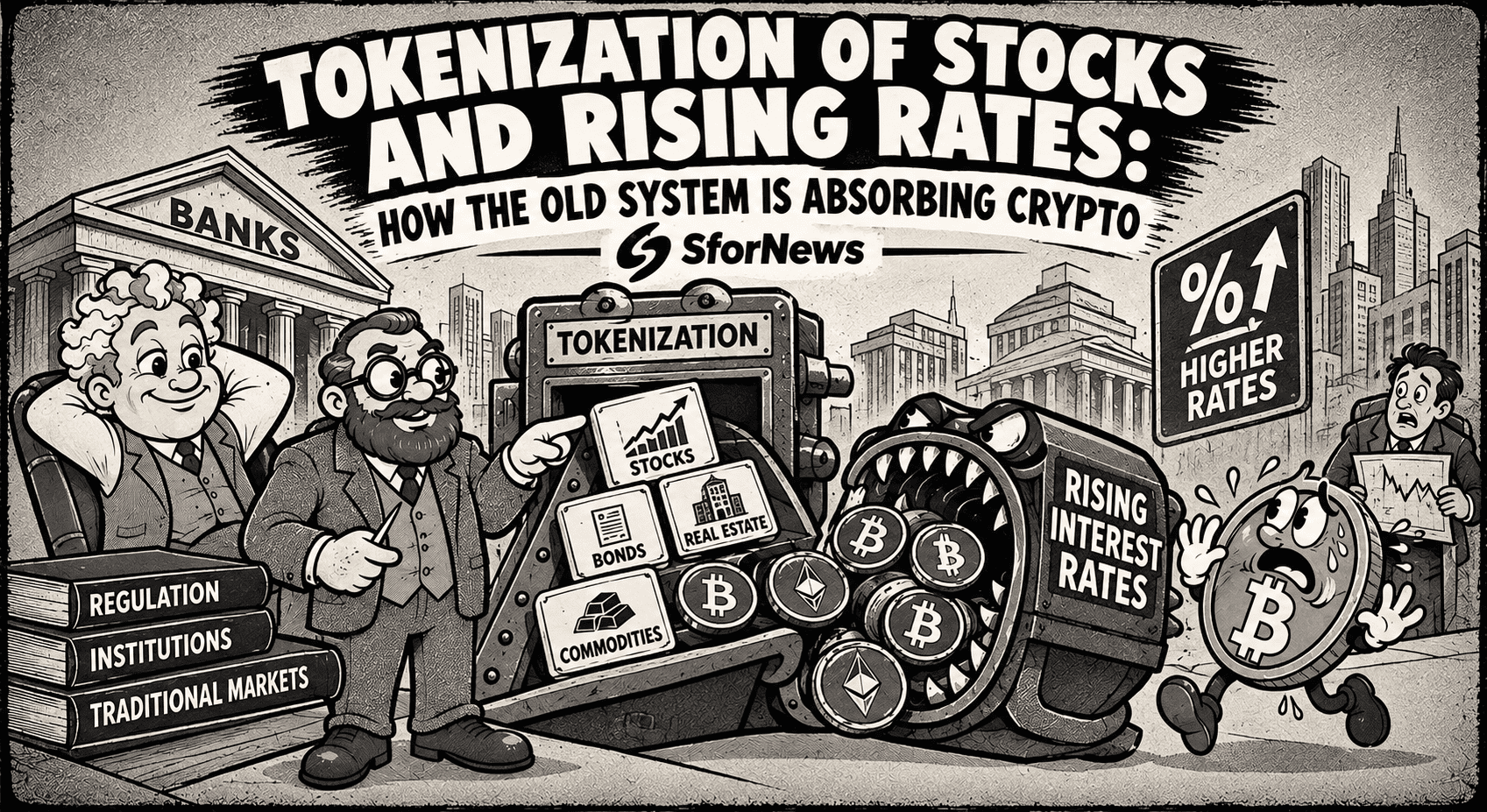
### 🇺🇸 US SEC delays plan for tokenising American stocks
The SEC has urgently postponed a regulatory relief plan for “tokenised stocks,” reigniting tensions between the crypto industry and traditional financial markets. For Russian platforms and investors, this is an important signal: the US regulator remains tough on tokenisation of traditional assets.
### 🇪🇺 France’s president calls for tighter crypto controls
French President Emmanuel Macron called for tightening regulation of crypto assets, warning that without adequate controls they could be used to finance terrorism, launder money, and evade sanctions.
### 💶 ECB to review key rates on June 5
The European Central Bank confirmed its next key rate meeting will take place on June 5. The market expects another 25 bps rate hike amid persistent high inflationary pressure in the eurozone.
—
## 📋 Incidents & Fraud
### 🇷🇺 Scammers laundered about 295 billion rubles through crypto last year
Analysts at Sber said that in 2025, fraudsters funnelled stolen money through cryptocurrency and crypto exchangers totalling about 295 billion rubles. This underscores the scale of the problem and the need for stronger oversight of P2P exchangers and illegal crypto services.
### 🚬 Unusual lawsuit in New York claims rights to “forgotten” bitcoins
Plaintiffs are asking a court to grant them rights to 39,069 long‑inactive Bitcoin addresses, which they estimate could hold about 3.7 million BTC (over $280 billion at current prices). Among the “sleeping” wallets are addresses of early miners, supposedly Satoshi Nakamoto himself, and wallets linked to the Mt.Gox hacker.
Analysis: Experts consider the chances of success extremely low due to the lack of legal mechanisms to claim unowned cryptocurrency. However, the precedent itself could trigger a wave of similar claims.
### 🚓 US: scammers impersonating G7 analysts steal $50 million
The FBI has uncovered a large‑scale scheme in which fraudsters posing as “G7 analysts” sent “exclusive” crypto market signals to investors, luring them to phishing platforms. Twelve people have been arrested.
### 🚬 Russia: crypto scammers defraud pensioner of 7.2 million rubles
A group of fraudsters has been detained in the Moscow region after convincing a 72‑year‑old pensioner to transfer 7.2 million rubles to a “safe crypto wallet.” The scammers posed as Central Bank employees and persuaded her that her savings needed to be urgently converted to cryptocurrency to protect them from sanctions.
### ⚡️ Russia records first case of electricity theft for mining in an apartment building
In the Krasnodar region, illegal connection to communal power grids for crypto mining has been uncovered. Damage to the utility company exceeds 2 million rubles. A criminal case has been opened.
### 🏦 Turkey: major crypto exchange goes bankrupt with $150 million in damages
A large Turkish crypto exchange with tens of thousands of clients has declared bankruptcy. Preliminary data suggests the exchange’s assets were moved to offshore accounts, and total investor claims are estimated at $150 million. Local law enforcement has launched an investigation.
### 💳 Russia’s Rosfinmonitoring expands “suspicious” crypto transaction criteria
The Russian agency has added new indicators for potential money laundering using digital assets. The list now includes frequent transactions between anonymous wallets, transfers to foreign crypto exchanges without economic justification, and operations involving privacy tokens.
—
## 🧬 Blockchain & Technology (Development)
### 🪙 Ethereum Foundation launches Kohaku SDK for private transactions
The Ethereum Foundation has released Kohaku SDK — a toolkit that allows wallets and applications to add private transactions to the Ethereum network without complex setup for end users. This is an important step toward implementing confidential payments at the base layer of the ecosystem.
—
## 🔮 Curiosities & Trends
### ⚰️ AI learns to predict death — Life2Vec model gains popularity
Researchers from Denmark have unveiled an updated Life2Vec model that predicts life expectancy with up to 78% accuracy based on health, education, and socio‑economic data. Despite warnings against commercial use, applications based on the technology are rapidly gaining popularity in Europe.
### 📺 Kanye West releases music video fully generated by neural network
American rapper Kanye West has released a new music video generated entirely by neural networks. The director of the video was an AI agent trained on West’s own visual style. The video has sparked heated debate: some criticise the lack of “live” creativity, while others call it a breakthrough in the music industry.
### ⚖️ Lawsuit for 3.7 million BTC: attempt to claim Satoshi’s wallets
The New York lawsuit claiming rights to 39,069 inactive addresses (potentially 3.7 million BTC) became the day’s main legal oddity. Lawyers are sceptical: even if the court recognises the plaintiffs’ rights, technically accessing the private keys is impossible. Still, the precedent itself could trigger a wave of similar claims.
—
## 📊 Summary for May 26, 2026
Tuesday, May 26, was a tense day for all asset classes — from oil to cryptocurrencies. The main storyline was Middle East escalation following US strikes on Iranian targets, which pushed oil back above $100 per barrel but deepened the Russian stock market’s slide to November 2025 lows. The MOEX index fell to 2,580 points.
Key positive events:
– US indices rose: Nasdaq +1.07%, Dow +0.1%.
– Tech giants to invest $725 billion in AI infrastructure — 77% more than last year.
– Ethereum Foundation launches Kohaku SDK for private transactions, simplifying confidentiality.
– Astra Group buys 26% of AI developer AiB, strengthening its multi‑agent systems position.
Key negative events:
– MOEX index hits multi‑month low — 2,580 points.
– VTB shares plunge 6–8.5% on news of dividends (only 25% of profit) and a planned SPO.
– Yuzhuralzoloto (UGLD) crashes 10.5% after a state stake auction fails.
– UK imposes first bank‑style sanctions on crypto exchanges (Huobi and companies from Georgia, UAE), requiring asset freezes.
– Privacy tokens (ZEC, XMR) drop 4–5% on profit‑taking amid geopolitical tensions.
– Russian household inflation expectations rise to 13.0% — highest since start of year.
– Unknown person burns 107 BTC ($8.2 million) to an invalid address.
The day will be remembered for several “firsts”:
– The UK applied bank‑style sanctions to crypto exchanges for the first time.
– Russia’s Investigative Committee proposed a separate criminal article for illegal mining with large‑scale damage.
– The Ethereum Foundation made private transactions accessible to ordinary wallets via the Kohaku SDK.
– A lawsuit for 3.7 million “sleeping” BTC was filed in New York, including Satoshi’s wallets.
The main takeaway for the evening: The world is balancing on the edge of two scenarios — Middle East de‑escalation (which would crush oil but support risk assets) and full‑scale escalation (which would accelerate inflation and break supply chains). Geopolitical fog is thickening, and market participants are reacting reactively: oil prices swinging 10% up and down within hours, stocks and cryptocurrencies in turmoil.
Regulators on both sides of the ocean continue tightening control over the crypto industry: London hitting intermediaries (Georgia, UAE), Moscow preparing criminal articles for illegal mining, and the SEC halting a plan to tokenise US stocks at the last minute. Fraud remains a massive problem: in Russia alone, 295 billion rubles of stolen funds were laundered through crypto last year.
The day’s curiosity — a New York lawsuit claiming 3.7 million “forgotten” bitcoins. The chances are virtually zero, but the fact itself shows that even 16 years after Bitcoin’s creation, legal battles over early coins are not abating.
Investors find themselves at a crossroads: on one hand, US strikes on Iran and harsh rhetoric from Moscow; on the other, talks in Qatar that, according to Rubio, continue and could bring de‑escalation in the coming days.
The old world has collapsed. We are building the new one. And in this new world, even burning millions of dollars to an invalid address is not a reason for panic, but a reminder: in crypto, no one is immune to error. Or to a grand gesture. Stay with us so you don’t miss the main events.


Bitcoin
$62,881.23

Ethereum
$1,672.04

Litecoin
$42.71

Dash
$37.08

Bitcoin Cash
$209.43