Results of the day February 10th
Daily Summary, February 10th The Great Filtering: Regulators Build Walls, Innovations Find Workarounds —
1. REGULATORY AND SOVEREIGNTY: THE FRONT OF BRITISH BORDER DEFINITION ⚖️🛡
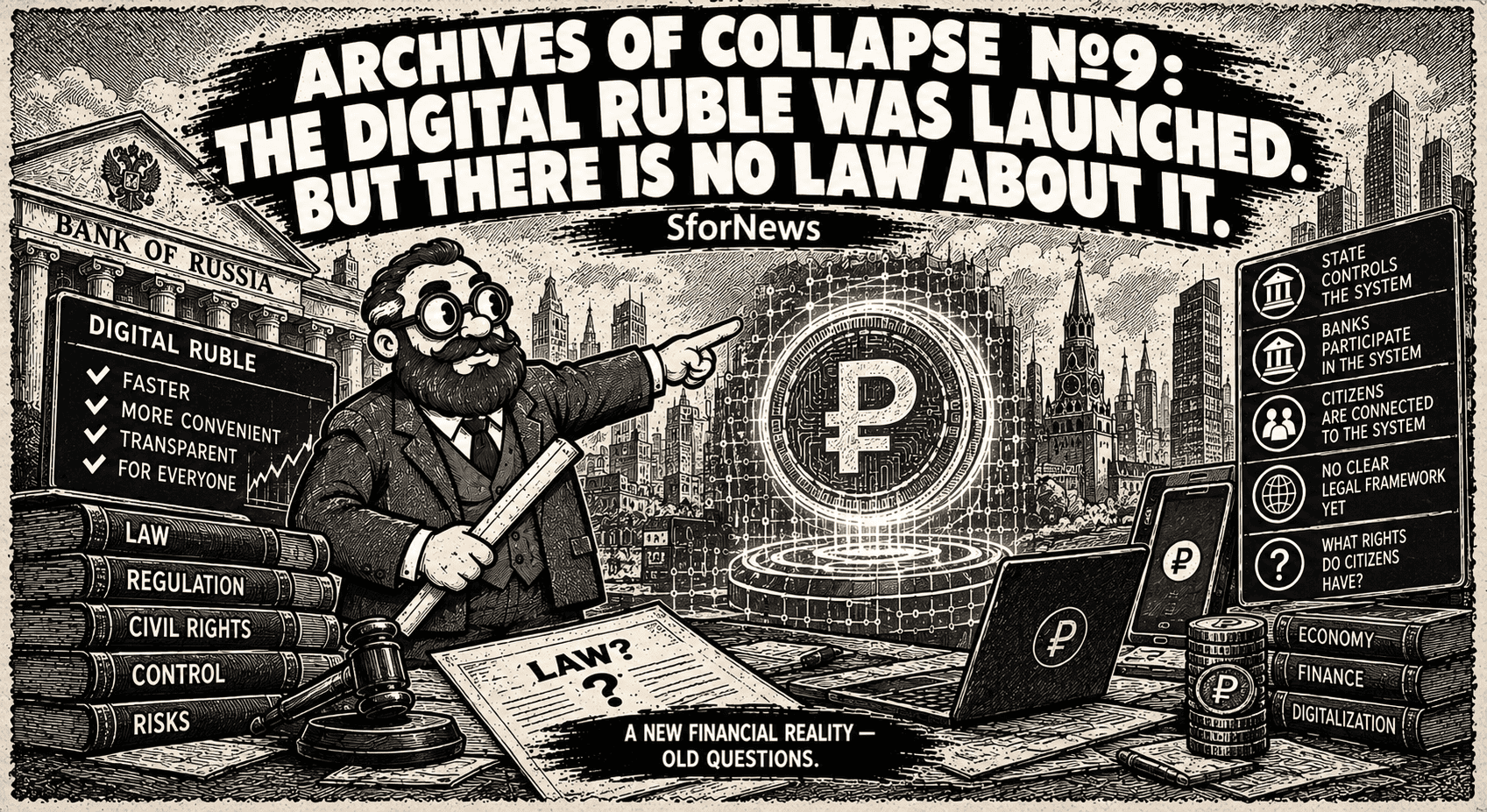
Russian authorities have decided to slow down Telegram, and officially recognized cryptocurrency as property subject to confiscation. * Analysis: Digital Sovereignty Day. Two decisions form a systemic trend: complete control over digital flows. Slowing down Telegram is a test of the “manageability” of a platform that has refused to cooperate with law enforcement. Recognizing cryptocurrency as property is not liberalization, but the creation of a legal tool for its confiscation under the Criminal Code. The state is consistently erasing digital “gray zones.” The European Union is proposing a complete ban on crypto transactions with Russia and imposing sanctions against Kyrgyz banks. * Analysis: The geopolitical battle is entering an all-out phase. The ban on all transactions is an attempt to impose a digital financial blockade, forcing Russia and its partners to either violate sanctions or rapidly build closed alternative chains. The strike on Kyrgyzstan’s banks is a warning to any third country whose financial system could be used to circumvent restrictions.
—
2. INFRASTRUCTURE AND TECHNOLOGY: NEW LANDSCAPES OF WAR AND GROWTH 🏗🤖
Sberbank announced a 500 billion ruble supercomputer for AI infrastructure. * Analysis: The state giant is betting on sovereign computing power as a strategic asset. Amid restrictions on the import of chips and services (Google, AWS), creating its own “computational sovereignty” is a matter of survival for the development of competitive AI. This is a direct investment in future technological parity. Vitalik Buterin advocates for AI that enhances human freedom. * Analysis: On a day of regulatory pressure, this is an important philosophical framework from a key Web3 figure. Buterin points to a key ethical dividing line in AI development: will it be a tool for centralized control or a “smart amplifier” for decentralized communities and personal autonomy. His narrative forms the ideological foundation for alternative developments. Decentralized exchange Hyperliquid is “quietly” overtaking Coinbase in key metrics. * Analysis: The trend toward disintermediation is gaining momentum. Hyperliquid’s success demonstrates that, in a context where regulators are stifling centralized platforms (Coinbase under pressure from the SEC), demand is shifting to more resilient, decentralized protocols without a single point of failure. This is a classic ecosystem response to pressure.
—
3. MARKETS AND CAPITAL: CATHARSIS AND REDISTRIBUTION 💸🔥
A major trader lost $3.6 million on SOL, Tether burned 3.5 billion USDT. * Analysis: A day of painful capitulation and “blowing off steam.” The loss-making sale of a large SOL stake (an unsuccessful attempt to play the rebound) is a sign of the forced closure of leveraged positions and the exit of weak hands. The simultaneous large-scale release of USDT from circulation (burning) indicates either a decline in speculative demand or Tether’s preparation to transfer liquidity to other networks. The market is being cleared of excess liquidity and ineffective traders. Binance controls 87% of the Trump family stablecoin (USD1). * Analysis: Political narrative meets market reality. Even a “Trump stablecoin” cannot exist outside the orbit of a major exchange. This demonstrates the critical dependence of new projects on existing infrastructural hegemony (Binance’s liquidity, user trust). Political branding is losing out to market mechanics.
—
4. INNOVATIONS AND ABERRATIONS: ATTENTION AS AN ASSET ⚡️🎭
Polymarket and Kaito AI launch “attention markets” for betting on public sentiment. * Analysis: A revolutionary step in the tokenization of an intangible asset—collective attention. This transforms social media and the media landscape into a financially incentivized prediction market. The project legalizes and monetizes speculation on narratives, creating a financial reflection of information warfare. Danger and potential, all rolled into one. The Israeli crypto industry is lobbying for relaxed regulations, promising $38 billion for the economy. * Analysis: While some countries (Russia, the EU) are building walls, others see regulation as a tool to attract capital and talent. Israel, with its powerful tech sector, is trying to carve out a niche as a “friendly jurisdiction” for innovation, focusing on economic impact rather than control. A resident of Tatarstan lost 3.6 million rubles in a crypto scam. * Analysis: An eternal aberration, exacerbated in moments of chaos. While sovereignty wars rage at the highest level and supercomputers are being built, archaic scams (digital “Nigerian letters”) continue to operate effectively at the grassroots level. This is a reminder that the technological complexity of the system does not improve personal literacy or eliminate human gullibility.
—
SYSTEM TRENDS OF THE DAY:
🧱Trend toward fortification: States (Russia, EU) are moving from targeted regulation to erecting digital barriers and jurisdictional walls, attempting to control everything from instant messaging apps to cryptocurrency flows. * 🔄 Trend toward disintermediation: Indestructible decentralized protocols (Hyperliquid) are responding to pressure, taking market share from traditional players (Coinbase). * 🧠 Trend toward sovereign capacity: The focus on technological autonomy is leading to massive investments in national AI infrastructure (Sber), which is reshaping the competitive landscape. * 🎯 Trend toward tokenization of everything: Not only assets but also intangible phenomena—attention, sentiment, and narratives—are being financed (Polymarket), creating new, highly volatile markets.
—
ARCHITECTURAL CONCLUSION
February 10th marks the “Great Filtration” and a new crystallization.
The market and regulation have simultaneously undergone a painful selection process. Weak, dependent, and speculative elements have been weeded out: losing traders, excess stablecoin liquidity, gullible investors. Strong, sovereign, and innovative elements are strengthening their positions: the state building digital borders; banks investing in supercomputers; protocols offering fundamentally new markets. The key conflict of the future has been laid bare: between a world of controlled, fenced-off digital jurisdictions (where even Telegram can be slowed down and crypto confiscated) and a world of decentralized, pressure-resistant protocols and ethical AI (as Buterin calls for). It’s not just the strongest who survive, but those most adaptable to the new reality of double standards: where at one extreme lies strict control, at the other, complete anarchy of innovation. The bridge between them is technological sovereignty, whether at the level of the state (Sber’s supercomputer) or the individual (the use of DEX and private instruments). The filtering is complete. The construction of a new landscape begins.


Bitcoin
$62,881.23

Ethereum
$1,672.04

Litecoin
$42.71

Dash
$37.08

Bitcoin Cash
$209.43