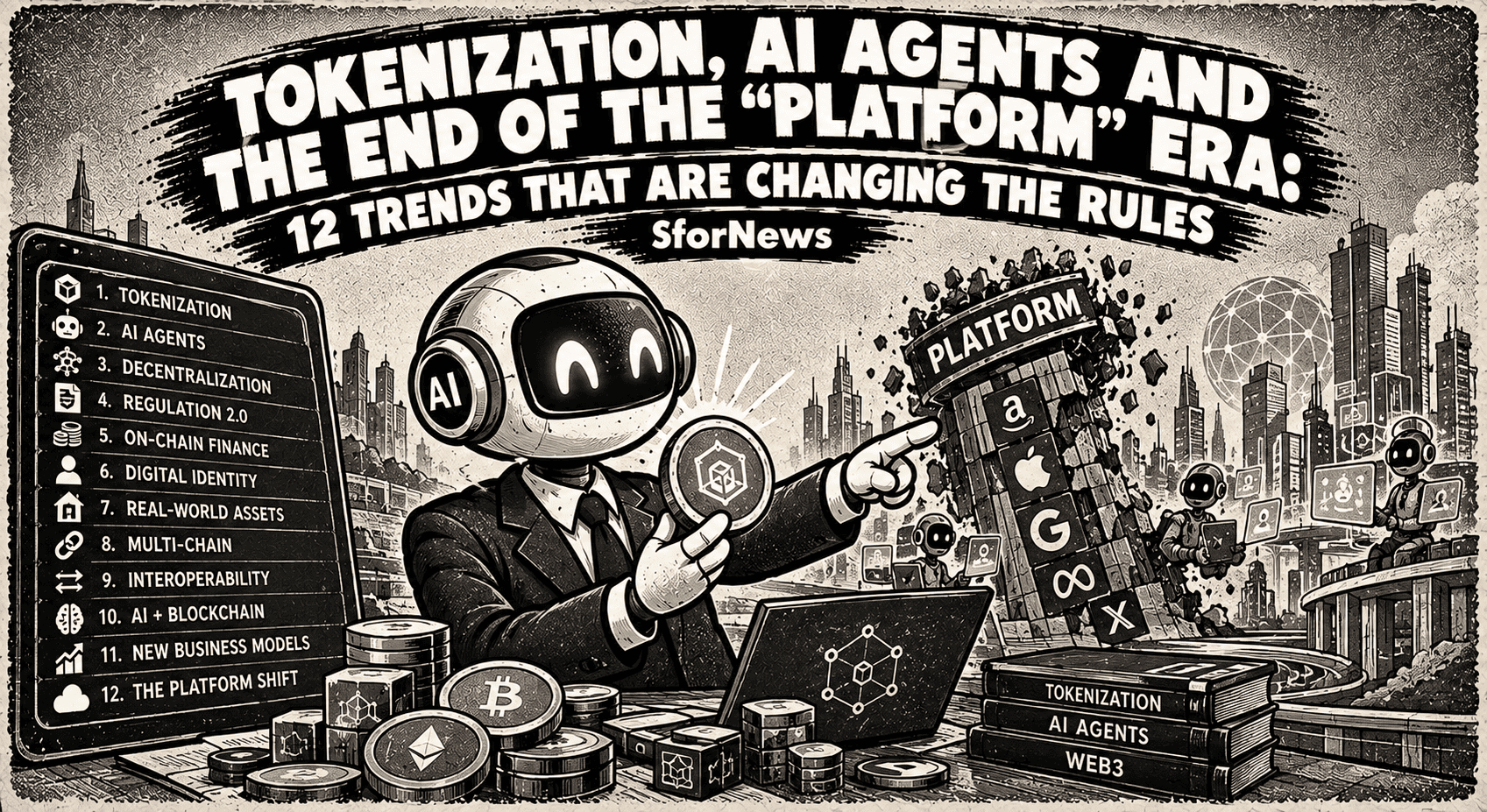
Daily Summary, 2-5 October
NEWS DIGEST — OCTOBER 2–5, 2026
FOCUS: REGULATION, CRYPTOCURRENCIES, MACROECONOMICS, INFRASTRUCTURE
1. REGULATION AND GOVERNMENT
BANK OF RUSSIA: CRYPTO EXCHANGER REGISTRY OFFICIALLY OPENS ON OCTOBER 5
As of October 5, 2026, the Bank of Russia began accepting applications for inclusion in the registry of crypto exchangers, digital depositories, and information-system operators.
Capital requirements:
- at least RUB 50 million for exchangers;
- at least RUB 100 million for depositories;
- management with verified qualifications;
- registration is mandatory.
ARCHITECTURAL CONCLUSION:
The legal perimeter has been formed. Those who do not enter the registry will automatically find themselves outside the legal framework. This is not a “crypto ban” — it is domestication.
EU: INVESTIGATION INTO BINANCE CONTINUES
European regulators continue examining Binance over potential operations without a MiCA license.
The exchange used the “reverse solicitation” exemption to serve clients in the EU. All six of Binance’s registrations in the EU have expired.
ARCHITECTURAL CONCLUSION:
Europe is building walls. MiCA is a filter. Even the world’s largest exchange has not obtained a license. That is significant.
CFTC AND SEC: JOINT WORKING GROUP ON TOKENIZED ASSETS
The CFTC and SEC announced the creation of a joint working group on tokenized assets.
Chairmen Michael Selig and Paul Atkins said the agencies would work toward a “synchronization of approaches.”
ARCHITECTURAL CONCLUSION:
After the failure of the Clarity Act, the two regulators are acting in sync for the first time. A unified framework closes loopholes. Whoever creates a functioning standard first will shape the rules for the entire market.
U.S. HOUSE CREATES COMMITTEE ON DIGITAL DEVELOPMENT AND AI
The Russian State Duma announced the creation of a committee on digital development and artificial intelligence.
ARCHITECTURAL CONCLUSION:
Russia is accelerating the institutionalization of the digital perimeter. The committee is a signal that the state is taking control of digital development.
HESTER PEIRCE LEAVES THE SEC
Today is Hester Peirce’s final day at the SEC.
The commissioner, known in the crypto industry as “Crypto Mom,” is leaving after eight years at the regulator.
ARCHITECTURAL CONCLUSION:
The departure of “Crypto Mom” is symbolic. The SEC is changing course. The institutionalization of stablecoins and tokenized assets is moving forward without her. The era of “crypto-friendly” regulators is coming to an end.
2. CRYPTOCURRENCIES AND BLOCKCHAIN
BITCOIN: HOLDING ABOVE $85,000
As of October 5, Bitcoin is trading in the $85,000–$86,500 range.
Ethereum is trading around $2,750–$2,780.
ARCHITECTURAL CONCLUSION:
The market is in a consolidation phase. If BTC holds above $85,000, the next impulse could be upward.
HISTORICAL FACT: FIRST BTC BEAR MARKET WITHOUT A CLOSE BELOW REALIZED PRICE
This bear market became the first in Bitcoin’s history in which the price never closed below Realized Price — the average acquisition price of all coins on the network.
ARCHITECTURAL CONCLUSION:
This is not a “coincidence.” It is a structural shift. Long-term holders are not selling. The market has become more resilient. BTC is maturing.
SPOT BITCOIN ETFs: INFLOWS CONTINUE
Spot Bitcoin ETFs ended September with $2.65 billion in inflows.
Combined fund assets rose to $108 billion.
ARCHITECTURAL CONCLUSION:
Institutional demand is growing. ETFs are becoming the primary channel for capital inflows into BTC.
TOKENIZED STOCKS REACH $3 BILLION
Tokenized stocks reached $3 billion in September 2026.
That represents more than fourfold growth since January.
The broader RWA market reached $38 billion, up 50% since the beginning of the year.
ARCHITECTURAL CONCLUSION:
Tokenized stocks are a bridge between traditional markets and blockchain. The growth rate is 4x over the year.
MYDOGE LAUNCHES DOGEOS TESTNET — AN L2 FOR DOGECOIN
The MyDoge team launched the public DogeOS testnet — an L2 solution for Dogecoin with smart contracts and DeFi applications.
ARCHITECTURAL CONCLUSION:
Dogecoin is a meme. But it is a meme with a multibillion-dollar market capitalization. DogeOS turns the meme into a platform.
USDT ON BITCOIN TO LAUNCH THIS MONTH
USDT on the Bitcoin blockchain is scheduled to launch this month.
ARCHITECTURAL CONCLUSION:
USDT is coming to Bitcoin. This is a bridge between the largest stablecoin and the largest cryptocurrency. Liquidity is moving toward the base layer.
EIGHT OLD BITCOIN WALLETS AWAKENED IN SEPTEMBER: 2,184 BTC
In September 2026, at least eight old Bitcoin wallets that had remained dormant for 12 to more than 15 years became active.
Their owners moved 2,184.3 BTC.
ARCHITECTURAL CONCLUSION:
Early miners are returning. This is a signal. $178 million in profits represents capital that could enter the market.
BITCOIN HOLDERS REALIZE $3.8 BILLION IN NET PROFIT IN ONE WEEK
Bitcoin holders realized approximately $3.8 billion in net profit over the past seven days.
Long-term holders are not selling. Short-term holders are taking profits.
ARCHITECTURAL CONCLUSION:
This is not a peak — it is consolidation. The market is in an accumulation phase.
BLAST IS SHUTTING DOWN
Blast is shutting down — the once-hyped Ethereum L2, backed by $20 million in investments and a huge TVL, can no longer sustain its own infrastructure.
ARCHITECTURAL CONCLUSION:
The L2 race is over. Those creating real value survive. Those who failed to do so leave.
SWITCHBOARD AND LINERA ARE SHUTTING DOWN
The crypto market is being cleaned out.
Switchboard and Linera are shutting down. BitMEX has closed after 11 years of operation.
ARCHITECTURAL CONCLUSION:
Natural selection. Those who adapted survive.
3. SECURITY INCIDENTS
METAMASK: SECURITY INCIDENT AFFECTS PART OF THE INFRASTRUCTURE
MetaMask reported a security incident affecting non-custodial staking.
Nineteen validators received block rewards, 18 of which sent funds to an address funded through Tornado Cash.
Approximately 523,000 ETH belonging to validators was withdrawn as a precautionary measure.
ARCHITECTURAL CONCLUSION:
Even the largest players are vulnerable. Security is not optional. It is a condition of existence.
NEAR INTENTS: $3.8 MILLION HACK, ATTACKER IDENTIFIED
NEAR Intents halted operations after a $3.8 million hack.
The attacker was identified and given 48 hours to return the funds. The protocol committed to compensating affected users.
ARCHITECTURAL CONCLUSION:
Cross-chain infrastructure is the most vulnerable part of the crypto ecosystem. $3.8 million is not a catastrophe. But it is a warning.
SEPTEMBER WAS 2026’S WORST MONTH FOR HACKS: $766.5 MILLION ACROSS 55 ATTACKS
Hackers stole approximately $766.5 million across 55 major attacks.
That represents a 462% increase compared with August.
ARCHITECTURAL CONCLUSION:
Security is the main risk in the crypto market. Fifty-five attacks in one month indicate a systemic problem.
RUSSIAN INTERIOR MINISTRY WARNS OF NEW SCHEME TARGETING IPHONE OWNERS
The Russian Interior Ministry warned of a new scheme targeting iPhone owners.
A person receives a fake notification claiming that an iPhone was purchased with cryptocurrency and is then urged to cancel the payment through a link or “support” service.
ARCHITECTURAL CONCLUSION:
Social engineering targets basic emotions — fear and greed. The new scheme follows the same principle. Only the scenery has changed.
UKRAINIAN AUTHORITIES SHUT DOWN $14 MILLION SHADOW FINANCIAL NETWORK
Ukrainian authorities reported dismantling a major shadow financial network involved in currency exchange, money transfers, and money laundering through cryptocurrency.
Authorities seized UAH 630 million, approximately $14 million, and conducted more than 30 searches.
ARCHITECTURAL CONCLUSION:
The shadow sector is being cleaned out. States are bringing crypto under control. Those outside the perimeter become criminal actors.
4. MACROECONOMICS
TRUMP DELIVERS A MAJOR ULTIMATUM TO PUTIN OVER THE RETURN OF WESTERN BRANDS
Sources claim Washington presented Moscow with a new framework: if an energy ceasefire holds for at least six months without major violations, the United States would begin gradually easing some restrictions and preparing conditions for American companies to return to the Russian market.
This would not mean an immediate lifting of sanctions.
First, the White House would be prepared to open selected financial and logistics channels, simplify operations for American businesses in Russia, and provide companies with legal guarantees.
Trump reportedly set a strict condition: any major violation of the energy ceasefire by Russia would automatically halt the entire process.
ARCHITECTURAL CONCLUSION:
This is not “peace.” It is a deal. The energy ceasefire is a test. If it holds, thawing begins. If it fails, isolation continues.
The return of brands would be a public signal. More significant decisions concerning banks, settlements, and individual economic sectors could follow.
10-YEAR JGB YIELD REACHES 3.15% — HIGHEST SINCE 1996
The yield on Japan’s 10-year government bonds rose to 3.15%, a new high since August 1996.
ARCHITECTURAL CONCLUSION:
Japan is leaving the era of free money. Japanese capital financed global risk for decades through carry trades. If rates continue rising, that flow could reverse.
FED: PROBABILITY OF A SECOND OCTOBER HIKE RISES TO 65%
The probability of a second rate hike in October rose to 65%, up from 50% a week earlier.
ARCHITECTURAL CONCLUSION:
Synchronized tightening. The era of cheap money is ending.
MIDDLE EAST: U.S.–IRAN TALKS CONTINUE
The second U.S.–Iran meeting took place in New York.
The sides agreed on a “road map” for further negotiations.
ARCHITECTURAL CONCLUSION:
A ceasefire is not peace. It is a pause. But the very fact that dialogue is taking place is a signal.
5. INFRASTRUCTURE
OPEN ANONYMITY AND ETHEREUM FOUNDATION LAUNCH ZKAPI
Open Anonymity, together with the Ethereum Foundation, launched zkAPI — a system for private payment for APIs and AI services through Ethereum.
ARCHITECTURAL CONCLUSION:
Privacy is moving to the infrastructure layer. zkAPI is a bridge between anonymity and AI. Whoever controls APIs controls access to AI.
CIRCLE: ARC CHAIN ATTRACTS $1.2 BILLION IN TWO WEEKS
Circle reported that two weeks after launch, on-chain assets on Arc Chain reached $1.2 billion.
ARCHITECTURAL CONCLUSION:
Circle is evolving from a stablecoin issuer into an infrastructure player. Arc is positioned as a blockchain for regulated finance.
BINANCE INVESTS $100 MILLION IN CIRCLE — DEAL CLOSED
Binance completed its $100 million investment in Circle Internet Group.
ARCHITECTURAL CONCLUSION:
Binance and Circle are forming a strategic alliance. $100 million is a bet on USDC as a global stablecoin.
EUROPEANS CALL ON THE EUROPEAN COMMISSION TO EASE MiCA RULES
European stakeholders called on the European Commission to ease MiCA rules and allow regulated stablecoin issuers to offer holders cashback, discounts, and other rewards.
ARCHITECTURAL CONCLUSION:
Europe is building walls. But the market is pushing against those walls. MiCA is not simply “consumer protection.” It is a filter. But the filter can be loosened.
EL SALVADOR RECEIVES IMF MONEY AGAIN DESPITE VIOLATING THE PROGRAM’S BTC ACCUMULATION CONDITION
El Salvador received another IMF disbursement despite already violating the program condition requiring it to stop accumulating Bitcoin.
ARCHITECTURAL CONCLUSION:
The IMF provides the money. El Salvador accumulates BTC. Double standards. Or — reality. Those who accumulate win.
BITCOIN MINERS: AI CLOUD REVENUE CONTINUES TO GROW
Luxor Technology reported that revenue from AI cloud services can reach $941 per MWh, compared with $175 per MWh for HPC hosting.
ARCHITECTURAL CONCLUSION:
Miners are becoming AI operators.
ENERGY → COMPUTING → VALUE
Whoever controls energy controls the future.
6. KEY INDICATORS TO WATCH
| INDICATOR | WHAT TO WATCH |
|---|---|
| Bank of Russia | Who enters the crypto-exchanger registry first |
| CFTC / SEC | First TSV platforms, harmonization of requirements |
| EU / MiCA | Binance investigation, potential easing of rules |
| Federal Reserve | Probability of a second October hike (~65%) |
| Bank of Japan | Carry-trade dynamics and JGB yields |
| BTC / ETH | BTC holding above $85,000, ETH above $2,700 |
| MetaMask | Outcome of the security investigation |
| NEAR Intents | Fund recovery and user compensation |
| Circle / Arc | Arc TVL and fee dynamics |
| Binance / Bitget | Hack consequences and compensation |
| Miners / AI | Pace of transition to AI infrastructure |
| State Duma / AI | First legislative initiatives of the committee |
| Trump / Putin | Energy ceasefire, return of Western brands |
| Open Anonymity | zkAPI development |
| Blast / BitMEX | Project closures, market consolidation |
| USDT on Bitcoin | Launch date |
7. THE SITUATION AS OF OCTOBER 5
The day was marked by regulatory acceleration and continuing security incidents.
Bitcoin is holding above $85,000.
For the first time in history, a BTC bear market has not closed below Realized Price.
This is a structural shift.
SECURITY
Security remains the main problem.
MetaMask, NEAR Intents, $766.5 million across 55 attacks in September. Russia’s Interior Ministry is warning about new schemes.
REGULATORS
Regulators are accelerating.
The CFTC and SEC created a working group. The EU is investigating Binance. Russia opened its crypto-exchanger registry on October 5. The State Duma created an AI committee. Hester Peirce is leaving the SEC.
MACROECONOMICS
Macroeconomics is at an inflection point.
Trump has reportedly given Putin an ultimatum: six months of an energy ceasefire in exchange for a thaw. Japan is leaving the era of free money. The Federal Reserve is raising rates. The Middle East is in a phase of bargaining.
INFRASTRUCTURE
Infrastructure is being built at the institutional level.
Circle attracted $1.2 billion. Binance invested $100 million in Circle. Open Anonymity launched zkAPI. USDT is coming to Bitcoin. Tokenized stocks reached $3 billion. Miners are being repurposed into AI operators.
MARKET CLEANUP
The crypto market is being cleaned out.
Blast, Switchboard, Linera, and BitMEX are shutting down.
Those creating real value survive.
MAIN ARCHITECTURAL CONCLUSION
Legislation is failing to keep pace with the market.
Regulators are taking the initiative.
Europe is protecting banks while considering softer rules. The United States is institutionalizing stablecoins. Russia is building its own regulatory framework.
Trump and Putin are negotiating over an energy ceasefire.
Corporations are accumulating BTC.
Miners are becoming AI operators.
The key direction of the system:
REGULATION → TOKENIZATION → STABLECOINS → COMPUTING → ENERGY
Whoever builds open, verifiable systems will win.


Bitcoin
$62,881.23

Ethereum
$1,672.04

Litecoin
$42.71

Dash
$37.08

Bitcoin Cash
$209.43