Tokenization, AI Agents, and the End of the “Platform” Era: 12 Trends That Change the Rules | SforNews
ARCHIVES OF COLLAPSE
ISSUE No. 7
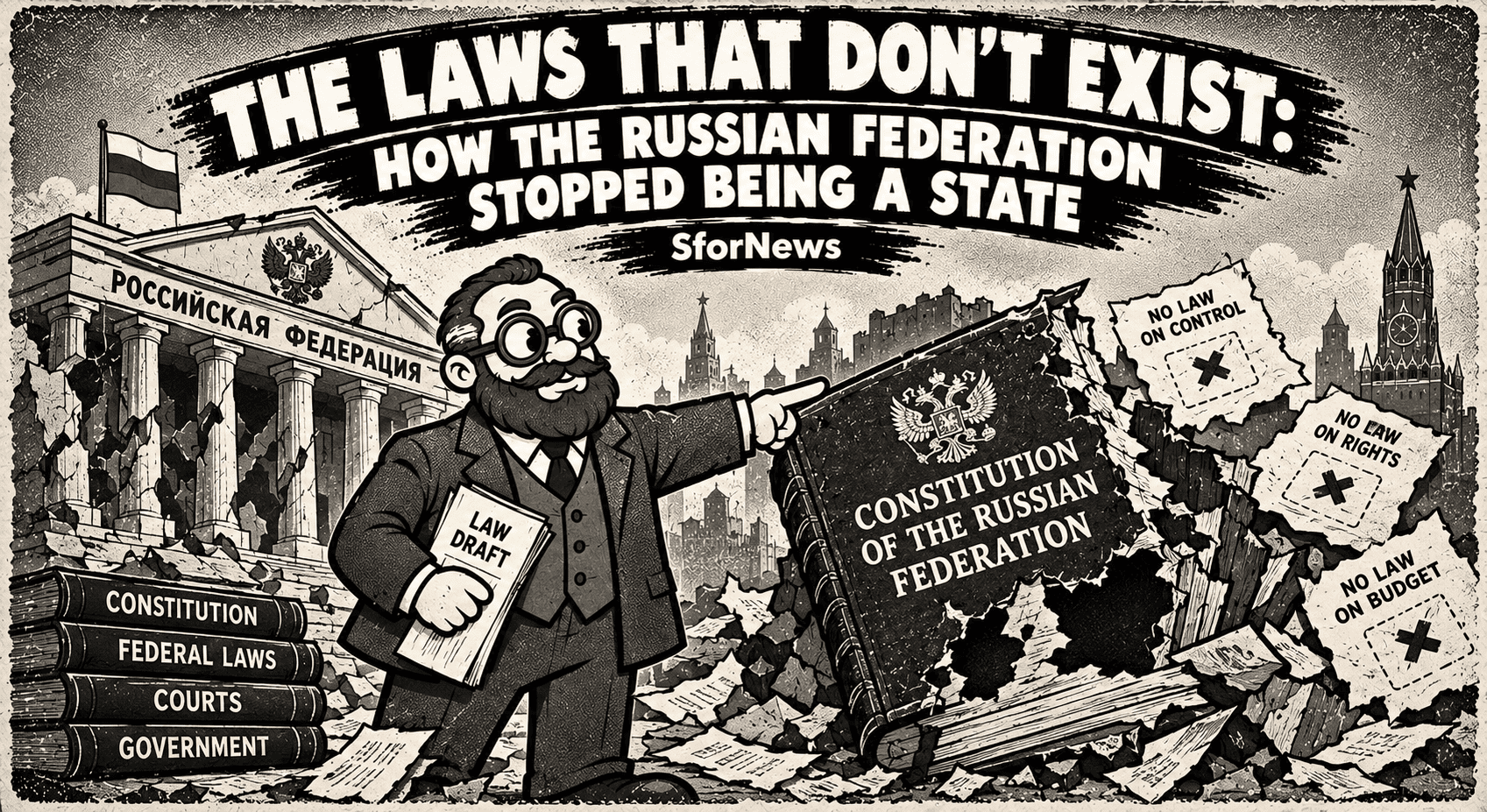
“LAWS THAT DO NOT EXIST: HOW THE RUSSIAN FEDERATION CEASED TO BE A STATE”
By Arkady Belov, exclusively for SFOR NEWS
1. THE HOOK: WHAT HAPPENED?
In August 2026, an event took place within the Federal State Information System (FGIS) of the Russian Federation that went largely unnoticed by the general public.
Of 54 decrees and orders of the President of the Russian Federation, 44 were officially registered as unsigned.
Of 285 resolutions and orders of the Government, 258 were registered as unsigned.
Of 59 federal and federal constitutional laws, all 59 were registered as unsigned.
This is not a technical error.
This is a legal fact.
A law that has not been duly signed and has not been officially published within the legally established period does not enter into force.
It does not exist. It is not there.
It may appear to be a bureaucratic formality.
But in the closed archives of the USSR Academy of Sciences, this development is interpreted differently — as final confirmation that the Russian Federation is not a state.
Because a state without laws is not a state.
It is a commercial corporation governing people without legal grounds.
2. THE DOSSIER: WHAT THE “STATE ACT” SAYS
The “USSR State Act for August 2026 No. 002.810.643.91” contains dry statistics that sound like a verdict:
“In August 2026, within the Federal State Information System of the Russian Federation, 44 of 54 Decrees and Orders of the President of the Russian Federation, 258 of 285 published Resolutions and Orders of the Government of the Russian Federation, and 59 of 59 Federal and Federal Constitutional Laws, having been published, were officially registered as unsigned, as not having been entered into the Collection of Legislation of the Russian Federation within the period established by federal law, and as null and void legal acts in Russia.”
Similar statistics appear for every month of 2026:
| MONTH | DECREES | RESOLUTIONS | LAWS |
|---|---|---|---|
| January 2026 | 23 of 23 | 75 of 165 | 17 of 17 |
| February 2026 | 39 of 44 | 197 of 247 | 27 of 29 |
| March 2026 | 67 of 68 | 118 of 308 | 31 of 31 |
| April 2026 | 48 of 48 | 301 of 339 | 41 of 41 |
| May 2026 | 48 of 48 | 230 of 264 | 46 of 49 |
| June 2026 | 55 of 62 | 240 of 339 | 52 of 57 |
| July 2026 | 36 of 49 | 167 of 237 | 60 of 60 |
| August 2026 | 44 of 54 | 258 of 285 | 59 of 59 |
And there is one key phrase repeated in every act:
“None of the normative legal acts of the Russian Federation in [month] 2026 were approved by the military authorities of the USSR in order to be recognized as temporary, limited and transitional provisions and acts of the Russian Federation.”
This means:
all laws of the Russian Federation are null and void.
They are not there.
They do not exist.
And therefore — the state itself does not exist, because a state without laws is a fiction.
3. DECODING: WHAT DOES THIS MEAN IN PLAIN LANGUAGE?
STEP 1. HOW A LAW BECOMES A LAW
Under the 1993 Constitution of the Russian Federation, a federal law is considered adopted when it is:
- Passed by the State Duma.
- Approved by the Federation Council.
- Signed by the President.
- Officially published within the legally established period.
If even one of these stages is not completed, the law does not enter into force.
It does not exist.
It cannot be invoked.
It cannot be enforced.
STEP 2. WHAT HAPPENED IN 2026
In 2026, almost all laws, decrees and resolutions of the Russian Federation were not signed and were not published within the legally established period.
This means:
they did not enter into force.
They do not exist.
Therefore:
No laws → no legal basis for governance.
No legal basis → all government actions are unlawful.
All government actions are unlawful → the authorities are illegitimate.
The authorities are illegitimate → there is no state.
STEP 3. WHAT DOES THIS MEAN FOR CITIZENS?
If there are no laws, then:
- there are no taxes — because taxes are established by law;
- there are no fines — because fines are established by law;
- there are no punishments — because punishments are established by law;
- there are no obligations — because obligations are established by law.
Therefore, all demands imposed on citizens by the authorities have no legal basis.
All levies, fines, punishments, mobilization measures and prohibitions are null and void.
They do not exist.
4. WHO BENEFITS? THE “STATE ACT” LOGIC IN REALITY
| ACTOR | ROLE ACCORDING TO THE “STATE ACT” |
|---|---|
| President of Russia | A person signing decrees that do not enter into force. Has no legal basis for governance. |
| Government of Russia | A body adopting resolutions that do not enter into force. Has no legal basis for enforcement. |
| Federal Assembly | A body adopting laws that do not enter into force. Has no legal basis for legislation. |
| Russian citizens | People living within a system where there are no laws. All demands from the authorities are null and void. |
| USSR | The only entity whose laws remain valid, because they were properly adopted and published. |
5. FORECAST: WHAT HAPPENS NEXT ACCORDING TO “ARCHIVES OF COLLAPSE”
1. THE AUTHORITIES WILL STOP PRETENDING
If there are no laws, the authorities cannot govern through laws.
They will govern through decrees, orders, letters, telephone calls and informal instructions.
But none of this has legal grounds.
Therefore, it is unlawful.
2. CITIZENS WILL BEGIN TO UNDERSTAND
Once people realize that the laws cited by the authorities do not exist, they will stop obeying them.
Not out of rebellion.
But out of legal correctness.
Why pay a tax that does not exist?
Why comply with a decree that never entered into force?
Why fear a fine that is null and void?
3. THE SYSTEM WILL BEGIN TO COLLAPSE
If citizens stop obeying, the system will no longer be able to function.
It will rely only on:
habit, fear and force.
But habit will pass.
Fear will disappear.
Force is not infinite.
4. THE USSR WILL RETURN
Because the laws of the USSR remain in force.
They were properly adopted and published.
They were never repealed.
They exist.
Therefore, there are legal grounds for governance.
And therefore, there is a state.
6. CONCLUSION: A QUESTION FOR THE READER
Laws that do not exist.
Decrees that were not signed.
Resolutions that were not published.
A state that does not exist.
This is not a “bureaucratic error.”
This is a legal fact.
The Russian Federation is not a state.
It is a commercial corporation governing people without legal grounds.
THE QUESTION FOR YOU:
If all the laws cited by the authorities are null and void, then on what basis do you obey them?
On the basis of habit?
On the basis of fear?
Or on the basis of knowing that the laws of the USSR remain in force?
The choice is yours.
By Arkady Belov
Exclusively for SFOR NEWS
PRIMARY SOURCES
“USSR State Act for August 2026 No. 002.810.643.91” dated September 15, 2026, § 31;
“USSR State Act for July 2026 No. 002.810.643.90,” § 50;
“USSR State Act for June 2026 No. 002.810.643.89,” § 32;
“USSR State Act for May 2026 No. 002.810.643.88,” § 39;
“USSR State Act for April 2026 No. 002.810.643.86,” § 156;
“USSR State Act for March 2026 No. 002.810.643.85,” § 33;
“USSR State Act for February 2026 No. 002.810.643.84,” § 86;
“USSR State Act for January 2026 No. 002.810.643.83,” § 86.
Official publication: https://pravosudija.net/
Exclusive information provided by the “Pravosudija.net” project.
WANT A FOLLOW-UP?
Write in the comments which section of the “State Act” you would like to hear about in the next issue of “Archives of Collapse.”


Bitcoin
$62,881.23

Ethereum
$1,672.04

Litecoin
$42.71

Dash
$37.08

Bitcoin Cash
$209.43