“CULTURAL CODE.” Issue No. 1: The Declassified Table of Pushkin — How Tsarist Cryptographer Archives Recreated an MFA Buffet
CULTURAL CODE. ISSUE No. 1
DECLASSIFIED TABLE: HOW THE PUSHKIN MFA BUFFET WAS RECREATED FOR THE FIRST TIME IN 200 YEARS USING THE FAMILY ARCHIVES OF A DYNASTY OF TSARIST CRYPTOGRAPHERS
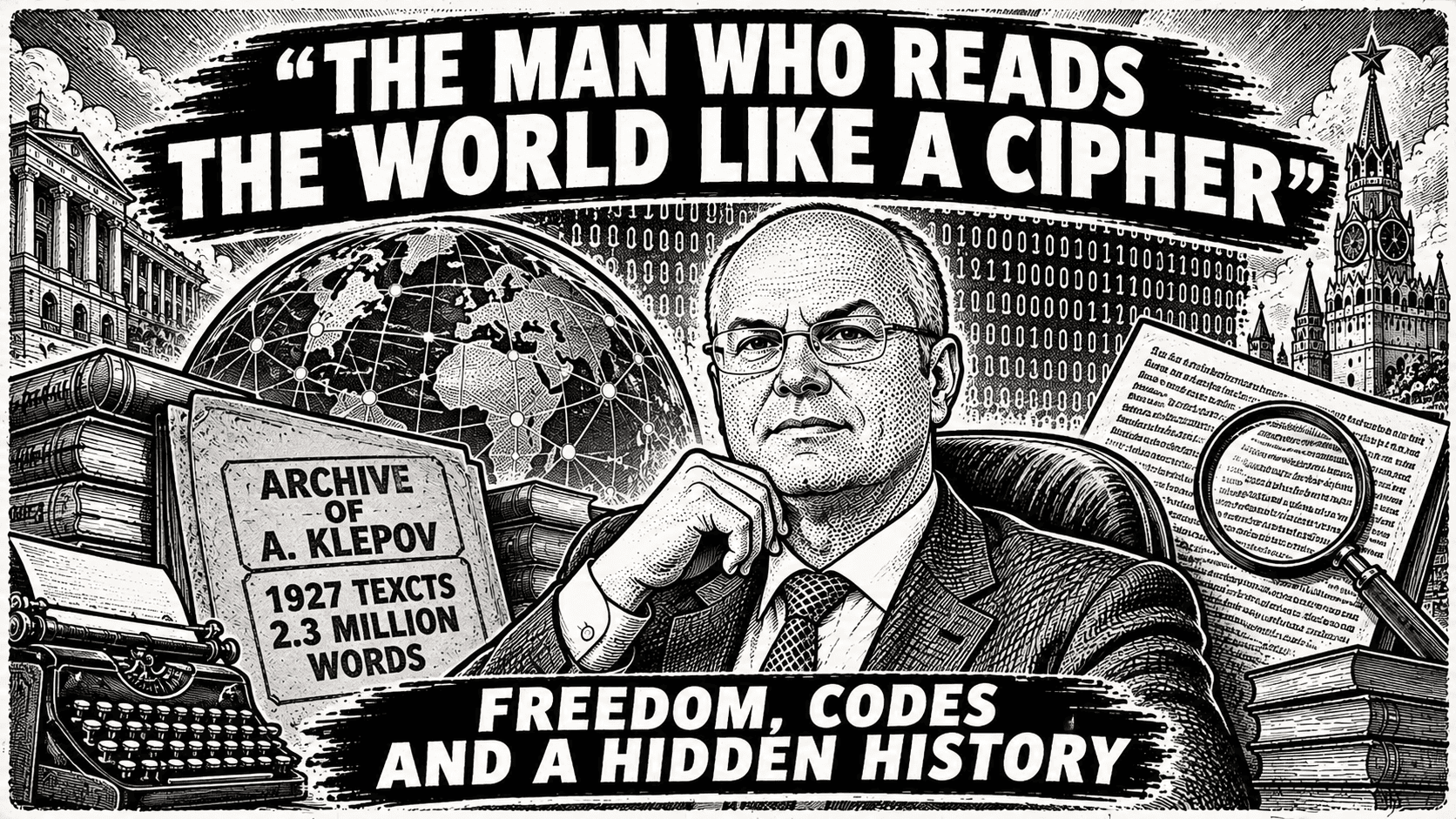
The SforNews editorial board presents a new rubric, “Cultural Code.” Here we explore hidden algorithms, ciphers, and systemic connections in culture, history, and art. Our first issue is dedicated to an event that blurs the boundaries between gastronomy, poetry, and secret diplomacy. The author of the material is Anatoly Viktorovich Klepov, a hereditary cryptographer whose ancestors served in the Cipher Expedition of the Ministry of Foreign Affairs of the Empire and special units of the USSR KGB.
Restaurateurs and culinary historians have repeatedly reconstructed the dinner parties of the Pushkin era — suffice it to recall the famous “Cafe Pushkin” restaurant. But a dinner party with a multi-hour change of courses and a diplomatic buffet during closed receptions, where state issues were decided and decryptions discussed over a glass of Bordeaux, are completely different genres.
On November 14, 2026, an event took place that historical gastronomy and Pushkin studies had been waiting for two centuries. In the creative workshop of sculptor and academician Grigory Pototsky, at the presentation of the sensational book by Anatoly Viktorovich Klepov “Alexander Pushkin. Secrets of Service in the MFA,” for the first time in 200 years, Alexander Sergeevich’s buffet table was meticulously reproduced.
And most surprisingly, it was possible to recreate this table thanks to unique documents that had been carefully preserved for two centuries in the family archive of the Klepov dynasty of cryptographers.
FOUR GENERATIONS OF SECRET SERVICE: FROM THE CIPHER EXPEDITION TO THE USSR KGB
Why is it that for 200 years no Pushkin scholar could either write such a book or reconstruct this diplomatic reception? The answer is simple: a cipher is mathematics, not a metaphor. To see the work of a cipher clerk behind the poet’s lines, one must belong to this closed brotherhood oneself.
Anatoly Viktorovich Klepov represents a unique dynasty comprising four generations of cryptographers in the service of the Fatherland:
His ancestor, Pyotr Klepov, served in the legendary Cipher Expedition of the MFA of the Russian Empire — the very secret cipher department previously headed by Baron Pavel Lvovich Schilling von Cannstatt, Pushkin’s close friend and colleague in decryption. Later, Pyotr Klepov became the personal tsarist cryptographer of Emperor Nicholas II (this dramatic page of history is dedicated to the first volume of Anatoly Klepov’s works about his ancestor — “The Cipher of Betrayal”).
Anatoly Viktorovich Klepov himself served in the most secret unit of the USSR KGB, where state ciphers were created — a structure that became the direct historical successor of Pavel Schilling’s Cipher Expedition!
Inside the Cipher Expedition, legends, professional secrets, and everyday details of the life of the empire’s first cipher clerks were passed down for decades. It was precisely the archival memoirs of the tsarist cryptographer Pyotr Klepov, preserved in the author’s family archive, that allowed for the documentary-accurate recreation of the buffet table set during the receptions of Pushkin and Schilling.
SYMBOLISM OF THE PLACE: FROM IMPERIAL CIPHERS TO RUSSIA’S DIPLOMATIC MISSION IN GENEVA
The choice of space for the presentation turned out to be deeply symbolic. The creative workshop of academician Grigory Pototsky is a true headquarters of cultural and public diplomacy. The master has created and installed 23 sculptures of Alexander Pushkin in various countries around the world.
Moreover, just two months before the presentation — on September 8, 2026 — the first monument to A.S. Pushkin in the history of Switzerland, created by Grigory Pototsky, was solemnly unveiled in Geneva. And it was installed precisely at a diplomatic post — in the building of the Permanent Mission of Russia to the UN Office in Geneva.
That evening in the sculptor’s workshop, among bronze busts, burning candles in massive candelabras, and stands showcasing the achievements of the world-class Russian cryptographic school, centuries of secret and cultural diplomacy converged. Prominent figures of science, art, and Moscow high society gathered to congratulate the author — among the guests shone the famous fashion trendsetter, international fashion expert, and president of a media holding, Beatrice Malakhova.
THE GASTRONOMIC CODE FROM THE FAMILY ARCHIVE: WHAT WAS ON THE POET’S AND CRYPTOGRAPHER’S TABLE?
Every dish at this evening became a decrypted page of history, where the archival notes of Pyotr Klepov and the memoirs of contemporaries intertwined with Pushkin’s own stanzas:
Diplomatic wine list and the “drink without translation”: champagne on ice as a tribute to the poet’s youth (“Veuve Clicquot” and “Moët” — perhaps the only widow with whom Pushkin had an exceptionally warm relationship!), aged Bordeaux (“a comrade always, everywhere”), and classic vodka — a drink that requires no translation in any MFA in the world.
Roast beef — a culinary clue to friendship with Schilling: the head of the Cipher Expedition, Baron Schilling (inventor of the electromagnetic telegraph, creator of the impenetrable bigram cipher, and relative of A.Kh. Benckendorf) was distinguished by his enviable corpulence and adored roast beef and pies in all forms. We open “Eugene Onegin” — and see on Pushkin’s table the same “bloody roast-beef.” Friends wrote poetry and ciphers separately, but they clearly ordered roast beef together.
Two pies — three days of diplomacy versus half an hour of friendship: the legendary “immortal” Strasbourg pie, which is prepared in stages over three days (pâté, crust, aging), and the homemade Trigorskoye apple pie, for which Pushkin traveled from Mikhailovskoye to the Wulfs.
Pozharsky cutlets (“specifically cutlets!”) and a golden pineapple: cutlets from Torzhok according to Daria Pozharskaya’s recipe and a real greenhouse pineapple (which in Pushkin’s time cost as much as a small estate) next to Limburg cheese.
Russian hospitality under the tailcoat of a St. Petersburg dandy: pancakes with red fish and pink boiled pork, crispy French baguette, sauerkraut and pickled cabbage, milk-cap mushrooms, saffron milk caps, barrel pickles, small round boiled potatoes, and a tea finale in the traditions of the Larins’ house — lingonberry and gooseberry jam in small dishes.
DIRECT SPEECH: THE WORDS OF THE HOST OF THE EVENING
To let you feel the atmosphere of this closed reception in Grigory Pototsky’s workshop, we present the host’s speech in full:
“Ladies and gentlemen! The way to a diplomat’s heart lies through a buffet. The way to a poet’s heart, as it turns out, does too. And the way to a cryptographer’s heart is through pies, but more on that later.
Today we have not just a dinner. This is a table declassified for one evening, and, as is proper in a respectable department, with a cipher.
Let’s start with the wines. Alexander Sergeevich served in the diplomatic department and knew the European wine list firsthand. In his youth, he preferred champagne and, as a true diplomat, named the brands in plain text, without any encryption:
Veuve Clicquot or Moët / Blessed wine / In a bottle frozen for the poet / Is immediately brought to the table.
Notice: ‘Veuve Clicquot’ is perhaps the only widow with whom Pushkin had an exceptionally warm relationship!
Over the years, champagne gave way to a more serious interlocutor:
But you, Bordeaux, are like a friend, / Who, in grief and trouble, / Is a comrade always, everywhere, / Ready to do us a service…
Bordeaux on our table is also ready to do you a service. Do not refuse it.
And now — the main thing. There is a person in Pushkin’s biography who is spoken of much less often than he deserves. Pavel Lvovich Schilling von Cannstatt. Cryptographer, creator of the bigram cipher, which European mathematicians could not crack for half a century. Inventor of the world’s first electromagnetic telegraph. And, importantly for our evening, a relative of Alexander Khristoforovich Benckendorf: his mother, née Baroness Schilling von Cannstatt, is from the same family. Two branches of one family, and both, as it turned out, in the service of the secret affairs of the empire.
Anatoly Viktorovich Klepov, a cryptographer who worked with archival documents of the MFA, proved: Pushkin was next to Schilling not only as a friend, but also as a colleague in decryption. Let’s be frank: literary scholars are not the judges here. A cipher is mathematics, not a metaphor. And mathematics speaks in favor of Klepov.
And here is the proof right on the plate. Contemporary Stogov wrote that Schilling was a man of extraordinary thickness. Therefore, Pavel Lvovich treated food with all the seriousness befitting a scientist. And he had two weaknesses: pies in all forms and roast beef.
And now a coincidence that makes one uneasy. Pushkin in “Onegin” describes a dream dinner — and what is there next to the truffles and pineapple?
Before him bloody roast-beef, / And truffles, the luxury of young years, / The best flower of French cuisine, / And the immortal Strasbourg pie / Between living Limburg cheese / And a golden pineapple.
Roast beef! Schilling’s favorite dish — on Pushkin’s table! A coincidence? Perhaps. But in cryptography, there are no coincidences. They say Alexander Sergeevich wrote poetry, and Pavel Lvovich wrote ciphers. But they apparently ordered roast beef together.
The Strasbourg pie — that very “immortal” one. It is prepared in stages over three days: pâté, crust, aging. This is perhaps the only cipher in history that no one tried to crack because everyone was waiting for it to be ready.
And next to it — an apple pie. The very one for which Pushkin was not too lazy to travel from Mikhailovskoye to Trigorskoye to the Wulfs and about which he wrote in his letters. Three days for the Strasbourg pie, half an hour for the apple pie — that’s the whole difference between diplomacy and friendship!
Pozharsky cutlets. Here Pushkin left us a direct instruction — not in poetry, but in a letter to a friend:
At your leisure, dine / At Pozharsky’s in Torzhok, / Taste the fried cutlets — specifically cutlets! — / And set off light.
So our cutlets are from Torzhok, according to Daria Pozharskaya’s recipe. And note: Pushkin specifically clarified — ‘specifically cutlets.’ A poet who understood food better than some understand ciphers knew what he was asking for.
By the way, pineapples during Pushkin’s time were grown in greenhouses, and they cost as much as a small estate. Ours is real, golden. So each of you today can feel like a very rich landowner.
Under the tailcoat of a St. Petersburg dandy, however, beat the heart of a Russian gentleman. Pushkin himself warned:
They had on fat Maslenitsa / Russian pancakes.
We have them too — with red fish and with pink boiled pork. You don’t have to choose: diplomacy is the art of compromise. Next to them is a crispy French baguette, cabbage — both sauerkraut and pickled, milk-cap mushrooms, saffron milk caps, barrel pickles, and that very small round boiled potato that is customary to take three at a time and return for it twice more.
And for tea — what the Larins used to greet guests with:
The well-known rite of refreshment: / They bring jams on saucers…
Ours is lingonberry and gooseberry jam. If you see a neighbor taking a third dish, do not judge: the person is immersing themselves in the era!
And lastly. There is a drink that requires no translation in any MFA in the world. Pushkin also found lines for it:
Let’s drink, kind friend / Of my poor youth, / Let’s drink from grief; where is the mug? / The heart will be more cheerful.
We have no grief today, only joy. But the heart will still be more cheerful — tested by the classic.
And now allow me to say why this evening is special. For two hundred years, Pushkin’s dishes have been prepared in restaurants. And for two hundred years, they have been served next to the poet’s portrait. Today — for the first time — they are served next to his cipher.
No one before had gathered Pushkin and Schilling at one table. No one had built a dinner around the fact that the poet and the cryptographer sat next to each other and did the same thing. For two hundred years, we have been accustomed to honoring Pushkin the poet, Pushkin the husband, Pushkin the duelist. And Pushkin the cipher clerk has been waiting for his book all this time. And he has waited.
Dear guests! Champagne, Bordeaux and vodka, baguette and cheeses, Strasbourg pie and apple pie, Pozharsky cutlets and that very roast beef, pancakes with fish and boiled pork, potatoes, pickles and jams — everything is waiting for you right now.
Let us raise our glasses, clink them together! / Long live the muses, long live reason!
To Pushkin the poet, to Schilling the cipher clerk, to the tandem that cracked both ciphers and hearts — and to the new book by Anatoly Viktorovich Klepov! Please come to the table! We will decrypt the menu together!”
INSTEAD OF AN AFTERWORD
When the family archives of four generations of Klepov cryptographers — from the tsarist cipher clerk Pyotr Klepov to the special unit of the USSR KGB — the sculptural diplomacy of Grigory Pototsky from Moscow to Geneva, and the authentic taste of the Pushkin era converge in one space, history ceases to be a museum exhibit. And Pushkin appears before us not as a bronze monument, but as a brilliant state mind in the service of Russia.
Photo gallery of the evening:
Photo 1: Table with buffet, candelabras, pies, and pineapple. (Caption: “For the first time in 200 years: a reconstruction of the diplomatic buffet of A.S. Pushkin and P.L. Schilling, recreated from the family archives of the tsarist cryptographer Pyotr Klepov — from the three-day Strasbourg pie and greenhouse pineapple to Pozharsky cutlets and Trigorskoye pastries”).
Photo 2: Grigory Pototsky and Anatoly Klepov with the book and a microphone. (Caption: “Academician Grigory Pototsky (author of 23 monuments to Pushkin worldwide, including the bust of the poet unveiled in September 2026 at the Permanent Mission of the Russian Federation to the UN in Geneva) and representative of four generations of cryptographers Anatoly Klepov — author of the books ‘The Cipher of Betrayal’ and ‘Alexander Pushkin. Secrets of Service in the MFA’ and more than 30 other books hosted on Litres”).
Photo 3: Anatoly Klepov and Beatrice Malakhova in a red coat against the backdrop of a cryptography stand. (Caption: “The tandem that cracks both ciphers and hearts: hereditary cryptographer Anatoly Klepov is warmly congratulated on the release of his book by the famous fashion trendsetter and president of a media holding, Beatrice Malakhova”).
Photo 4: Igor Nikolaevich Shumeyko — famous historian, journalist, writer, publicist.
Photo 5: Svetlana Vasilyevna Savitskaya — founder of the National Literary Prize “Golden Pen of Russia,” writer, public figure, Doctor of Philosophy in Sociology and Cultural Studies, academician of the International Academy of Integration of Science and Business, member of the Union of Writers of Russia.
Photo 6: Valentin Ivanovich Petrushin — famous psychologist, Doctor of Pedagogical Sciences, professor, specialist in the psychology of art and the creative personality.
Photo 7: Vladimir Ilyich Gorovoy — Hero of the Soviet Union, veteran of special services, chief operational curator of the unprecedented 1970s operation to capture and decrypt US Navy ciphers (an operation that changed the balance of power in the Cold War and had no analogues in the world).
P.S. A 20-minute video created with the help of AI, where for the first time in 200 years the method by which A. Pushkin and P. Schilling decrypted foreign dispatches is reconstructed. Link to Rutube
Which dish from the “declassified” buffet of Alexander Sergeevich and Pavel Lvovich would you try first? Share in the comments! 👇


Bitcoin
$62,881.23

Ethereum
$1,672.04

Litecoin
$42.71

Dash
$37.08

Bitcoin Cash
$209.43