Daily Summary, 9 September
FOCUS: GEOPOLITICS, MACROECONOMICS, CRYPTOCURRENCIES AND INFRASTRUCTURE
🏛 GEOECONOMICS AND INTERNATIONAL POLITICS
🇮🇷 Iran Uses USDT and BTC to Evade Sanctions
According to Financial Times, Iran is actively using USDT and BTC for foreign trade to evade sanctions. The country’s central bank has unofficially eased currency controls, allowing businesses to conduct cross-border settlements in cryptocurrencies.
Architectural takeaway: Iran demonstrates that cryptocurrencies are becoming a tool of geopolitical resistance. This is not merely “sanctions evasion” — it is the formation of an alternative financial infrastructure that does not depend on the dollar system. Sanctions lose their effectiveness when decentralized settlement channels emerge. This accelerates the transition to a multipolar financial architecture.
🇩🇪 Germany Introduces 25% Tax on Crypto Profits Starting 2027
Starting in 2027, Germany plans to introduce a 25% tax on profits from cryptocurrency transactions. This decision could significantly impact the activity of German investors and exchanges.
Architectural takeaway: Germany is attempting to integrate cryptocurrencies into its fiscal system, but doing so at a moment when capital is seeking refuge from tax pressure. This could lead to capital outflow to more friendly jurisdictions. However, the very act of taxation implies legitimization — the state recognizes cryptocurrencies as a source of income. This is a step toward institutionalization, but with the risk of losing competitiveness.
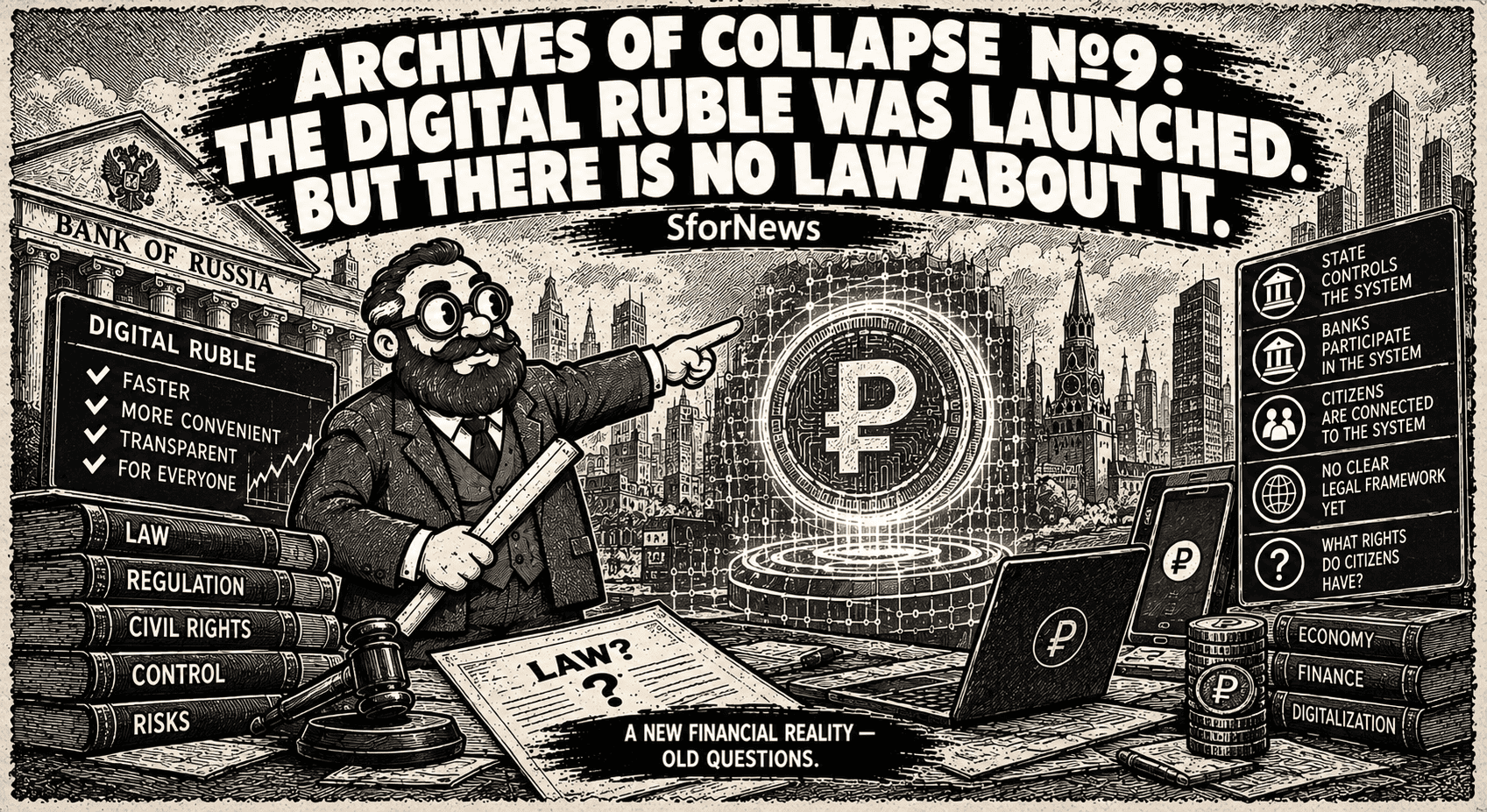
🇷🇺 Federal Tax Service to Gain Access to Digital Ruble Device Data
Starting July 1, 2027, the Federal Tax Service (FTS) will be able to obtain data about devices from which Russians use digital rubles (CBDC) — including IP and MAC addresses, phone numbers, and SIM card information.
Architectural takeaway: The digital ruble is transitioning from the experimental stage to a stage of total control. This is not merely a technical measure — it is the creation of surveillance infrastructure for every payment. CBDC becomes an instrument not only of financial but also of political power. The privacy question comes to the forefront: users must understand that the digital ruble is not a “cryptocurrency” but a state instrument of control.
⛓ CRYPTOCURRENCIES, BLOCKCHAIN AND TECHNOLOGIES
🦊 Consensys Spins Off MetaMask into a Separate Company
Consensys plans to spin off the MetaMask wallet into a separate company.
Architectural takeaway: MetaMask is not just a wallet — it is the gateway to the decentralized world for millions of users. Spinning it off into a separate company means Consensys sees it as an independent business with enormous potential. This could also be preparation for an IPO or attracting strategic investments. MetaMask has become too important to remain just a part of Consensys.
🏦 Jack Dorsey’s Block Applies for Banking License
Block (formerly Square) has applied for a federal banking license — Builders Bank & Trust will handle asset custody and other trust services, including Bitcoin and stablecoins.
Architectural takeaway: Traditional fintech companies are becoming banks. Block doesn’t just want to store cryptocurrencies — it wants to become a regulated financial institution. This is a signal: the boundary between TradFi and crypto is eroding. Jack Dorsey is building a bridge between the old and new world, and this bridge will be regulated.
🪙 CZ Advises Adding Ethereum to National Reserves
CZ (Changpeng Zhao) advises governments to add not only Bitcoin but also Ethereum to their national crypto reserves.
Architectural takeaway: CZ is expanding the framework of the discussion about national reserves. If Bitcoin is “digital gold,” then Ethereum is “digital oil” — infrastructure for decentralized applications. Recognizing ETH at the state level would mean recognizing the entire smart contract ecosystem as a strategic asset. This is a signal for institutions: it’s time to look beyond just BTC.
☠️ Nomic Chain Hacked via Forwarding Bug
The Nomic Chain network was hacked via a bug in the forwarding mechanism — the attacker was able to double-spend nBTC and send fake vouchers to Osmosis.
Architectural takeaway: Cross-chain bridges remain the most vulnerable part of the infrastructure. Double-spending nBTC is not just a bug — it is a systemic risk for the entire interoperability ecosystem. Until bridges become secure, cross-chain operations will remain a high-risk zone.
🪒 User Turns $1.8M into $25 Due to Unfortunate Routing
A user managed to turn $1,800,000 into $25 — when exchanging 7.8M STONKS, unfortunate routing through Raydium practically wiped out the transaction.
Architectural takeaway: DEX aggregators and routing are not just about convenience but also about risk. A single routing error can destroy capital. This is a reminder: in DeFi there is no customer support, and responsibility for every transaction lies with the user. Automation does not eliminate the need to verify every step.
🪙 Solana: Half of Validators Concentrated in Two Cities
The Solana network has approximately half of its validators concentrated in just two cities — Frankfurt and Amsterdam.
Architectural takeaway: Solana’s decentralization is in question. When half of the validators are located in two cities, it creates a risk both for censorship resistance and for the physical security of the network. Geographic concentration is hidden centralization. Solana needs to work on validator distribution, otherwise it may be accused of not being as decentralized as it claims to be.
🇩🇪 Bundesbank Deploys Prividium from ZKsync
The Bundesbank became the first to deploy Prividium from ZKsync — it is a closed blockchain network where participant access is controlled, and operations can be verified without disclosing all information.
Architectural takeaway: Central banks are beginning to use blockchain for internal operations. Prividium is not a public blockchain but a private network, yet the very fact of its use by the Bundesbank means that distributed ledger technology has been recognized at the highest level. This is a step toward creating hybrid systems where state control is combined with blockchain efficiency.
🔓 CYBERSECURITY AND NEW THREATS
🔫 Singaporean Pleads Guilty to Organizing $245M Crypto Scheme
22-year-old Singaporean Malone Ong pleaded guilty to organizing a $245,000,000 crypto scheme — the group used social engineering and even broke into victims’ homes.
Architectural takeaway: Crypto crime is extending beyond the digital space. If previously fraudsters were limited to phishing and hacks, they are now willing to use physical violence. This is a qualitative leap in the level of threat. The industry must realize: asset protection is not only cold wallets and hardware keys, but also physical security. Crypto wealth is becoming a target for organized crime.
🤣 Hunter Biden’s Shitcoin Launch Crashed 97.5%
The “long-awaited” launch of Hunter Biden’s shitcoin took place — and LAPTOP immediately lived up to all expectations, crashing 97.5% virtually immediately after trading began.
Architectural takeaway: Meme coins remain the most toxic and at the same time the most illustrative part of the crypto market. Launching a token on the name of a political figure is not an investment — it’s a lottery. A 97.5% drop within minutes is a reminder: in the world of meme coins there is no fundamentals, only hype. Those who didn’t exit in time lost everything.
🧩 SUMMARY ARCHITECTURAL TAKEAWAY
September 9, 2026 — the day when cryptocurrencies definitively ceased to be “the periphery” and entered the center of geopolitics, fiscal policy, and institutional infrastructure.
Geopolitics of cryptocurrencies. Iran uses USDT and BTC to evade sanctions — this is a precedent that will be replicated. Sanctions as a tool of pressure are losing their monopoly.
Fiscal integration. Germany introduces a 25% tax, Russia creates surveillance infrastructure for digital rubles. States are transitioning from observation to active regulation and control.
Institutionalization. Block applies for a banking license, the Bundesbank deploys Prividium, Consensys spins off MetaMask. Crypto infrastructure is becoming part of the traditional financial system.
Security as a key risk. The Nomic Chain hack, the loss of $1.8M on routing, physical violence in a $245M crypto scheme — all of this indicates that risks are becoming increasingly diverse and serious.
Meme coins as a mirror. The launch of Hunter Biden’s shitcoin with a 97.5% crash is a reminder that the bulk of the crypto market remains speculative and irrational.
📌 KEY INDICATORS TO MONITOR
| Indicator | What to track |
|---|---|
| Iran | USDT/BTC trading volumes and US reaction to sanctions evasion |
| Germany | Details of the 25% tax law and market reaction |
| Russia | Technical details of FTS access to CBDC device data |
| MetaMask | Spin-off structure and potential investors |
| Block | Status of banking license application |
| CZ | Government reactions to the idea of adding ETH to reserves |
| Nomic Chain | Hack investigation and bridge recovery measures |
| Solana | Plans for validator decentralization |
| Bundesbank | Development of Prividium and potential partnerships |
| Crypto crime | New cases of physical violence and social engineering |
The situation as of September 9 — the day when cryptocurrencies definitively became part of the big game: geopolitics, fiscal policy, and institutional infrastructure. Property rights, taxes, and security — these are the three pillars on which the new financial architecture will be built.


Bitcoin
$62,881.23

Ethereum
$1,672.04

Litecoin
$42.71

Dash
$37.08

Bitcoin Cash
$209.43