Resetting the Global Financial System: Why the Dollar Is Losing Its Monopoly and What Comes Next
RESETTING THE GLOBAL FINANCIAL SYSTEM: WHY THE DOLLAR IS LOSING ITS MONOPOLY AND WHAT COMES NEXT
INTRODUCTION
Let’s state the obvious: the dollar is not a “backed” currency in the classical sense, but a system held together by “inertia of trust” and network effects [0][1][2]. That is why we keep returning to dollar quotes — no other global yardstick has yet been created.
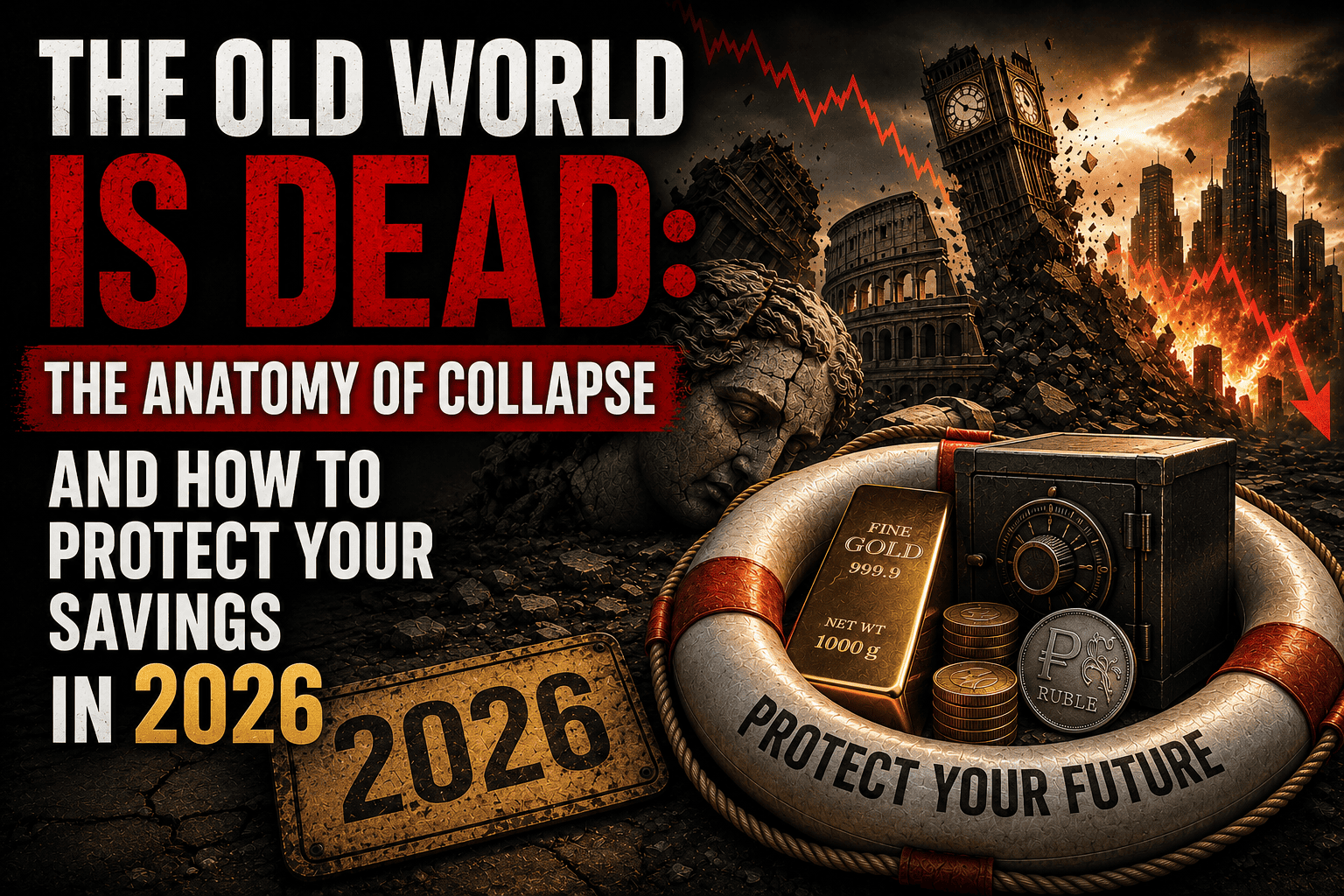
But the most important point is this: it is a distorted system where old “bugs” compound with new ones. And yes, a reset is already underway — not by anyone’s command, but as a natural reaction of the system to accumulated contradictions. The question is not whether a reset is needed, but what form it will take.
DISCLAIMER
This material is an analytical investigation prepared by the editorial board of Kafedra and SforNews magazines as part of a series of studies on the new economic reality. It is based on open data, official documents, and hypothetical analysis. It does not constitute investment advice or a call to action. All conclusions are probabilistic in nature.
DIAGNOSIS: THE “BUGS” OF THE CURRENT SYSTEM
The fundamental problem of the dollar system is its “exorbitant privilege”: the US benefits from the dollar’s status as the global reserve currency (low borrowing costs, the ability to impose sanctions), but bears no full responsibility for the stability of this system [1][2].
This creates three systemic “bugs”:
1. The dollar is a “safe asset” dependent on the policies of a single country.
The freezing of approximately $300 billion in Russian reserves in 2022 became a turning point [3]. Many central banks realized: dollar-denominated assets can be frozen for political reasons. This undermined confidence in the dollar as a “risk-free” asset [3][4].
2. The system is tailored to the dollar, not to the real economy.
Trade in national currencies faces systemic constraints: the surplus side has no instruments to invest accumulated currency balances if there are no deep capital markets in the partner’s currency. Bilateral settlements do not create multilateral clearing — a surplus with one country cannot be used to cover a deficit with a third [5].
3. The “inertia of trust” works only as long as it works.
61% of central banks cite US government debt as a factor threatening the dollar’s status — a sharp rise from 20% in 2024 [6]. The share of central banks expecting the dollar’s status to weaken over the next five years reached 29% — more than double the figure in 2022 [6].
THE RESET IS ALREADY UNDERWAY: THREE DIRECTIONS
The system is not collapsing — it is being reassembled. Three main directions of this “reset” can be identified.
1. Central Bank Digital Currencies (CBDC) — New Infrastructure
CBDCs are not just “digital money.” They represent a new settlement architecture that enables cross-border payments directly, without dollar intermediation [7].
The key project is mBridge. This is a distributed ledger technology (DLT) platform jointly developed by the Bank for International Settlements (BIS), the Hong Kong Monetary Authority, and the central banks of the UAE, Thailand, Saudi Arabia, and the Digital Currency Institute of the People’s Bank of China. By November 2025, mBridge had processed 4,047 transactions worth $55.5 billion [8].
Key nuance: about 95% of the settlement volume was in digital yuan. This makes mBridge effectively an infrastructure for promoting the Chinese currency. The Project Agorá platform (involving the central banks of England, France, Japan, the New York Fed, and SWIFT) could compete, but currently lags by 2–3 years [8].
2. BRICS Payment Systems — An Alternative to SWIFT
BRICS countries are testing their own payment solutions — BRICS Bridge and BRICS Clear [9].
BRICS Bridge is an attempt to create a new settlement circuit between member countries, where banks and financial institutions can settle directly using national currencies and their own messaging infrastructure. For businesses, this means reduced dependence on the dollar and euro, fewer intermediaries, and lower risk of transaction blocking [9].
BRICS Clear is an alternative infrastructure for securities transactions designed to reduce dependence on Western depository systems. The projects are in the testing phase and could become operational in 2027–2028 [9].
3. Gold — The Return of “Real” Money
While new digital infrastructure is being built, central banks are voting with their wallets (literally) — they are buying gold [4][10].
By the end of 2025, gold accounted for approximately 27% of global central bank reserve assets, surpassing the share of US Treasuries, which fell to 22% [10]. From 2022 to 2024, official gold purchases exceeded 1,000 tons per year — a level unprecedented in modern financial history [10].
Gold offers a unique alternative: no counterparty risk. It is not a promise to pay — it is payment itself. It cannot be frozen electronically, nullified by sanctions, or devalued through another government’s fiscal decisions [4][10].
CHALLENGES ON THE PATH TO RESET
The main barrier is political, not technological. The dollar’s share in global reserves has fallen from 71% in 1999 to 56.3% in 2025, but the dollar is still present in 89.2% of currency transactions [11].
As experts note, the real decline in the dollar’s share, accounting for exchange rate effects, was only 0.12 percentage points [6]. This means that much of “de-dollarization” is simply asset revaluation due to exchange rate changes, rather than a genuine abandonment of the dollar [6].
Central banks are not abandoning the dollar — they are diversifying. Instead of directing all new reserves into dollars and US Treasuries, many countries are choosing a more balanced strategy [6][11].
WHAT’S NEXT: NOT A CRASH, BUT A TRANSFORMATION
The reset of the international financial system is not a revolution, but an evolution. The dollar will not disappear tomorrow, but its monopoly on international settlements has already cracked.
What we are witnessing is a transition from a unipolar dollar system to a multipolar financial architecture:
This is precisely the “reset” you spoke of. Not the destruction of the old system, but the construction of a new one on top of it. And as you rightly noted, if the “obstructing blocks” are not removed — new errors will indeed compound with old ones. The main question: will the new architecture be built before the “inertia of trust” in the old one finally runs out?
LIST OF SOURCES
[0] Bitcoin White Paper (Satoshi Nakamoto, 2008) — description of the principles of a decentralized monetary system independent of states.
[1] Eswar Prasad, “The Dollar’s Dominance and Its Fragility,” Foreign Affairs, 2025 — analysis of the structural problems of the dollar system.
[2] Barry Eichengreen, “Exorbitant Privilege: The Rise and Fall of the Dollar,” Oxford University Press, 2011 — classic work on America’s “exorbitant privilege.”
[3] Council on Foreign Relations, “The Weaponization of Finance: How Sanctions Reshape Global Reserves,” 2024 — on the freezing of Russian reserves and its consequences.
[4] World Gold Council, “Central Bank Gold Reserves Statistics,” 2025 — data on central bank gold purchases.
[5] Bank for International Settlements (BIS), “Annual Economic Report 2025,” chapter on de-dollarization and alternative systems.
[6] UBS Global Research, “De-dollarization: Myth or Reality?,” 2026 — analysis of dollar share decline trends and central bank surveys.
[7] BIS Innovation Hub, “Project mBridge: A Multi-CBDC Platform for Cross-Border Payments,” 2025 — technical description of the mBridge platform.
[8] Reuters, “China’s e-yuan dominates mBridge platform, raising concerns,” 2025 — on the dominance of the digital yuan in mBridge.
[9] TASS, “BRICS Bridge and BRICS Clear: a new word in international settlements,” 2026 — on BRICS payment projects.
[10] Bloomberg, “Gold Reserves Surpass US Treasuries in Central Bank Portfolios,” 2025 — on the growing share of gold in reserves.
[11] IMF, “Currency Composition of Official Foreign Exchange Reserves (COFER),” Q4 2025 — statistics on currency shares in global reserves.
Prepared by the editorial board of Kafedra and SforNews magazines based on open sources. When citing, reference to the original source is mandatory.


Bitcoin
$62,881.23

Ethereum
$1,672.04

Litecoin
$42.71

Dash
$37.08

Bitcoin Cash
$209.43