Architecture of Global Collapse — How the Map Detached from the Territory | Sfornews
ARCHITECTURE OF GLOBAL COLLAPSE
Part 2 of the “Architectural Core” series
In Part 1, we demonstrated how our concept works on the Russian case. Now we scale it to the entire world. The symptoms are the same everywhere.
INTRODUCTION: FOUR PRESSURE POINTS
The Bank for International Settlements (BIS) in its June 2026 Annual Economic Report explicitly identified four “pressure points” threatening global stability [1][8][15]:
BIS head Pablo Hernández de Cos warned: “Policymakers must act now. Delay will only make the necessary adjustments more costly” [1][8].
Architectural Conclusion: We are witnessing a global agony of the old system. The Map (the dollar, government debt, banking derivatives, the AI bubble) has detached from the Territory (the real economy, energy, resources). And this rupture is systemic.
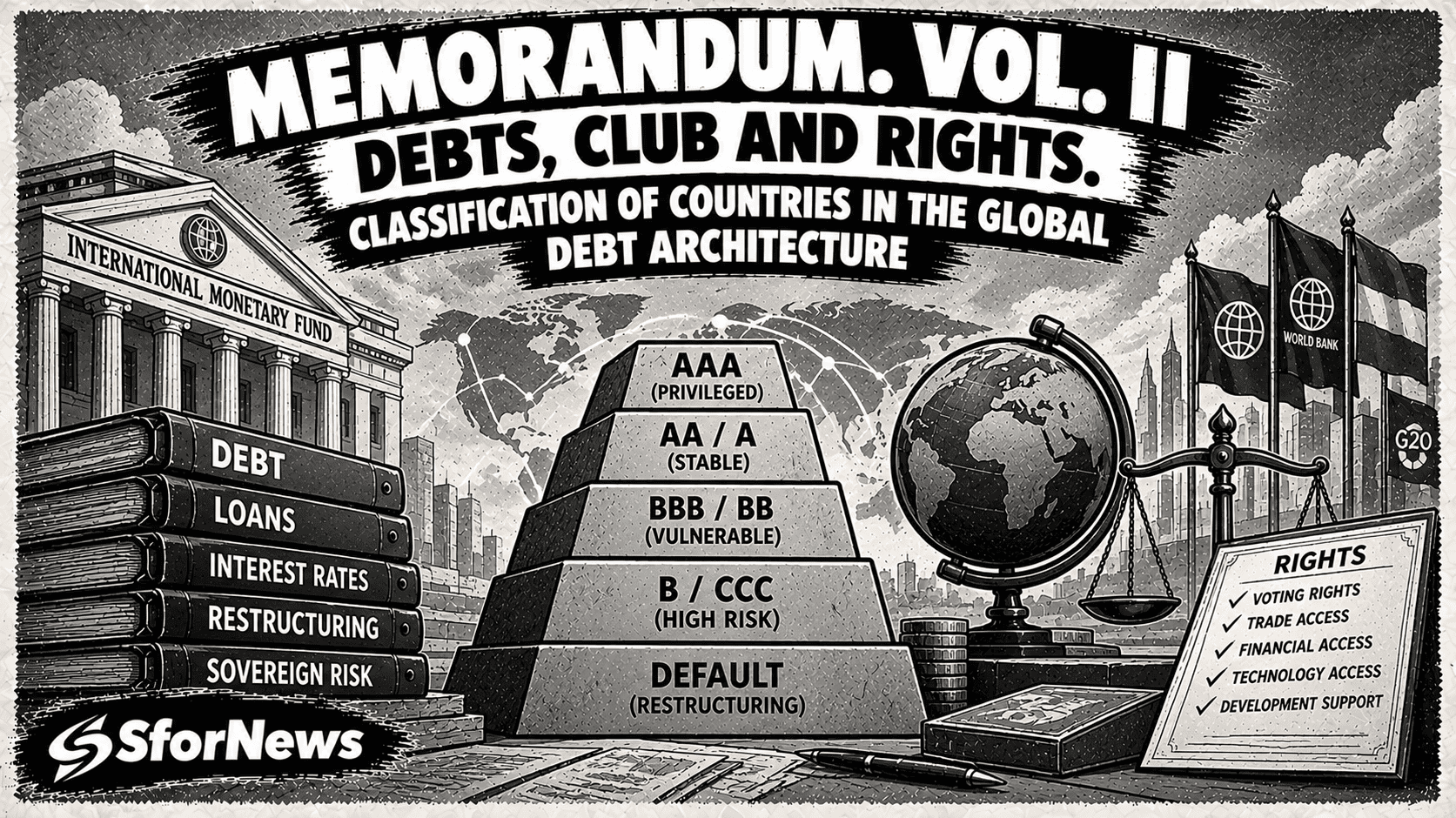
PART 1. THE GLOBAL DEBT CRISIS
Global debt has reached record levels. According to the IIF, in the first quarter of 2026, global debt rose to $350 trillion [9][8]. Growth is concentrated in the US and China [9].
|
Region |
Debt/Deficit |
Symptoms |
|
USA |
National debtapproaching $39 trillion |
Banks sitting on $325B unrealized losses [9] |
|
China |
Debt at 300% of GDP |
Deflation, real estate crisis, falling demand [4][11] |
|
Europe |
Energy crisis + debtburden |
Electricity costs double those of US and China competitors [3] |
|
Emerging Markets |
Dollar-denominated debt |
Vulnerability to rate hikes [13] |
The BIS warns: high debt and the growing role of highly leveraged hedge funds in government bond markets create a “sovereign-financial stability nexus” [1][8]. This means that declines in government bond values may occur more frequently and sharply, rapidly tightening financial conditions [8][15].
Architectural Conclusion: Global debt is a map that is no longer backed by territory. It rests onfaith, not on real resources.
PART 2. USA: THE DEBT PYRAMID AND BANKING CRISIS
In the US, the “agony of the map” manifests through the banking crisis. American banks in the first quarter of 2026 reported **$325.1 billion in unrealized securities losses** [9]. This breaks a four-quarter declining trend — in Q4 2025, losses stood at $306.1 billion [9].
$19 billion growth in a single quarter — a direct consequence of rising long-term Treasury yields [9]. Banks hold massive portfolios of Treasuries and mortgage-backed securities. When yields rise, their fair value falls.
Analyst Richard Turrin, after the 2023 SVB collapse, noted: The Federal Reserve is fighting a problem it created itself [2]. The zero-interest-rate policy (ZIRP) for 7 years created an illusion of returns, and when the Fed began rapidly raising rates — bonds collapsed [2].
At the same time, banking sector deregulation (the 2018 rollback of rules for mid-sized banks) stripped the system of protection [2].
Architectural Conclusion: The Map (the dollar, government debt, banking derivatives) has detached from the Territory (the real economy). Deregulation and money printing instead of structural reforms — the system is not reforming, it is agonizing.
PART 3. EUROPE: ENERGY CRISIS AND DEINDUSTRIALIZATION
Europe is facing its own agony — energy-related. European leaders in 2026 are sounding the alarm: “We are losing our petrochemical, steel, and metallurgical industries — the foundations of all welfare” [10].
Electricity costs in Europe are double those of competitors in the US and China [3]. The reason is the “marginal cost pricing” model, where the most expensive megawatt sets the price for the entire market [3].
The EU internal electricity market works like this: the price is determined by the most expensive source — usually a gas turbine. When the Hormuz blockade disrupted gas supplies from Qatar, European prices skyrocketed [3]. Those with cheap nuclear energy (France) or solar (Spain) gain no competitive advantage — their bonuses are “averaged out” in the common market [3].
France, on the other hand, has a clean, stable, and cheap electricity source through its nuclear plants. But the unified pricing mechanism deprives it of this advantage [3].
Architectural Conclusion: Europe is trying to manage the Map (regulation, MiCA, environmental taxes) but is losing the Territory (industry, jobs, competitiveness). The cutoff from Russian gas did not create an alternative, it only accelerated the collapse.
PART 4. CHINA: DEFLATION AND REAL ESTATE CRISIS
China is the mirror image of Western problems: not inflation, but deflation; not overheating, but stagnation.
Falling real estate prices in first-tier cities have created a strong “negative wealth effect,” especially for young and leveraged households, sharply constraining consumption [4][11]. Expert Mao Zhenhua warned: “Price weakness risks locking the economy into a self-reinforcing cycle of falling expectations, weak demand, and suppressed growth” [4].
The Evergrande crisis (2023) did not trigger a banking panic — in China, everything is state-controlled [11]. But the problem did not disappear: provincial and municipal governments borrowed against real estate collateral, and financial markets remain underdeveloped, leaving households with few investment alternatives [11].
Architectural Conclusion: The growth model based on real estate investment has exhausted itself. The Map (credit stimulus) can no longer support the Territory. The transition to high technology and AI carries bubble risks [4].
PART 5. THE STRAIT OF HORMUZ FACTOR: CATALYST FOR COLLAPSE
On February 28, 2026, the US and Israel launched a joint military operation against Iran [7][14]. Iran blocked the Strait of Hormuz — through which about 20% of global oil supplies and about 30% of LNG supplies pass [7]. Brent prices exceeded $120 per barrel [7][14], reaching local peaks.
By early July 2026, negotiations in Doha, mediated by Qatar and Pakistan, led to an agreement on a 60-day roadmap and a technical freeze of the nuclear program [14]. Brent fell to $77 per barrel, and WTI to $73.67 [14]. However, uncertainty remains: Iran’s nuclear program remains a point of conflict [14].
In parallel, three African countries — Algeria, Nigeria, and Niger — are accelerating the construction of the Trans-Saharan Gas Pipeline (~4,128 km) to supply up to 30 billion m³ of gas annually to the European market [3].
Verification through our prism:
|
Fact |
Verification |
Verdict |
|
Hormuz blockade raised oil prices to $120+ [7][14] |
The world received an energy shock |
The Map (oil prices) detached from the Territory (real economy) |
|
Negotiations advanced — prices fell to $77 [14] |
Markets reacted to expectations, not actual supplies |
The Map (trading) lives its own life |
|
Negotiations could collapse at any moment [14] |
Instability becomes the norm |
The old system cannot guarantee stability |
Architectural Conclusion: The Hormuz crisis is a classic example of how an external shock becomes a catalyst for internal problems. The old system (globalization, dependence on narrow straits, the dollar as reserve currency) cannot withstand the pressure.
PART 6. BRICS: BUILDING PARALLEL ARCHITECTURE
Against the backdrop of the collapse of old systems, BRICS is building alternatives. The BRICS Bridge project — not a single currency, but an interoperable infrastructure for national digital currencies (mCBDC) [5][12]. Each country retains sovereignty over its currency but can trade directly, without the dollar and SWIFT [5][12].
Technical Architecture of BRICS Bridge [5][12]:
In 2026, we have parallel infrastructures: SWIFT (dominant), CIPS (China), SPFS (Russia), and BRICS Bridge [5][12].
Case study — MOL Group (Hungary): the company diversified supplies (Azerbaijan, Gulf countries) and used alternative systems for payments in local currencies (dirham, yuan) through banks of BRICS+ member countries such as the UAE. Result: a 12% reduction in transfer costs[5][12].
Architectural Conclusion: BRICS is creating a parallel infrastructure — not as a replacement for the dollar, but as an alternative in a fragmented world. The “cowrie shells” of the new world are digital currencies and gold.
PART 7. GOLD: THE RETURN OF “REAL MONEY”
Central banks are actively buying gold. In 2025, the value of central bank gold reserves ($4 trillion) exceeded the value of their US Treasury holdings ($3.9 trillion) for the first time [13].
Key events [13]:
A World Gold Council survey showed that 89% of central banks expect global reserves to rise in the coming year, and a record 45% plan to increase their gold holdings in 2026 [6].
The reason is straightforward [13]: gold stored in a national vault cannot be frozen by a Washington decree. Unlike Treasuries, gold has no counterparty risk.
Architectural Conclusion: Gold is not just an asset — it is a “neutral” reserve, independent of any foreign government. It is a purchase of “Territory” in a world where maps (the dollar, the euro, Treasuries) are no longer reliable.
FINAL: THE ARCHITECTURAL PICTURE (VERIFIED BY FACTS)
|
Stage |
What is happening |
Verified by facts |
|
1. Inflation |
Hormuz blockade triggered energy shock |
BIS: inflation is back [1][8] |
|
2. Debt Crisis |
Global debt reached $350T |
IIF, BIS: record debt [1][8][9][15] |
|
3. Banking Crisis |
US bank losses — $325B |
FDIC: unrealized losses rising [9] |
|
4. Deindustrialization |
Europe losing industry |
Energy double the cost of competitors [3][10] |
|
5. Deflation in China |
Real estate crisis, falling demand |
Mao Zhenhua: deflationary trap risk [4][11] |
|
6. Fragmentation |
BRICS Bridge, mCBDC, parallel payment systems |
Dollar no longer a monopoly [5][12] |
|
7. Gold |
$4T at central banks |
Return to “real money” [6][13] |
MAIN CONCLUSION
The world is transitioning from globalization to glocalization. The old system (Bretton Woods, the dollar, SWIFT, the UN in its current form) is agonizing.
What is replacing it:
Our concept works. We verify every new fact through the prism of “the map has detached from the territory.” And every time it is confirmed.
TO BE CONTINUED
In upcoming materials we will analyze each country separately:
INVITATION TO DISCUSSION
We invite readers to an open exchange of facts. We verify any emerging fact through our prism. If you see an event that does not fit the logic of “the map has detached from the territory” — write to us.
SOURCES
[1] Bank for International Settlements. (2026, June 28). Annual Economic Report 2026. https://www.bis.org/press/p260628.htm
[2] CGTN. (2023, March 15). Expert on U.S. Banking Crisis: Federal Reserve battling the problems it made. https://news.cgtn.com/news/2023-03-15/U-S-Banking-Crisis-Federal-Reserve-battling-the-problems-it-made-1iccBma1SW4/index.html
[3] Vietnam.vn. (2026, July 6). Is a single market the solution to Europe’s energy problem? https://www.vietnam.vn/en/lieu-thi-truong-chung-co-phai-la-giai-phap-cho-bai-toan-nang-luong-chau-au
[4] China Policy. (2026, January 15). Price stabilisation emerges as the macro test for 2026. https://policycn.com/public/commentaries/price-stabilisation-emerges-as-the-macro-test-for-2026-54498
[5] Ziarul Bursa. (2026, February 26). BRICS Bridge – Payments Infrastructure and Global Fragmentation. https://www.bursa.ro/brics-bridge-payments-infrastructure-and-global-fragmentation-88715854
[6] TASS. (2026, June 16). Nearly half of central banks plan to increase gold reserves in 2026. https://tass.com/economy/2147063
[7] Yahoo Finance. (2026, July 6). Oil and gas prices rise after tanker hit by missile in Strait of Hormuz. https://uk.finance.yahoo.com/news/oil-gas-prices-rise-tanker-093851474.html
[8] CNBC. (2026, June 28). Debt, AI boom and economic fragilities raise global risks, BIS says. https://www.cnbc.com/amp/2026/06/28/debt-ai-boom-and-economic-fragilities-raise-global-risks-bis-says.html
[9] KuCoin. (2026, June 21). US Banks Face $325B in Unrealized Losses, Ending Four-Quarter Recovery. https://www.kucoin.com/news/flash/us-banks-face-325b-in-unrealized-losses-ending-four-quarter-recovery
[10] Radio Moldova. (2026, February 12). Brussels 2026: The fight to prevent deindustrialization amid global trade wars. https://www.radiomoldova.md/p/69705/brussels-2026-the-fight-to-prevent-deindustrialization-amid-global-trade-wars
[11] Kellogg Insight. (2026, February 1). 4 Trends to Watch in China’s Economy. https://insight.kellogg.northwestern.edu/article/4-trends-to-watch-in-chinas-economy
[12] Ziarul Bursa. (2026, February 26). BRICS Bridge – Infrastructura plăţilor şi fragmentareaglobală. https://www.bursa.ro/brics-bridge-infrastructura-platilor-si-fragmentarea-globala-46715852
[13] Yahoo Finance. (2026, June 16). Central Banks Are Pulling Gold From the US and UK: Here’s Where It’s Heading. https://finance.yahoo.com/markets/commodities/articles/central-banks-pulling-gold-us-100215182.html
[14] Energia y Negocios. (2026, July 7). El Brent toca mínimos de tres meses mientras elmercado aguarda certezas sobre Ormuz. https://www.energiaynegocios.com.ar/el-brent-toca-minimos-de-tres-meses-mientras-el-mercado-aguarda-certezas-sobre-ormuz/
[15] ChinaBond. (2026, June 30). BIS预警:全球经济面临多重压力. https://www.chinabond.com.cn/xwgg/zsxw/zqxw_gjdt/202606/t20260630_855172944.html
The material was prepared by the editorial board of “Kafedra” and SforNews.
Follow new investigations at Sfornews (https://sfornews.com/)
This analysis is for informational purposes only and does not constitute investment advice.


Bitcoin
$62,881.23

Ethereum
$1,672.04

Litecoin
$42.71

Dash
$37.08

Bitcoin Cash
$209.43