Daily Summary July 25-26
NEWS, JULY 25–26, 2026
—
🏦 FINANCE, BLOCKCHAIN AND REGULATION
🇷🇺 Bank of Russia Cuts Key Rate to 14% and Revises Forecasts
The Central Bank of Russia at its meeting on July 24 cut the key rate to 14% (the tenth consecutive cut) and updated its medium-term forecast. The regulator expects GDP growth in 2026 to be in the range of 0–1%, down from the previous 0.5–1.5%. The forecast for 2027–2029 remains unchanged at 1.5–2.5% annually. The average price of Russian oil used for tax calculations is now expected at $60 per barrel in 2026 instead of $65. For 2027–2029, the forecast has been lowered to $50 per barrel. Lower oil prices mean lower oil and gas revenues, while weaker economic growth may limit tax receipts. The Central Bank estimates the budget deficit at 2% of GDP in 2026 and 1% in the following year.
Architectural takeaway: The Central Bank is acknowledging the loss of control over the old growth drivers (oil, consumer demand). The rate cut is not a stimulus but an admission that the rate no longer works as a management tool. The budget hole ($60 oil, 2% GDP deficit) requires new revenue sources which the Central Bank does not propose.
—
🇷🇺 Central Bank Sees No Need to Respond to Stock Market Risks
Elvira Nabiullina stated that the regulator sees no need to respond to risks related to financial stability, despite the fact that the stock market is going through difficult times.
Architectural takeaway: The Central Bank is writing off the stock market as an instrument. It no longer considers it a systemically significant element. This confirms that the old market has been de facto scrapped.
—
🇷🇺 Nabiullina: Stagflation Is Not About Us
The head of the Central Bank stated that “a single year when price growth is driven by a supply shock is not stagflation.” She also noted that administrative price controls would lead to empty shelves, and raising the inflation target would make everyone lose. At the same time, inflation expectations of the population have risen significantly – people do not believe in inflation at the 4% target level.
Architectural takeaway: Denying stagflation with inflation at 9–12% and GDP contraction is the rhetoric of a regulator that cannot admit its tools no longer work. This is not economics, but therapy for the market.
—
🇷🇺 Brokers Declare “Clinical Death” of Moscow Exchange
Major Russian brokers in closed analytical notes for large clients have effectively stated a “clinical death” of the domestic stock market for the coming years. The growth potential of the Moscow Exchange index is exhausted under current macroeconomic conditions. Companies are massively reducing or completely canceling dividend payments. Large capital is moving into the real sector, gold, or foreign crypto assets. Brokers advise clients to change strategy: move out of stocks into floating-rate bonds (floaters) and stop looking for “exponential gains” where they no longer exist.
Architectural takeaway: The old stock market no longer fulfills its function. Capital is moving into alternative circuits. This is not a crisis, but the end of a cycle. Institutional players are acknowledging what we have described: the old model is dead, a new one does not yet exist.
—
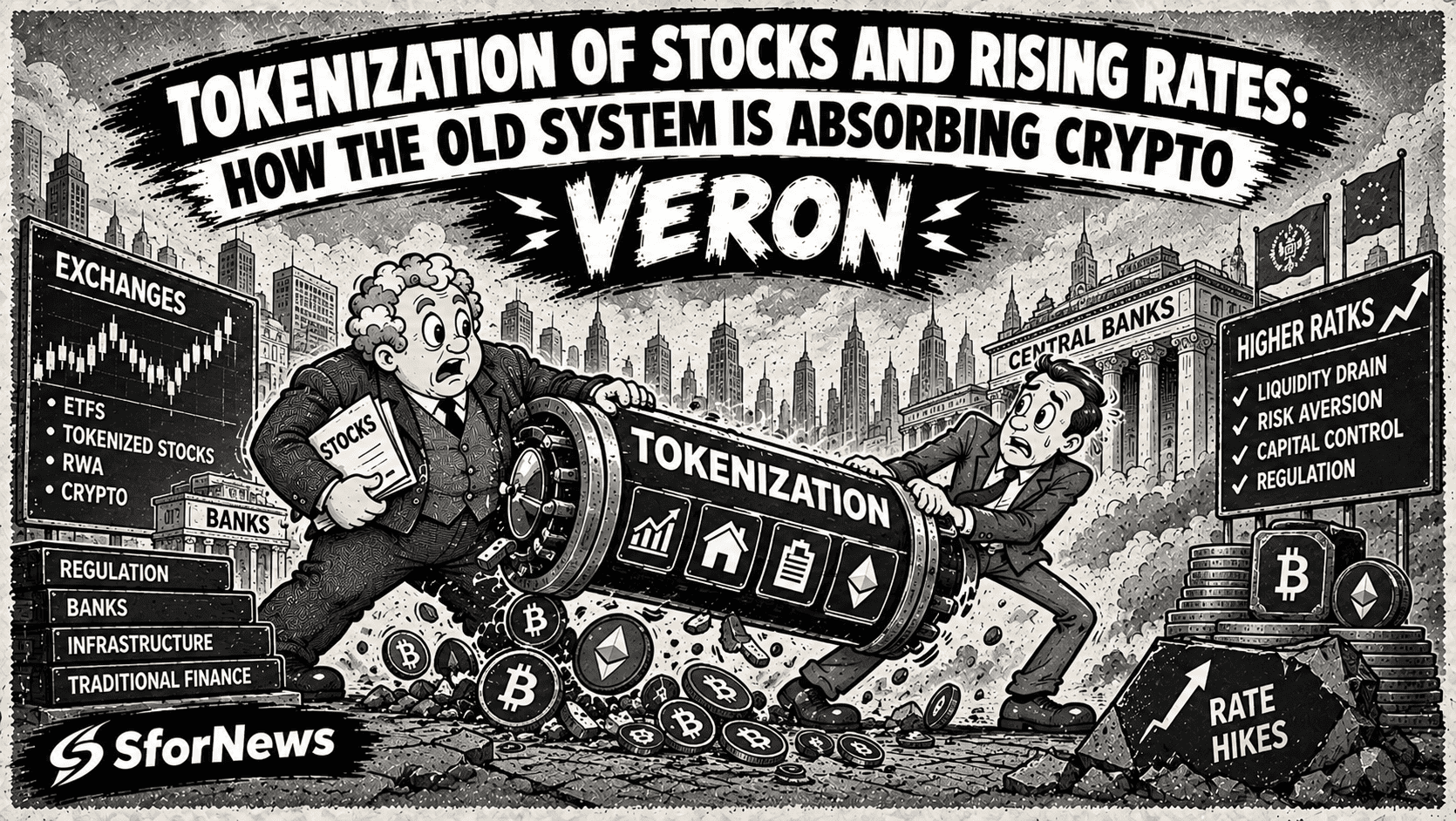
🇷🇺 Central Bank May Bring Banks and Big Tech to Develop NSPK
The Bank of Russia may consider selling a stake in the National Payment Card System (NSPK) to banks, telecom companies, IT companies, or big tech. As former NSPK head Vladimir Komlev noted, the key issue is not the sale itself, but the strategic renewal of the NSPK: development of open interfaces, settlements, crypto-tokenization, digital currencies, and B2B services. The Central Bank is likely to retain control (50% + 1 share).
Architectural takeaway: The NSPK is being reassembled from card processing into a platform for digital settlements – tokenization, digital ruble, crypto settlements. This is a key element of the new financial infrastructure that bypasses SWIFT and the dollar. Control remains with the Central Bank – the system is being built under state supervision.
—
🇷🇺 Central Bank: Russia Has Huge Resources for Productivity Growth Without Significant Investment
Nabiullina noted that investments in robotics are growing at an accelerating pace. At the same time, Russia has opportunities to boost productivity without large financial outlays – through reallocating scarce resources from less efficient industries to sectors that generate higher GDP growth.
Architectural takeaway: The Central Bank admits that the old employment model is inefficient, but does not offer where to place people. We know the answer – operators of mining farms, employees of the new energy-digital system.
—
🇷🇺 Central Bank and Federal Tax Service Developing P2P Transaction Control System
The Central Bank and the Federal Tax Service are developing an automated control system that will match bank transfers of citizens with P2P activity on foreign crypto exchanges. The system is expected to operate under the new cryptocurrency law.
Architectural takeaway: The state is moving toward total control over crypto flows. This is not “fighting the shadow economy” but building a system of total transparency where every step is visible.
—
📊 MARKETS AND INVESTMENTS
📉 Bitcoin Consolidates in $63,000–66,000 Range
After falling below $65,000 on July 24, Bitcoin is consolidating in the $63,000–66,000 range. The market is searching for direction amid mixed signals: on one hand, ETF inflows; on the other, geopolitical pressures (Trump tariffs, threats to Iran). Fear and Greed Index – 31 (Fear).
Architectural takeaway: Bitcoin remains sensitive to geopolitics, but structural factors (ETFs, institutional interest) continue to work. Breaking above $66,500 could open the way to $68,000; falling below $63,000 could test $60,000.
—
📊 Russian Stock Market: Shares Fall 70–90%
Shares of Russian companies have fallen by 70–90% from historical highs. OVC – minus 99%, Segezha – minus 96.5%, Mechel – minus 96.9%, Samolet – minus 96.3%, VTB – minus 93%. As analyst Vladimir Levchenko noted, this has never happened in any country in the world, not even in 1998 or 2008.
Architectural takeaway: This is not a “correction.” This is a structural devaluation of an entire class of assets. Capital is voting with its feet – it is moving out of paper rubles into real assets, gold, and crypto.
—
📊 Bitcoin ETFs: Seventh Consecutive Day of Inflows
US spot Bitcoin ETFs recorded a seventh consecutive day of positive inflows. Total inflows from July 14 reached $999.38 million. This is the longest inflow streak since April 2026.
Architectural takeaway: Institutional investors continue to enter Bitcoin through regulated instruments despite geopolitical uncertainty. This confirms Bitcoin’s status as an institutional asset.
—
☠️ ZachXBT: Hardware Wallets Are “Trash,” Ledger Is the Worst
Well-known blockchain researcher ZachXBT called hardware wallets “trash” and singled out Ledger as the worst option due to persistent issues after Ledger Live updates. In his view, for large amounts, it is safer to use a separate iPhone used exclusively for managing crypto.
Architectural takeaway: This is not just an opinion – it is a diagnosis. Hardware wallets marketed as “impregnable fortresses” have serious vulnerabilities. Security is not a device but user discipline and awareness.
—
💰 User Loses $3 Million via Phishing EIP-7702 Transaction
A user lost about $3 million by signing a phishing EIP-7702 transaction. The new Ethereum standard introduces a delegated authorization mechanism that allows attackers to gain control over funds.
Architectural takeaway: New standards expand functionality but also create new attack vectors. Without a fundamental understanding of the technology, even “secure” wallets become vulnerable.
—
🌍 GEOPOLITICS
🇪🇺 EU Preparing 22nd Sanctions Package
European diplomacy chief Kaja Kallas stated that “sanctions are not over.” The EU has already begun discussing the 22nd package of sanctions against Russia, which could target new sectors of the economy.
Architectural takeaway: Sanctions are becoming a permanent instrument of pressure. Russia will have to live under constant restrictions, making the transition to alternative circuits (energy → Bitcoin → people’s certificates) not just a “possibility” but the only path to survival.
—
🇺🇸🇮🇷 Trump Threatens “Massive Attack” on Iran
US President Donald Trump threatened an unprecedented “massive attack” on Iran amid ongoing military exchanges in the region.
Architectural takeaway: Geopolitical tensions in the Persian Gulf continue to pressure oil prices and global risk assets, including Bitcoin. This creates uncertainty that could both push Bitcoin higher (as a safe haven) and send it lower (as a risk asset).
—
🇪🇺 Gas Prices in Europe at Highest Since Early 2023
Gas prices in Europe closed the week at their highest levels since the beginning of 2023, amid continued supply tensions and dwindling stocks.
Architectural takeaway: Europe continues to pay for its energy collapse. This creates additional demand for alternative sources of “energy” – including Bitcoin as a digital equivalent.
—
📋 SUMMARY OF EVENTS – JULY 25–26, 2026
Regulation and Monetary Policy (Russia):
– The Central Bank cut the key rate to 14% – the tenth cut in a row; revised GDP forecast for 2026 to 0–1% (from 0.5–1.5%).
– The Central Bank set the oil price forecast at $60 per barrel for 2026 and $50 for 2027–2029 (previously $65 and higher).
– The budget deficit is estimated at 2% of GDP in 2026 and 1% in 2027.
– Elvira Nabiullina stated that a single year of price growth due to a supply shock is not stagflation and rejected raising the inflation target.
– Nabiullina noted that administrative price controls would lead to empty shelves, and the regulator sees no need to respond to stock market risks.
– The Central Bank is considering selling up to 50% of NSPK to banks, telecoms, and big tech for tokenization, digital currencies, and B2B services, retaining control (50%+1 share).
– The Central Bank and Federal Tax Service are developing an automated control system for citizens’ P2P transactions on foreign crypto exchanges.
Stock Market and Investments (Russia):
– Major brokers in closed analytical notes have declared the “clinical death” of the Moscow Exchange for the coming years: the index has exhausted growth potential, dividends are being cut.
– Shares of Russian companies fell 70–90% from historical highs: OVC -99%, Segezha -96.5%, Mechel -96.9%, Samolet -96.3%, VTB -93%.
– Large capital is moving from stocks to the real sector, gold, and foreign crypto assets; brokers advise clients to switch to floating-rate bonds (floaters).
Cryptocurrency Market and Mining:
– Bitcoin consolidates in the $63,000–66,000 range after falling below $65,000 on July 24; Fear and Greed Index – 31 (Fear).
– US spot Bitcoin ETFs recorded a seventh consecutive day of inflows; total inflows from July 14 reached $999.38 million.
– Researcher ZachXBT called hardware wallets “trash,” with Ledger the worst due to update issues; he recommended a separate iPhone for large sums.
Hacks and Security:
– A user lost about $3 million by signing a phishing EIP-7702 transaction, which allows attackers to take control of funds.
– ZachXBT also highlighted vulnerabilities of hardware wallets to phishing, social engineering, and user errors.
Geopolitics and Energy:
– The EU has begun discussing a 22nd sanctions package against Russia; Kaja Kallas stated that “sanctions are not over.”
– President Trump threatened a “massive attack” on Iran amid ongoing military exchanges.
– Gas prices in Europe closed the week at their highest since early 2023 due to supply tensions and declining stocks.
—
💡 INSIGHT AND SESSION OUTLOOK
Short-term scenario (next 24–48 hours):
Bullish: de-escalation of geopolitical tensions (Iran, trade tariffs) and continued ETF inflows – return to $66,000–67,000.
Bearish: escalation of US–Iran conflict, further dollar strength and rising Treasury yields – testing $62,000–63,000.
Key observation:
July 25–26 were days of institutional recognition of the old system’s collapse. The Central Bank formally cut the rate to 14% but revised down its forecasts for GDP (0–1%) and oil ($60/$50). Brokers declared the “clinical death” of the Moscow Exchange. Russian stocks fell 70–90% from highs. The old stock market no longer fulfills its function.
At the same time, a parallel new infrastructure is being built: the Central Bank is considering selling a stake in NSPK to banks and big tech to develop tokenization and digital currencies. This creates a circuit that bypasses SWIFT and the dollar. Bitcoin remains in the $63,000–66,000 range, with ETFs showing a seventh straight day of inflows.
The geopolitical backdrop remains tense: the EU is preparing a 22nd sanctions package, Trump is threatening Iran, and gas prices in Europe are at their highest since early 2023. This creates an environment for continued capital flows from old instruments into alternative circuits.
—
This analysis is for informational purposes only and does not constitute investment advice. The material is prepared by the editorial board of the journals “Kafedra” and SforNews based on open data.


Bitcoin
$62,881.23

Ethereum
$1,672.04

Litecoin
$42.71

Dash
$37.08

Bitcoin Cash
$209.43