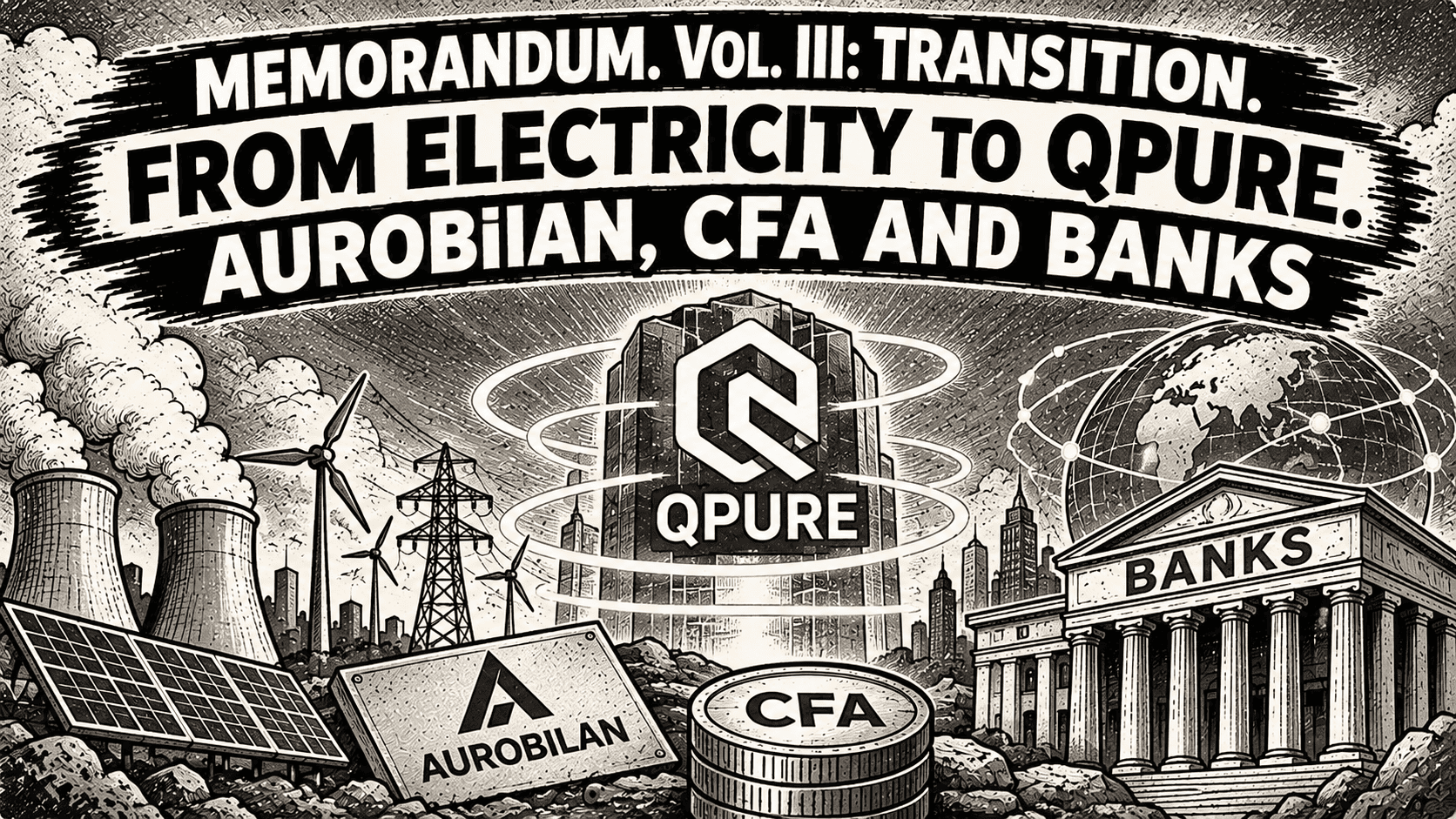
MEMORANDUM. Volume III, Part 8: Conclusion. The Architect of the Transition
MEMORANDUM. VOLUME III
THE TRANSITION: FROM ELECTRICITY TO QPURE. AUROBILAN, DIGITAL FINANCIAL ASSETS AND BANKS
DISCLAIMER
This document is a conceptual project prepared on the basis of open data, public statements and analytical materials. This Memorandum is not a legal document, investment recommendation or call to action. All conclusions are probabilistic and analytical in nature.
THE BOUNDARY BETWEEN THE VOLUMES
- Volume I (physical architecture): energy as a common public asset, Bitcoin as an energy derivative, and the NES as a distribution mechanism. Subject: defining the resource.
- Volume II (financial architecture): debt, the Club, Basel, and resource-extraction mechanisms. Subject: the mechanism for extracting resources and building an alternative.
- Volume III (ontological architecture): substantiating the impossibility of an energy standard, QPURE as an anchor to the Earth, Aurobilan as an accounting system, integration with digital financial assets and banks, and the cross-border nature of intangible assets. Subject: the transition from electricity to QPURE and a way out of the dead end for every country.
Elements of Volumes I and II (NES, Basel, the debt pyramid) are not duplicated in this volume and are referenced where relevant. However, to ensure continuity, this volume contains three bridges:
- Bridge I → III (Part 9): how the NES (a share in the Bitcoin pool, Volume I) relates to QPURE (a share in the land, Volume III), and what happens to an NES holder during the transition.
- Bridge II → III (Part 10): how the debt pyramid (Basel, the Club, defaults, Volume II) is refinanced through QPURE and where the “way out of the dead end” comes from.
- Bridge from ontology to operations (Part 11): who measures psi, verifies reserves and establishes the Lankearch—in other words, how QPURE is transformed from a declaration into a functioning mechanism.
Without these three bridges, Volume III remains a description of a standard but does not become a transition mechanism. This is precisely why they have been included in the present edition.
PART 8. CONCLUSION: THE ARCHITECT OF THE TRANSITION
8.1. The Transition as an Accomplished Fact
The transition has already begun. Most actors look at the map rather than the territory and therefore fail to recognize the transition.
8.2. Three Transition Scenarios
| Scenario | Description | Who benefits | Who loses |
|---|---|---|---|
| Soft | Gradual anchoring of QPURE to reserves, integration with digital financial assets and banks | Resource-rich actors | Actors outside the Club (in the short term) |
| Hard | Rapid transition, resistance from elites, sanctions pressure | Resource-rich actors | Indebted actors |
| Collapse | Refusal to transition, preservation of the debt system | Nobody | Everyone |
Dispelling Myth 23. “There is no third option” is not a myth but a proposition that requires further elaboration. “There is no third option” does not mean “the choice is binary”; it means “refusal to transition = collapse.” Collapse is also a scenario, and it is a losing scenario for everyone. Pattern 8: refusing to transition is also a scenario.
8.2.1. Analysis of the Scenarios
Soft. Gradual anchoring of QPURE to reserves. Integration with digital financial assets and banks. Resource-rich actors benefit. Actors outside the Club lose in the short term.
Hard. Rapid transition. Resistance from elites. Sanctions pressure. Resource-rich actors benefit. Indebted actors lose.
Collapse. Refusal to transition. Preservation of the debt system. Nobody benefits. Everyone loses.
8.3. Potential Architects: The Cross-Border Context
Within a cross-border framework, a location cannot be the architect. Intangible assets become cross-border; therefore, the architectural role is determined not by geography but by the legal status of the actor and its ability to operate in a cross-border environment.
The assumption that Russia could act as the architect (Volumes I–II) holds true if certain rules are met. However:
- In its current status, the Russian Federation is not a fully sovereign state in the full sense of the term;
- In its current status, the Russian Federation cannot be the sole architect;
- No other territory can be the sole architect either.
The architect is not a location. The architect is an actor operating within a cross-border legal framework.
Dispelling Myth 21. “The architect is a country” is a myth because the architect is not a location but an actor operating within a cross-border legal framework. This is the key myth dispelled by Volume III. Pattern 7: the architect is not a location.
8.3.1. The Architect Is Not a Location, but Neither Is It a Corporation
The statement “the architect is not a location” (8.3) may be perceived as an attack on national sovereignty in favour of a global corporation. This is not the case. Let us clarify.
The architect is not a location. This means that the architectural role is determined not by geography (country, region), but by the legal status of the actor and its ability to operate within a cross-border legal framework.
The architect is not a corporation. This means that the architectural role cannot be usurped by a private entity. A corporation acts in the interests of its shareholders; the architect acts in the interests of the system. These are different roles.
The architect is an actor within a cross-border legal framework. This may be:
- a state (provided its legal status allows it to operate across borders);
- an international organization (provided it is recognized by the participants);
- a network of actors (provided it operates according to common rules).
A state can be the architect. The Russian Federation cannot do so in its current status (8.3), but it may be able to if its legal status changes (8.4). This is not an “attack on sovereignty” but a condition: sovereignty must be confirmed within the cross-border legal framework, not merely within a territory.
Why this matters. Without this clarification, the statement “the architect is not a location” sounds like “the architect is a global corporation,” which invites political objections. With this clarification, the statement becomes “the architect is an actor with legal status,” which is standard terminology in international law.
Verifiability. Take any candidate for the role of architect (a state, corporation or network). Ask: (1) Does it operate within a cross-border legal framework? (2) Is it recognized by the participants? (3) Does it act in the interests of the system rather than solely in its own interests? If the answer to all three questions is “yes,” it may be an architect. This is verifiable.
8.4. Two Scenarios: Not for a Location, but for an Actor
Scenario One. An actor (including the Russian Federation, if its legal status changes and certain rules are met) becomes the architect of QPURE: it recognizes energy as a common public asset, anchors QPURE to reserves, connects Aurobilan to digital financial assets and banks, ensures direct payments to citizens, and establishes sovereignty.
Scenario Two. An actor remains a resource supplier for those who lead the transition: resources are wasted, income accumulates offshore, and the system deteriorates.
There is no third option. But the architect is not a location.
8.4.1. A Pilot Is Not an Architect
There is an apparent contradiction in the text: on the one hand, “the Russian Federation cannot be the architect in its current status” (8.3); on the other, there is a “pilot project in the Irkutsk Region” (7.1.1, 8.5). A reader may conclude that these statements contradict each other. They do not. A pilot and an architect are different roles.
A pilot is an actor that is the first to complete the path from energy to fiat and records the result in Aurobilan. The pilot demonstrates the feasibility of the method within a limited framework. The pilot does not “own” QPURE; it tests it.
An architect is an actor that scales the method across a cross-border legal framework. The architect defines the rules; the pilot tests them.
The Irkutsk Region can serve as a pilot even if the Russian Federation cannot be the architect in its current status. The pilot proves that the method works; the architect scales it. These are different tasks, with different timelines and different requirements.
Three pilot options:
Irkutsk Region (Russia) — the most likely pilot. Reasons: surplus hydropower, a legal pathway (digital financial assets + mining), and regional political will. The pilot uses the practical layer: energy → mining → digital financial assets → bank → fiat. The ontological layer (psi, DOBRA, Lankearch) is introduced as it becomes ready.
Kazakhstan — the second most likely option. Reasons: the digital tenge, 10% of mining output allocated to a crypto reserve, and mBridge. The pilot uses state infrastructure.
Paraguay — a “success laboratory.” Reasons: 3,480 MW of surplus, an electricity tariff of $0.037–0.050, and fourth place in hashrate. The pilot uses the “bypass” mode (7.3.1): Aurobilan without banks.
Why this matters. Without this section, the reader sees a contradiction: “The Russian Federation cannot be the architect, but there is a pilot in Irkutsk.” With this section, the distinction becomes clear: a pilot and an architect have different roles. The pilot proves the method; the architect scales it.
Key proposition: a pilot is not a location. A pilot is an actor that is the first to complete the process. The architect is likewise not a location. This is the same Pattern 7 applied to the pilot.
Verifiability. Take any candidate for a pilot (Irkutsk, Kazakhstan, Paraguay). Ask: (1) Is there surplus energy? (2) Is there a legal pathway? (3) Is there political will? If the answer to all three questions is “yes,” it may serve as a pilot. This is verifiable.
8.4.2. A Pilot Is Not an Owner: Temporary Administration
Proposition. A pilot is not only not an architect (8.4.1); it is also not the owner of the resource on which it tests the method. The national jurisdiction in which the pilot is located (the Irkutsk Region, Kazakhstan, Paraguay) acts as a temporary administrator of a resource belonging to the people of the planet. This does not diminish the pilot’s status; it establishes the legal form through which three propositions of Volume III become operational:
- QPURE is anchored to the mass of the planet (1.4, 3.3);
- intangible assets are cross-border (5.2–5.6);
- the architect is not a location (8.3).
Without this form, “common public asset” is once again interpreted as a national asset, and Volume III becomes a restatement of Volume I in different language.
Why this matters. Volume I (EWA) speaks in language accessible to the majority: “energy is a common public asset.” In this language, “common public” means “an asset of the Russian people within Russian jurisdiction.” Volume III can go further because it has an ontological layer: the asset belongs to the people of the planet, while the national jurisdiction acts as a temporary administrator. This does not cancel EWA; it builds upon it: EWA is one step, Volume III is the next step (1.1).
Three requirements for temporary administration.
Sunset clause. The mandate of the temporary administration has a time limit and a condition for returning the resource to the ontological layer of QPURE. An indefinite mandate is ownership under another name.
Accountability to the beneficiary. Accountability must be provided not only to the national regulator (the central bank, tax authority), but also to Aurobilan as the ontological registry. Accountability to the national regulator is the profane layer (6.2); accountability to Aurobilan is the ontological layer.
Prohibition on alienation. The temporary administrator may not pledge, sell or transfer the resource to third parties. This directly prevents the privatization of the resource by oligarchs and foreign entities—the very outcome that the entire Volume III is designed to oppose (7.1, 8.6).
What this changes for the pilot. The pilot in Irkutsk (7.1.1, 8.4.1) ceases to be a “national project” and becomes a demonstration of the method within a limited framework. It tests the method using a resource it does not own; once testing is complete, the resource returns to the planetary pool. This resolves the final ambiguity in Volume III: the practical layer (digital financial assets, banks, taxes) is not only “profane” (6.2), but also does not own the resource.
Dispelling the embedded myth “The pilot is the owner of the resource.” This myth persists because the pilot geographically coincides with a national jurisdiction, while national jurisdictions have historically appropriated resources. But in the architecture of Volume III, territorial location and ownership do not have to coincide: the pilot is the actor that completes the process first (8.4.1), not the actor that owns the resource. Pattern 7: the architect is not a location (extended to the pilot and temporary administration).
Verifiability. Take any candidate for a pilot (Irkutsk, Kazakhstan, Paraguay). Ask: (1) Is there a sunset clause? (2) Is the pilot accountable to Aurobilan? (3) Is alienation of the resource prohibited? If the answer to all three questions is “yes,” it may act as a temporary administrator. If even one answer is “no,” it is an owner under another name. This is verifiable.
Limitations and conditions. The proposition “the pilot is a temporary administration” can be implemented provided that: (1) the sunset clause is established by law; (2) technical accountability to Aurobilan is possible (a decentralized network—Part 11); and (3) alienation of the resource is legally prohibited. If even one condition is not met, temporary administration remains a declaration.
Dispelling myths and patterns used. Myth dispelled: the embedded myth “The pilot is the owner of the resource.” Pattern used: 7 (the architect is not a location; extended to the pilot and temporary administration).
8.5. What to Do Now
Legal recognition. Preparation of a draft law recognizing energy as a common public asset.
Pilot project. Launching QPURE in one region with a connection to Aurobilan.
Information campaign. Publication of the Memorandum, book and articles.
International recognition. Negotiations with BRICS+ partners.
Education. Transferring the methodology through courses, books and communities.
8.5.1. Step-by-Step Plan
| Step | Action | Timeline | Responsible party |
|---|---|---|---|
| 1 | Preparation of a draft law | 0–6 months | Legal department |
| 2 | Pilot project | 6–12 months | Regional authorities |
| 3 | Information campaign | 0–18 months | Editorial team |
| 4 | BRICS+ negotiations | 12–24 months | Ministry of Foreign Affairs |
| 5 | Education | 12–18 months | Educational institutions |
8.6. Limitations and Risks
| Limitation | Description | Mitigation mechanism |
|---|---|---|
| Sanctions pressure | Blocking of channels | Parallel channels, Aurobilan |
| Resistance from elites | Dependence on the debt system | Gradual integration |
| Lack of infrastructure | No digital financial assets or banks | Aurobilan without banks |
| Legal uncertainty | No legal status for QPURE | Pilot regimes |
| Technological dependence | Dependence on external partners | Development of domestic solutions |
8.6.1. Analysis of Limitations
Sanctions pressure. Blocking of channels. Mitigation mechanism: parallel channels, Aurobilan.
Resistance from elites. Dependence on the debt system. Mitigation mechanism: gradual integration.
Lack of infrastructure. No digital financial assets or banks. Mitigation mechanism: Aurobilan without banks.
Legal uncertainty. No legal status for QPURE. Mitigation mechanism: pilot regimes.
Technological dependence. Dependence on external partners. Mitigation mechanism: development of domestic solutions.
8.7. Final Proposition
The transition from electricity to QPURE is neither a “utopia” nor a “revolution.” It is an architectural plan, every step of which has an implementation mechanism. The question is not whether the transition will happen. The question is who will become its architect. And the answer is not determined by geography: the architect is not a location, but an actor operating within a cross-border legal framework.
The architect is not a location; the pilot is not the owner. Temporary administration (8.4.2) is the legal form that makes this operational: the resource belongs to the people of the planet, while the national jurisdiction administers it under a mandate with a sunset clause, accountability to Aurobilan and a prohibition on alienation.
Dispelling Myth 22. “The transition is a revolution” is a myth because the transition is an architectural plan, not a utopia. Every step has an implementation mechanism (8.5.1). Pattern 8: refusing to transition is also a scenario.
8.8. Verifiability of Part 8
Key proposition: “The architect is not a location.” Verification: name any country and ask whether it can establish QPURE on its own. If it cannot (and it cannot, because QPURE is cross-border), then the architect is not a country. This is logically verifiable.
8.9. Limitations and Conditions of Part 8
The proposition that “the transition is feasible” depends on:
- Recognition of energy as a common public asset (legislation).
- Availability of a pilot region (Irkutsk Region).
- International support (BRICS+).
- Legal establishment of temporary administration status (sunset clause, accountability to Aurobilan, prohibition on alienation—8.4.2).
If even one condition is not met, the transition remains a project.
8.10. Myths Dispelled and Patterns Used in Part 8
Myths dispelled: 21 (“the architect is a country”), 22 (“the transition is a revolution”), 23 (“there is no third option”—expanded), and the embedded myth “The pilot is the owner of the resource.”
Patterns used: 7 (the architect is not a location; extended to the pilot and temporary administration), 8 (refusing to transition is also a scenario).
APPENDICES
Appendix 1. Comparison of the Volumes
| Parameter | Volume I | Volume II | Volume III |
|---|---|---|---|
| Theme | Energy | Debt | Reserves and QPURE |
| Subject | Defining the resource | Extraction mechanism | A way out of the dead end |
| Foundation | Electricity | Debt | Land (reserves) |
| Instrument | NES | Basel | Aurobilan + digital financial assets |
| Mechanism | Distribution | Alternative | Transition |
Appendix 2. Glossary of Terms
- QPURE — a unifier of the 12 kingdoms of nature; a deflationary standard anchored to the Earth.
- Aurobilan — an accounting system; the living Book of Identity; can be installed for any actor.
- Digital financial assets (DFAs) — an instrument for legalizing QPURE in the Russian Federation.
- Temporary administration — the status of the national jurisdiction in which the pilot is located; it administers a resource belonging to the people of the planet under a mandate with a sunset clause, accountability to Aurobilan and a prohibition on alienation (8.4.2).
- Ergia — a form of energy organization with its own unit of measure.
- EnErgia — one of many ergias; not the whole, but a part.
- Intangible assets (IAs) — a bridge between meaning and the Earth.
- Zero authorship — the principle of openly transferring meaning without a name or price tag.
- BITOS — 1 kg of Earth (36 elements); the physical foundation of QPURE.
- DOBRA — a measure of good; an ontological measure.
- psi — purity of intention; a measure of structural ergia.
- lambda — frequency; a measure of frequency-based ergia.
- Lankearch — a physical anchor; a link to the planet.
- NERD — an ontological detector; a purity check.
- 12 Justices — a sacred collegium; verification.
- NES — People’s Energy Certificate; a share in the Bitcoin pool (Volume I, Section 2.4).
- Erdebilан Registry — a registry of Lankearch anchors; verification of reserves.
- ESKAVE — a currency standard; a measure of contribution and a conversion rate.
Appendix 3. Chronology, 1991–2026
| Year | Event | What Was Lost | What Was Built |
|---|---|---|---|
| 1991 | Dissolution of the USSR | Common public ownership | — |
| 2008 | Emergence of Satoshi | — | Access to the system |
| 2016 | First mentor | — | Support |
| 2017 | Common mantra | — | Support for the system |
| 2026 | “If they refuse, the elotational options will take them away” | The old system | QPURE + Aurobilan |
Appendix 4. Formulas
QPURE anchoring: 1 QPURE = 1 BITOS = 1 kg of Earth (36 elements).
Total issuance: M(QPURE) = M(Earth) / 1 kg.
Theoretical limit: 5.97 × 10²⁴ QPURE units.
Practical issuance: determined by the available volume of resources and the psi coefficient.
NES → QPURE conversion: Number of QPURE units = (Number of NES units × Value of 1 NES) / Value of 1 QPURE.
Psi coefficient: psi = 0.6 × NERD + 0.4 × 12 Justices.
Appendix 5. Legal Foundations
- Berne Convention (1886).
- Vienna Convention (1961).
- New York Convention (1958).
- Charter of the United Nations (1945).
- Civil Code of the Russian Federation, Articles 128 and 1253.1.
- Federal Law No. 259 (2020).
- Federal Law No. 282 (2026).
- Tax Code of the Russian Federation, Articles 210 and 220.
- Resolution of the Constitutional Court of the Russian Federation dated 16 June 2026, No. 39-P.
Appendix 6. Extended Glossary
- Aurobilan — an accounting system; the living Book of Identity.
- Bitcoin — an energy derivative; linked to electricity.
- BITOS — 1 kg of Earth; the physical foundation of QPURE.
- 12 Justices — a sacred collegium; verification.
- Hyperinflation — a collapse of confidence; examples: Weimar, Zimbabwe, Venezuela.
- Deflation — the QPURE mechanism; anchoring to the Earth.
- DOBRA — a measure of good; an ontological measure.
- Gold standard — a standard anchored to gold; its limitation is the finite mass of gold.
- Inflation — the fiat mechanism; loss of value.
- Lankearch — a physical anchor; a link to the planet.
- lambda — frequency; a measure of frequency-based ergia.
- Intangible assets (IAs) — a bridge between meaning and the Earth.
- NERD — an ontological detector; a purity check.
- Zero authorship — the principle of openly transferring meaning without a name or price tag.
- psi — purity of intention; a measure of structural ergia.
- Tesla — a researcher of wireless energy transmission; alternative principles.
- Torsion fields — a theory not accepted by mainstream science; an example of the illusion of sufficiency.
- Fiat — a system based on trust; its limit is the collapse of confidence.
- Digital financial assets (DFAs) — an instrument for legalizing QPURE in the Russian Federation.
- Ergia — a form of energy organization; a measure.
- EnErgia — one of many ergias.
- QPURE — a unifier of the 12 kingdoms of nature; a deflationary standard.
- NES — People’s Energy Certificate; a share in the Bitcoin pool (Volume I).
- Erdebilан Registry — a registry of Lankearch anchors; verification of reserves.
- ESKAVE — a currency standard; a measure of contribution and a conversion rate.
Appendix 7. Legal Acts (Full List)
| Act | Content | Application |
|---|---|---|
| Berne Convention (1886) | Protection of copyright | Cross-border nature of intangible assets |
| Vienna Convention (1961) | Diplomatic immunity | Cross-border framework |
| New York Convention (1958) | Arbitration | Enforcement |
| UN Charter (1945) | Sovereign equality | Cross-border framework |
| Civil Code of the Russian Federation, Art. 128 | Digital currencies as property | Legal recognition |
| Civil Code of the Russian Federation, Art. 1253.1 | Information intermediary | Liability |
| Federal Law No. 259 (2020) | Digital financial assets | Legal recognition |
| Federal Law No. 282 (2026) | Mining | Circulation |
| Tax Code of the Russian Federation, Arts. 210, 220 | Taxation | Conversion into fiat |
| Constitutional Court Resolution No. 39-P | Marketplace liability | Protection of rights |
Appendix 8. Bridges to Volumes I and II (Summary Table)
| Bridge | What It Connects | Key Question | Answer |
|---|---|---|---|
| I → III | NES (Volume I) → QPURE (Volume III) | What happens to an NES holder? | NES becomes Level 11 of QPURE; a conversion corridor |
| II → III | Debt pyramid (Volume II) → QPURE (Volume III) | How is debt refinanced? | Three methods: direct, indirect and bypass |
| Ontology → Operations | psi, Lankearch, DOBRA → mechanism | Who measures and verifies? | NERD, 12 Justices, Erdebilан Registry, ESKAVE |
Appendix 9. Myth → Reality → Mechanism (Summary Table)
| No. | Myth | Reality | Mechanism | Location in the Volume |
|---|---|---|---|---|
| 1 | Energy = electricity | Energy = a multitude of ergias | Ergia (1.2), Table 1.5 | Part 1 |
| 2 | Gold is the eternal measure | A single measure is incomplete | Pattern 4 | 1.3.1 |
| 3 | Fiat is backed by trust | Belief cannot be measured | Pattern 5 | 1.3.2 |
| 4 | Bitcoin is the final standard | A step forward ≠ the final destination | Pattern 4 | 1.3.3 |
| 5 | An energy standard is impossible = no standard exists | Rejecting an energy standard ≠ rejecting the concept of a standard | QPURE (1.4) | 2.5 |
| 6 | Official science knows everything | Rejection of a theory ≠ impossibility of a phenomenon | Pattern 6 | 2.4 |
| 7 | One mining method = one measure | The method can be replaced | Pattern 4 | 2.3.1 |
| 8 | Deflation is impossible | Deflation = fixing the base | Formula 3.3 | 3.3 |
| 9 | Accounting is bookkeeping | Accounting ≠ counting | Four functions (3.6) | 3.6 |
| 10 | Ontology is metaphysics | Ontology → verification → operation | Pattern 3 | 3.6.1, Part 11 |
| 11 | The value of reserves is measured in dollars | The dollar is a fiat measure | Pattern 5 | 4.5 |
| 12 | Extraction is more important than reserves | Flow is inflationary; reserves are deflationary | Pattern 1 | 4.2 |
| 13 | A standard must be national | The mass of the planet cannot be divided by jurisdictions | Pattern 7 | 5.6 |
| 14 | Intangible assets belong to a territory | Brain drain is a consequence of territorial anchoring | Pattern 7 | 5.2 |
| 15 | An author must record their name and price | Value lies in the depth of the connection to the Earth | Pattern 3 | 5.4 |
| 16 | Cryptocurrency is speculation | An instrument ≠ speculation | Pattern 1 | 6.6 |
| 17 | Conversion into fiat is the end of the journey | Conversion into fiat is a channel | Pattern 2 | 6.3 |
| 18 | Resource-rich countries always win | Resources without a strategy create a debt trap | Pattern 7 | 7.1 |
| 19 | Countries with technology have no interest | Intangible assets as a share in the land | Pattern 3 | 7.2 |
| 20 | Countries outside the Club are doomed | Bypassing the debt system is possible | Pattern 8 | 7.3 |
| 21 | The architect is a country | The architect is not a location | Pattern 7 | 8.3 |
| 22 | The transition is a revolution | The transition is an architectural plan | Pattern 8 | 8.7 |
| 23 | There is no third option | Refusal to transition = collapse | Pattern 8 | 8.2 |
| 24 | Volume II should have discussed ergias | Volume II uses the language of the majority | Pattern 4 | 1.1 |
| 25 | The pilot is the owner of the resource | The pilot is a temporary administrator | Sunset clause, accountability to Aurobilan, prohibition on alienation | 8.4.2 |
© 2026, editorial offices of the journals “Kafedra” and SForNews. A link to the original source is mandatory when quoting.


Bitcoin
$62,881.23

Ethereum
$1,672.04

Litecoin
$42.71

Dash
$37.08

Bitcoin Cash
$209.43