Two Poles of One Force: Russia Builds a Crypto Contour, the US Blows Up the Banking Monopoly
Two Poles of One Force: Russia Builds a Contour, the US Blows Up a Monopoly
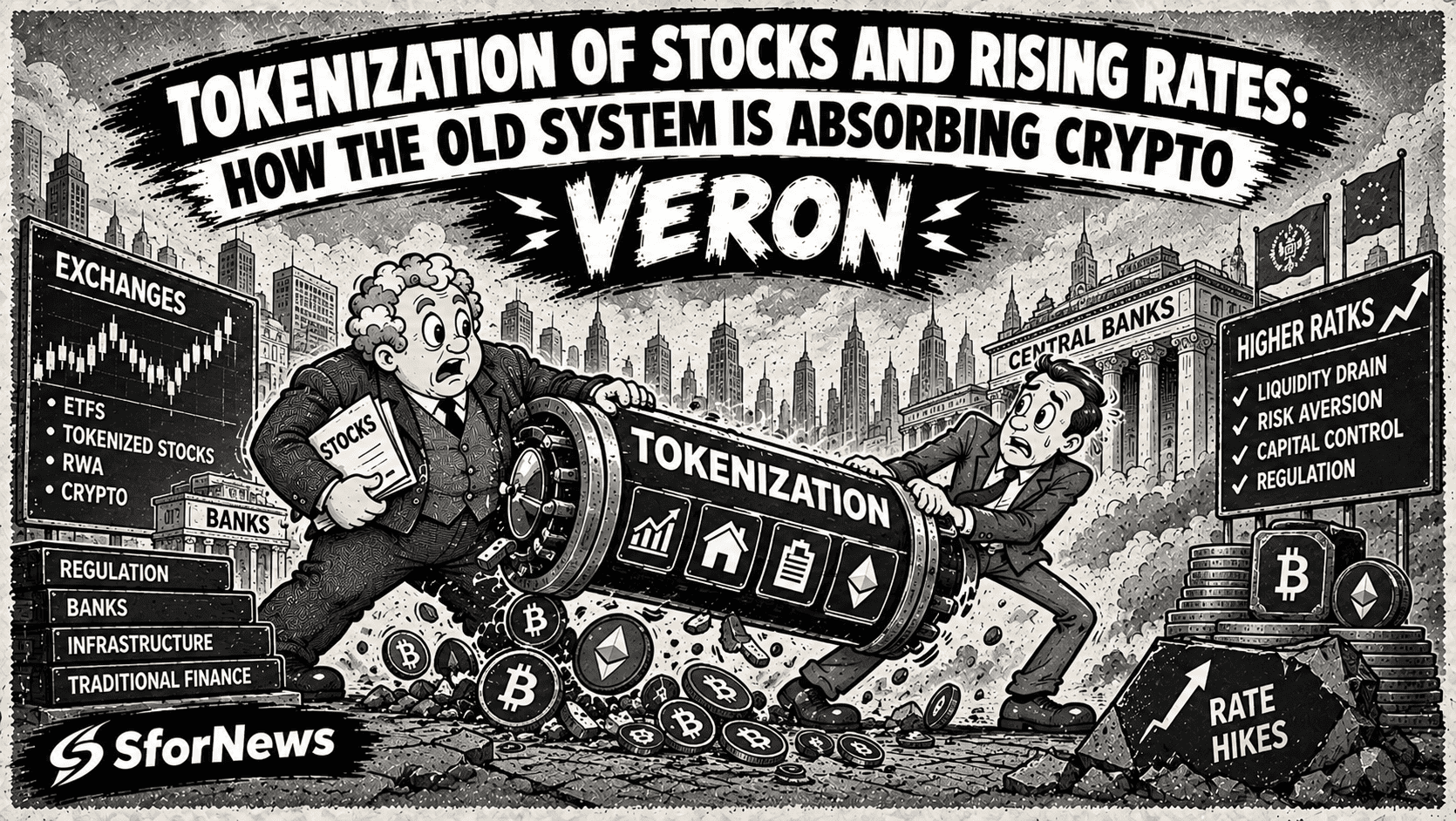
While Russia is only preparing to launch a large-scale cryptocurrency regulatory system on July 1, 2026, a real financial drama is unfolding in the United States. American banks have rebelled against the Federal Reserve System’s decision to grant the Kraken crypto exchange access to its payment infrastructure. Two different events on opposite ends of the world, it would seem. But in reality, they are two sides of the same coin: the old financial system is desperately resisting the new one, and the new one is trying to integrate into the old without losing itself.
Let’s figure out what lies behind these decisions and why they will determine the face of the financial world for decades to come.
🇷🇺 Part 1. The Russian Contour: Long-Awaited Rules of the Game
Russia will finally get a legal infrastructure for cryptocurrencies. The draft law “On Digital Currency and Digital Rights,” developed by the Central Bank and the Ministry of Finance, is set to partially come into force on July 1, 2026. This is not just another document—it’s an attempt to create a full-fledged ecosystem for the circulation of digital assets within the national jurisdiction.
What the Law Proposes
The project envisions the operation of five types of organizations:
• Licensed crypto exchanges
• Digital depositories
• Brokers
• Management companies
• Crypto exchangers included in the Central Bank’s registry
Residents will be able to buy and sell cryptocurrency only through Russian platforms. Exceptions are made for miners, non-residents, and participants in foreign economic activity. The emergence of legal exchangers and exchanges will open access to cryptocurrencies for a wide range of investors, including unqualified ones (with limits and testing).
At first glance, this is a step forward. But, as often happens, the devil is in the details.
The Risk of a “Closed Crypto Contour”
Experts warn: due to US and EU sanctions, Russian services may receive high-risk flagging in AML/KYT systems. This creates a risk of forming an internal crypto contour, isolated from the global market.
Sanctions flagging does not technically change the token, but it makes it undesirable for international exchanges. This means potential freezes and blocks when attempting to withdraw funds to global platforms. The Russian market is large enough to mitigate the effect within friendly regions, but full integration with the global crypto economy will have to be forgotten.
Storage Under Control
Digital depositories will function as custodial vaults. They will be able to:
• Store users’ cryptocurrency
• Freeze assets at the request of AML/CFT authorities
• If necessary, transfer assets without the client’s consent
Notably, liability for failures of public blockchains is not provided for. This is a classic legal construct: we are responsible for our servers, but not for the Bitcoin network.
Foreign Exchanges Under Control
Foreign platforms will only be able to operate in Russia through subsidiaries registered in the country. This radically changes the landscape:
• Withdrawing cryptocurrency to exchanges that do not “localize” through legal banks will become impossible
• Cryptocurrency must be stored at identifier addresses in depositories
• Assets outside these addresses will not be protected by court if not declared
It remains unclear how non-custodial wallets will be regulated. And this, as we know, is the last bastion of true decentralization.
The Flip Side: Growth of the Shadow Sector
Experts rightly note that tightening rules could strengthen the role of gray market exchangers. The high risk of flagging for cryptocurrency associated with the Russian contour creates an additional incentive for users to turn to unofficial services. If foreign exchanges stop accepting such assets, people will simply go into the shadows. Regulation without considering the global context risks creating the very thing it fights against.
🇺🇸 Part 2. The American Revolt: Banks Against the Future
Now let’s move to the USA. Events here are unfolding with cinematic intensity.
American banking organizations have sharply reacted to the Federal Reserve System’s decision to grant the Kraken cryptocurrency exchange a “limited master account.” This account opens access to the central bank’s payment infrastructure—that very “holy of holies” that banks have monopolized for decades.
Why the Fed’s Decision Caused Protest
The Fed continues to shape its policy regarding so-called “limited master accounts.” They are intended for financial organizations that do not fit the classical banking model but wish to interact with the central bank’s infrastructure.
However, just hours after the announcement, major banking associations voiced criticism. Paige Pidano Paridon from the Bank Policy Institute (BPI) stated that approving an account for Kraken causes “deep concern.” According to her, the decision was made before the completion of the Fed’s overall policy development for such accounts, effectively bypassing the public consultation process.
Main Complaints from the Banking Sector
Industry representatives highlighted several key problems:
• Violation of Fed procedures: The decision was made before public discussion concluded.
• Lack of uniform standards: It’s unclear whether rules will apply consistently across all regional Fed banks.
• Insufficient transparency: Banks received no information about control measures and risk management.
• Increased risks: Uninsured depository institutions carry higher systemic risks due to softer regulation.
Banking lobbyists are demanding a 12-month waiting period before crypto firms can qualify for such accounts.
What Really Lies Behind the Protests
Behind the legal formulations hides a simple truth: banks are protecting their age-old monopoly. Crypto companies’ access to central bank payment systems makes international transfers fast and cheap, pulling the rug out from under traditional intermediaries who take commissions at every step.
Significantly, another battle is unfolding in parallel—whether exchanges like Coinbase can offer interest on stablecoin balances. Banks see this as a threat of deposit outflow from the traditional system. The White House has already joined the negotiations.
On the banks’ side is Better Markets, warning of risks to the financial system. On the crypto companies’ side is the market itself and technological progress.
🌍 Part 3. Global Context: The Battle for the Future of Finance
Russia and the USA are just two theaters of operation in the global war for the future of finance. Similar processes are unfolding worldwide.
United Kingdom: Caution vs. Innovation
It’s interesting to compare the approaches of the USA and the UK. Regulators in the two countries have diverged on how to test tokenized securities. Britain is promoting a more cautious approach through regulatory “sandboxes.”
While the US under the Trump administration is easing regulation and encouraging cryptocurrency adoption, the Bank of England remains cautious. The American SEC doubts the commercial viability of sandboxes and is considering an alternative approach—”exemptive relief”—which the crypto industry supports.
FATF and Global Standards
At the global level, the Financial Action Task Force (FATF) continues to set the tone. In its latest reports, FATF pays special attention to P2P transfers through non-custodial wallets. These are seen as a key vulnerability allowing circumvention of sanctions and anti-money laundering checks.
FATF calls on countries to assess risks associated with stablecoins and take proportionate protective measures. This may include enhanced monitoring when non-custodial wallets interact with regulated platforms.
South Korea: Opening Up to Institutions
South Korea’s example is telling. A country that had effectively banned corporations from investing in cryptocurrencies since 2017 is now preparing to open this market. Public companies and professional investors will be able to allocate up to 5% of their capital to cryptocurrencies from the top 20 by market cap through five regulated exchanges.
This is a 180-degree turn. It could unleash enormous capital flows. For example, Naver, with $18.4 billion in capital, could potentially invest significant sums in the crypto market.
India: Total Control
At the opposite pole is India. There, the financial intelligence unit has introduced new rules requiring crypto exchanges to conduct strict user identification. Now accounts must be verified with a “live blinking selfie,” recording GPS coordinates, IP address, date, and time.
Support for ICOs and use of mixers are prohibited. All exchanges are required to store user data for five years. India has chosen the path of total control.
🔍 Part 4. Reasons for Decisions and Outrage: An Attempt at Systematization
Why are regulators and banks around the world reacting so sharply? Deep-seated reasons lie behind this.
1. Protection of Monopoly Rent
The banking system has earned from intermediation for centuries. Cryptocurrencies and blockchain make intermediaries unnecessary for a huge layer of operations. Kraken’s access to Fed infrastructure is not a technical detail—it’s the destruction of a monopoly. Banks are losing not just commissions; they are losing control over money flows.
2. Fear of the “Black Box”
Regulators don’t fully understand how decentralized protocols work. The Bank for International Settlements (BIS) in its reports warns of risks from tokenized funds and their integration with DeFi. The main problem is liquidity mismatch: the possibility of instant redemption of tokenized shares contradicts traditional settlement cycles.
Moreover, blockchain transparency could become a crisis catalyst: redemption operations are visible to all participants in real-time, which could trigger a chain reaction of mass withdrawals.
3. Combating Uncontrolled Anonymity
Regulators’ main headache is non-custodial wallets and P2P transfers. FATF directly calls them a “critical vulnerability” as they allow circumvention of controlled intermediaries.
Chainalysis calculated that in 2025, at least $154 billion was received by illegal addresses, with 84% of illegal transactions involving stablecoins. Although illegal activity accounts for less than 1% of total transaction volume, the absolute numbers frighten regulators.
4. The Pursuit of Sovereignty
Every country wants to control its financial system. The Russian approach of creating a “national crypto contour” is an attempt to achieve sovereignty in the digital sphere. The USA, conversely, seeks to maintain global dominance by integrating crypto companies into its system, but on its own terms.
The GENIUS Act, signed by Trump in July 2025, brings stablecoins under the Bank Secrecy Act and requires issuers to comply with strict AML norms.
🏛 Architectural Conclusion
The two news stories of this day—about Russian regulation and the American bank revolt—are really about the same thing. The world is moving from the era of “crypto as an alternative” to the era of “crypto as part of the system.”
Russia is choosing the path of controlled sovereignty. It is building its own crypto contour, understanding that global integration is hampered by sanctions. This is a pragmatic but risky path. It provides legality within the country but cuts it off from the global market. And, as experts warn, it could stimulate the shadow sector if restrictions become too harsh.
The US is choosing the path of controlled integration. The Fed is opening doors for select crypto companies, but banks are fiercely resisting. The old financial elite does not want to yield to new players. However, President Trump has made it clear: resistance is futile. The sector will either develop in the US or move to China and other countries.
The global trend is obvious:
• FATF is tightening requirements for stablecoins and P2P transfers.
• The UK is introducing full licensing of crypto assets by 2027.
• The EU is implementing MiCA with strict requirements for issuers.
• The UAE is strengthening its AML system, aiming to become a global compliance hub.
The key paradox of the moment: the more crypto integrates into the traditional system, the less remains of the original idea of decentralization. But the more it isolates itself (as in the Russian scenario), the less access it has to global liquidity.
The battle is not between crypto and fiat. The battle is over who will control the infrastructure of tomorrow. Banks understand this and are fighting to the death. Crypto companies understand this and are lobbying for access to central bank payment systems. And users are left to watch and choose: the security of a national contour or the freedom of the global one, but with the risk of flagging and blocks.
“The old system is dying. It is being replaced by a new one—transparent, fast, and cheap. The only question is who will manage it.”
Sources: Materials from the Central Bank of the Russian Federation and the Ministry of Finance, Bank Policy Institute, FATF, Reuters, Bloomberg, Chainalysis.
Crypto Emergency & Control Systems Design Bureau


Bitcoin
$62,881.23

Ethereum
$1,672.04

Litecoin
$42.71

Dash
$37.08

Bitcoin Cash
$209.43