Economist Vladimir Levchenko: Why propaganda and myths don’t change reality — an interview with The Trends
Beyond the Clichés: Economist Vladimir Levchenko on Why Propaganda and Myths Don’t Change Reality
The questions we put to Vladimir Levchenko were drawn from the loudest headlines of recent weeks—the kind that spread across tabloids and news feeds, creating the illusion of meaningful discussion. “Will oil collapse?”, “The dollar’s collapse is inevitable”, “Europe is freezing”, “China is taking over markets”, “Russia is losing the energy war”, “America’s golden age is ending”, “Iran is on the brink of collapse”, “The global economy is in its death throes”—behind every such cliché lies either a superficial reading, deliberate distortion, or a longstanding information strategy aimed at shaping a desired picture of the world.
We did not put these questions together by chance. They are a snapshot of how reality is “packaged” today—in bright, alarming, simplified constructs that are easy to reproduce and almost impossible to verify. But they share one common trait: almost all of them stem from a logic that has been imposed for decades as the only possible one. The logic of the Washington Party Committee, as our interlocutor calls it.
Vladimir Levchenko is an economist, publicist, and a man who predicted crises before they were written about in mainstream media. He does not give interviews every day and does not strive to fit the “questionandanswer” format. His answers do not merely challenge individual points; they break the very lens through which we are used to seeing events. He does not argue with numbers—he challenges the assumptions on which those numbers are built. He does not deny facts—he shows that they carry different meanings.
This conversation is not about guessing the dollar exchange rate or forecasting oil prices. It is about how not to become a hostage to someone else’s information matrix. About how economics is not a game of numbers, but a way of organizing life. And about how, in a world where everything has been mixed up, the only reliable compass is taking responsibility for yourself and refusing to follow imposed scenarios.
We break patterns. We step outside the boundaries of habitual misconceptions. We begin.
“The script you are forced to live by was not written by you.”
“We live in order to live, for meaning, not for numbers.”
Economist and publicist Vladimir Levchenko on why the old world is collapsing, why the new reality demands a different mindset, and how to recognize information attacks and break free from external control.
Instead of a preface
Tatiana Burmagina: Vladimir, good day. We have prepared a number of questions for you about the current crisis and its impact on Russia, Europe, the Middle East, and the global financial system. But before we begin, you wanted to make an important statement.
Vladimir Levchenko: Yes, Tatiana, thank you. I have read your questions. And before answering them, I need to make an important disclaimer.
The way they are asked, the way they are phrased… if I were to answer them exactly as formulated, first of all, it would be impossible to answer them. Because they are framed in the logic of the Washington Party Committee’s economics textbook. And if I were to answer them nonetheless, it would be a severe disservice to the audience—exactly what ninety, maybe even ninetynine percent of all global media do.
Therefore, I will look at what you have written but answer in a slightly different format.
1. On Russia as the crisis winner
Question: Vladimir, you called Russia the main winner of this crisis. But let’s look at the numbers: yes, oil has risen above $100, but the sanctions price cap and logistical difficulties prevent our companies from fully monetizing this “golden barrel.” Bessent’s Treasury temporarily allowed the sale of 130 million barrels of Russian oil, but the license expires on April 11. How sustainable is this gain? Are we talking about a longterm shift or a shortterm market condition that needs to be “cashed in” quickly?
Vladimir Levchenko: Regarding Russian export prices… a long, long time ago we should have stopped paying attention to what the United States does.
The global energy market—oil, gas, energy carriers—has firmly entered a new rising supercycle. Roughly the same as from 1973 to 1980 or from 2001 to 2008. The minimum was in 1999, but now, if we draw those parallels, we are somewhere in late 1973 or early 2002. And no sanctions, no one’s sanctions, no Trump who imagines himself the chief Satanist of mankind—nothing can change that.
2. On industrialization and structural reforms
Question: You call for “Stalinstyle industrialization.” But looking at the structure of our economy today—a high key rate (18%), labor shortages, corporate debt—do we have the institutional resources for such a leap? What needs to happen to free up those resources? And aren’t we repeating the mistake of the 1970s, when the Soviet leadership treated the oil shock as a “permanent” trend and failed to carry out structural reforms?
Vladimir Levchenko: I have never, ever called for industrialization or anything else according to anyone’s templates from the past. Parallels with the past are not iron rails we must follow.
First. The factors you mention—the high interest rate, labor shortages, and especially corporate debt—are precisely the fuel, the compost on which this… well, if you can put it this way, new industrialization will be built. Although, I repeat, the term is extremely crooked. It should not be used because people will again draw false parallels.
And indeed, this is the main risk: the current cycle of rising energy prices and prices for our exports could lead to resting on our laurels, as it did in the 1970s, and subsequently to major upheavals. Like back then—the collapse of the Soviet Union. That risk exists, but based on our reality, I consider it fairly low. Unfortunately, not symbolic, not minimal at all, but very low.
Why? Because besides the 1970s, there were also the 2000s, which I mentioned. And our leadership, our country made very good use of that period. But unlike the 2000s, what do we have now? We now have a serious fight against capital flight. In the 2000s, our country was an appendage of the West and the lion’s share of the value created was exported as tribute to Uncle Sam. Now that has changed radically. Therefore, based on ongoing processes, we have every chance to take advantage of the situation.
And naturally, the Western media—which, as many adherents of Western propaganda claim, cannot lie because of democracy and freedom of speech… However, as we see, they do nothing but lie. So we need to listen to them less.
3. On Europe: a loser or a player being reshaped?
Question: You talk about Europe as the loser. But there is a nuance: European markets are falling, but their defense sectors are growing. Rheinmetall, Thyssenkrupp, French arms manufacturers—these are new drivers. Perhaps we are not simply witnessing Europe being “finished off” but rather being reshaped? If the US shifts its focus from Ukraine to the Middle East, and Europe is left to deal with its principles alone (as with sanctions), is it not becoming a more independent player—albeit a poorer one?
Vladimir Levchenko: Europe is losing virtually everything. The growth of the defense sector is the standard story to show: “Look, all of Europe’s problems come from Russia. We need to go east again, rob Russia—and then everything will be fine for us.” Because from the perspective of Western Europeans, the whole world consists of their slaves, and we should all be happy to be their slaves.
But the key point: we have never been slaves to you. In our case, the residents of Russia, it is the opposite. We have never been slaves, which is why they do not understand us and hate us so much. We will simply stop respecting this Europe.
Europe is rapidly heading—no more, no less—toward famine. Given the earthquake in their debt and energy markets, the collapse of final demand in all key regions where Europe exports its goods, and the drop in final demand within Europe itself… They have very big problems, and they have no plan at all. Not even a plan—they have no idea how to deal with it.
Their only idea: the driver of hunger in Europe is “the Russian is to blame, we need to go take food from the Russian.” A 600million Europe will try to take food from a 150million Russia with a fundamentally different culture… It has happened many times in history, and it has always ended the same way. This time, for Europe, it will end much more seriously than World War II.
4. On the Middle East: Dubai and the Arab monarchies
Question: You called Dubai a “Tower of Babel that crashed before reaching orbit.” But we see that Saudi Arabia has managed to adapt: the Yanbu pipeline is operating at capacity, exports through the Red Sea have increased from 1.4 to 3.8 million barrels per day. That is not a collapse, but adaptation. Perhaps we underestimate the ability of the Arab monarchies to restructure quickly? Or do you believe their vulnerability lies in the absence of their own “human capital”—something that cannot be bought with petrodollars?
Vladimir Levchenko: The Persian Gulf region can exist as part of a developed human civilization only under conditions of extreme, I stress, extreme globalization. When the value of the resources in the Persian Gulf is simply multiple times, I stress multiple times, higher than the cost of extracting those resources—it is formally cheap. The value of the region’s resources covers the cost of living and even of the presence of any—not even significant, but any—number of people in this region many times over.
The idea of building a multimillioncity in a lifeless desert that can exist exclusively comfortably under total globalization, when logistics costs absolutely nothing… Why didn’t we decide to build another Moscow in Oymyakon? Or, okay, Oymyakon has no sea. We have Anadyr—there is not even a sea, there is an ocean. And the climate there is probably milder than in Dubai. And actually, the residents of Anadyr can feed themselves, unlike the residents of Dubai. That is the first point.
Second. Of course, blocking the Suez Canal and the Bab elMandeb Strait is slightly more difficult than blocking the Strait of Hormuz, but only slightly. And what we are seeing is simply another step toward deglobalization.
And one more point. The countries of the region—none of them, except Iran, as we see—cannot defend themselves in any way. They have never even tried. Now, question: if they start spending any money at all to be able to defend themselves at least somehow, what will happen to the profitability of their operation? The answer is obvious.
5. On Iran: why it holds on
Question: Iran, despite strikes on nuclear facilities and the loss of its leader, is holding on. Consolidation under external attack works. If this scenario plays out—Iran does not fall but consolidates—what does that mean for the longterm balance of power in the region? The US is pouring in billions but is not getting a political result. Is this a trap or a conscious strategy?
Vladimir Levchenko: The questions about Iran and China are again asked from that reality which is like the famous joke about the goldfish. A man caught a goldfish and said, “Fish, I want to have everything.” She replied, “Man, you already had everything.” That is about the idea that “everything has already been had.”
Iran holds on because they have real human values. And, as we see, a significant, perhaps even a majority, of Iran’s population adheres precisely to those real values, rather than selling their souls to the devil—or rather, giving them away and even paying for the privilege—in order to be part of the manipulations that US President Trump has been engaging in lately.
We are still far from that. And there is simply no force that could deal with that. God remains God, and the devil remains the devil.
6. On China: paper tiger or new center of power?
Question: You said, “It is we who desperately need China, not the other way around.” And that China will become more accommodating. But let’s look at the structure: China is the largest importer of Iranian oil, which has now de facto fallen out of legal circulation. Iran is looking for new sales channels, China is looking for stable supplies. Isn’t this a situation of mutual dependence rather than onesided advantage? And what does “more accommodating” mean for Beijing—concessions on Taiwan? On technological sovereignty? On the New Silk Road?
Vladimir Levchenko: Regarding China… China is a classic paper tiger. The AngloSaxons first humiliated China and then let it feel like some kind of big tiger. Now China is being put back in its place. And China at a fundamental level simply has no options to resist this.
7. On the new industrialization and Chinese equipment
Question: You speak of “a chance to carry out a new industrialization” based on Chinese factories copied from Western models. But Chinese equipment is often copies, not originals, and without Western components it may turn out to be uncompetitive. How do we resolve this dilemma? And will this “new industrialization” simply become a replacement of one foreign player with another, without creating our own technological sovereignty?
Vladimir Levchenko: When I talk about a new industrialization using Chinese industry, about the Chinese coming to us and setting up their factories, I am talking about minimal technological… how can I put it correctly? About the production of the most, so to speak, primitive consumer goods, which includes the Chinese car. With cars, it’s a bit more complicated because their production still requires a certain capacious domestic market. We have no domestic market at all—thanks to artificially low interest rates throughout our history.
I am by no means talking about industrialization based on any serious new technologies. Serious technologies for a new technological order can only be generated by us. And that is a separate task from all the others, and it is solved by absolutely noneconomic methods.
To set up, roughly speaking, a factory for producing toys—cheap, because for the Chinese their factories are unprofitable and there is no one left to supply toys to—in exchange for certain oil and gas flows, that’s a good story. Or a factory producing something, such as cars, that will cover our domestic needs—that is also good. So my theses about industrialization using Chinese technologies are precisely about that, nothing more.
8. On the US: garbage content and the real economy. On Trump and sanctions
Question: You said: the US invests in supertechnologies, the result of which is “garbage content.” That is a strong thesis. But if we look at real investments—CHIPS Act, IRA, oil production development—the US is also betting on the real sector. Perhaps we are not seeing a “mistake in emphasis” but a dual strategy: a technological leap for the future plus energy selfsufficiency for the present? Who has the better chance in this race?
Trump, by your logic, is going all in. But his 48hour ultimatum to Iran showed that tough rhetoric is not always backed by a willingness to act. If the US cannot quickly end the conflict and costs continue to rise ($28 billion already in three weeks), what will happen to the American economy? And more importantly, how will this affect the 2026 elections? The temporary lifting of sanctions against Russia and Iran looks like a palliative, not a strategy.
Vladimir Levchenko: The United States is incurring no costs in the Gulf. $28 billion over three weeks, as you wrote, is not even dust underfoot. Even if it were $280 billion over three weeks, it would still be dust underfoot for the American financial system. That is the first point.
On lifting sanctions… That’s just rare idiocy, I apologize. It’s foolish to comment, because any talk of lifting sanctions is manipulation, baiting. As I said at the end of 2021, two months before the start of the SMO: sanctions will be lifted when our troops take London.
The main contribution to US GDP is made by that very AI garbage content. So everything else they do, supposedly investing in some real sector, is again not even dust underfoot.
From an energy perspective, the war in the Gulf—one of the US goals in this conflict—is precisely about consolidating US leadership in the technological sphere, as it was in the 1970s and the 2000s. Back then, they succeeded: after the 1970s, the Soviet Union collapsed. After the 2000s, there was the breakthrough in mobile applications, mobile communications, social networks, which has culminated in the current story with artificial intelligence. But US leadership is primarily in the production of equipment for these things. The catch is that when the content is artificial intelligence, that content is largely garbage. GDP is drawn up, but the result is like with us—moving curbs from one side of the road to the other. Or like with the Chinese—building cities in the desert and then blowing them up. GDP grows, money is spent, but they yield nothing. To generate content, it must be stored somewhere, administered… that all costs money. But essentially, it contributes nothing to the real economy.
It’s as if you and I donated a certain amount of blood every day and simply flushed it down the toilet. Today we donate 10 milliliters, next month—15, and so on. And then the blood runs out. Because the content is garbage, but GDP grows.
9. What should a private investor do?
Question: If your analysis is correct and we are entering a world of regionalization, controlled logistics corridors, and a multicurrency system, how should a private investor’s portfolio be restructured? The classic 60/40 model (stocks/bonds) no longer works—we saw that from the dynamics in March. What is taking its place? Gold, infrastructure bonds, exporter stocks, perhaps tokenized assets?
Vladimir Levchenko: What should a private investor in our country do? What he has practically never done—believe in our country. Invest in our economy, in our business.
And our business, which is actually piznes [a pun: “business” distorted to “piznes” implying something base], stubbornly believes it is so cool because it is entrepreneurial, and stubbornly refuses to understand that its entire success was based on being able to borrow money at belowinflation rates. That is, systematically robbing everyone else.
We have entered a big cycle where the opposite is happening. Where to get investments, you have to pay, and pay a fair price. And if you pay a fair price, then 90 percent of these socalled entrepreneurs go bankrupt because they are unsustainable.
Our real interest rate in rubles is positive—and for a long time. It is above inflation. This means that simply placing your money in the debt market—deposits, bonds, but one must understand them, of course—will provide real capital growth. That is the key point. Otherwise, mind your own business. To paraphrase an old saying on this topic: don’t think too much—just live…
10. On forums and long money
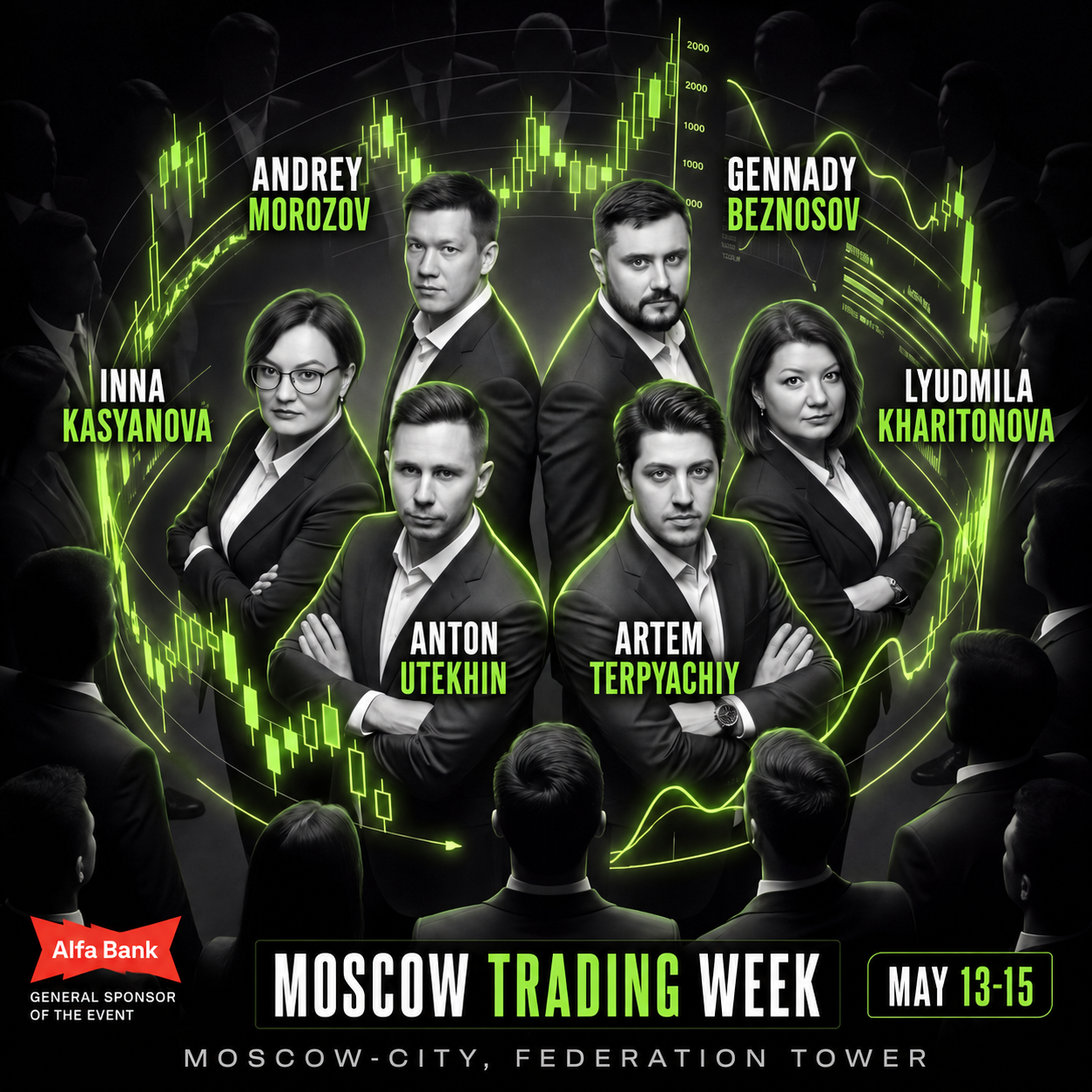
Question: You call for industrialization. But industrialization requires long money. Our financial system lacks long money—the interest rate is high, the capital market is underdeveloped. What needs to change in the institutional environment to bring about this long money? And what role can forums like The Trends and Moscow Trading Week play in this?
Vladimir Levchenko: Various forums not only fail to help the development of our economy, they harm it. Because these forums are designed for participation by market players, and our financial market—like all financial markets—works for the United States. For those who invented these markets and then promoted them.
So all these forums… I am not saying they are evil, by no means. They just need to be properly transformed.
When they say we don’t have long money because of the high interest rate, that is a lie from the same opera. Development on credit is an oxymoron. Development on credit is possible only if you are the metropolis. Because of that, you create an illusion and a skew: in the metropolis, money is safe, protected, but outside the metropolis it’s a nightmare, nightmare, nightmare, you cannot invest there. So this creates a skew. In the metropolis, the interest rate is artificially low, so money flows there. Outside the metropolis, the interest rate is artificially high, and on top of that there is extreme capital flight and high inflation. A paradox—the rate is high, but below inflation!
To create a capital market here, we first need to create an internal investment resource. That is exactly why we now have a positive real interest rate—significantly positive and for a long period. As soon as our internal investment resource reaches a size where competition begins not for that investment resource, but for investment projects—then we will see a reduction in real interest rates and then investments will flow in full.
If we try to artificially accelerate this process, we will simply get an avalanche of fraud, an avalanche of losses—not only for the broad pool of investors but also for larger investors—and destroy what we have been building, namely this internal investment market. Which, in fact, is what the West is trying to do, because if we don’t have an internal investment market, how will they survive? Capital will not flow to them.
11. On worldview and information sources
Question: In your talks, you use macrotheses that differ significantly from mainstream analysis. What is your information picture based on? What sources do you consider reliable under conditions where, in your own words, “the world is going into a tailspin”? And how do you protect yourself from confirmation bias—that is, seeking information that confirms your own worldview?
Vladimir Levchenko: You just need to have your own working picture of the world. As Leonid Bronevoy—or rather, Müller in the famous film from my childhood based on Yulian Semyonov’s book Seventeen Moments of Spring—said: “You can’t trust anyone. You can trust me.”
I predicted absolutely all the economic crises that occurred in our country, including the big war in the Gulf that we are now witnessing. The question here is not about who to read or what information to look at. The question is about how you relate to life. Whether you take responsibility for your own life or not.
Despite everything, making mistakes, sometimes even at the risk of breaking completely—you go after your own knowledge and experience and take responsibility for it. Instead of following imposed narratives and patterns.
In terms of information, you need to feel, not think. This is a very important point. The heart cannot be deceived. Logic, as we see, is easily fooled. But if we look at the world with a calm mind and let all information pass through us, including all other sensors, senses, intuition… then it is fundamentally difficult, practically impossible, to deceive us.
12. On the new financial architecture and the end of times
Question: If we follow your logic, the current crisis is not an accident but a natural stage: “the great liquidation of fiat,” clearing out the old before the new. How do you assess the probability that in 3–5 years we will be living in a world with a fundamentally different financial architecture? And what will replace the dollar in that architecture? A multicurrency basket? Central bank digital currencies? Gold?
Vladimir Levchenko: The interests you write about—there is nothing new in them. The economy is for life, not the other way around. We earn money to live, we do not live to earn money. Although in today’s reality, we are being convinced that the dynamics of numbers—precisely numbers, not real values—is everything. It is the one and only supreme value in one person. It’s like saying: we eat to live, not live to eat.
Right now, this is the war of Armageddon. It is about the fact that those who live to eat—who live for numbers, who are themselves numbers—they will remain in the old world. And those who use economic methods as a tool, who work to create a family, feed it, educate it, raise children, to spend time with them, not to throw them some useless gadget and continue to be a slave to numbers—these people will move on.
If not, then you and I, our generation, will witness the end of times.
In fact, there can be no other financial architecture here. It is a matter of the approach to existence itself, to the very essence of human existence.
© Vladimir Levchenko exclusively for The Trends
Interviewed by Tatiana Burmagina
The editorial board of The Trends and the team behind The Trends and Moscow Trading Week continue to monitor developments. The November The Trends forum will feature a special session dedicated to the role of the individual in the new economic reality.
[Buy a booth at Moscow Trading Week]
[Buy a ticket for Moscow Trading Week]


Bitcoin
$62,881.23

Ethereum
$1,672.04

Litecoin
$42.71

Dash
$37.08

Bitcoin Cash
$209.43