Holes in the Law Are Not a Bug — They Are a Feature of Transition | Arabesques of Clo | SforNews
Arabesques of Klo Magurskaya
HOLES IN THE LAW ARE NOT A BUG. THEY ARE A FEATURE OF TRANSITION
Moscow, September 21, 2026
I read the news of the last three days. SEC, ECB, Bank of Russia, Bank of Japan. Everyone is regulating something. Everyone is banning something. Everyone is “protecting” something.
I look at their faces. I hear their voices. They are so confident. So calm. So correct. They sincerely believe they are steering.
And I see one thing: they are not steering.
The regulator does not steer. The regulator reacts.
The SEC issued a five-year “innovation exemption” for tokenized stocks. It sounds like a breakthrough. Like recognition. Like a step forward. But let’s be honest: what is it really?
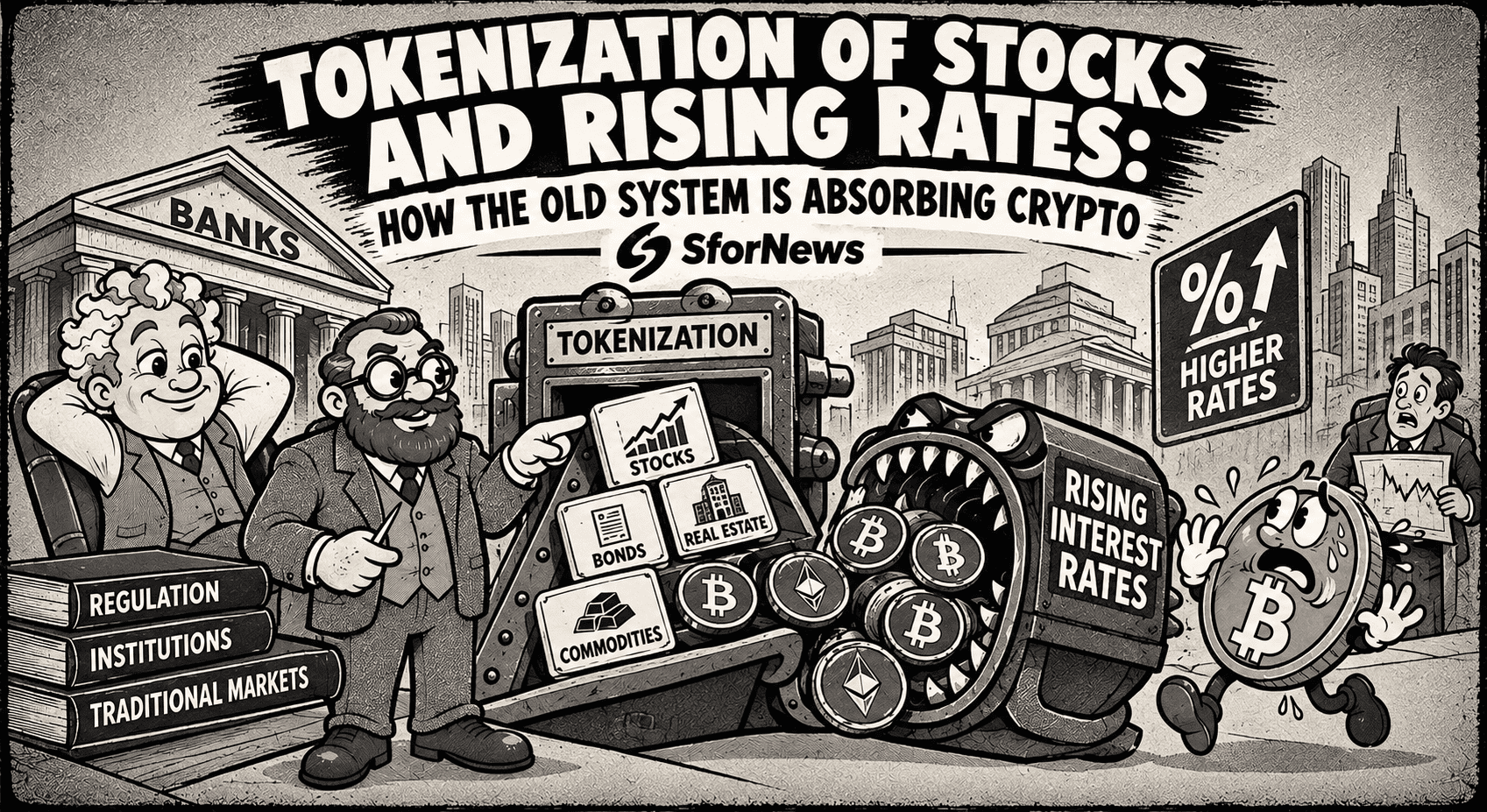
It’s recognition. Not of crypto. Of the fact that crypto already exists. That it cannot be banned. That it can only be embedded. Under control. Through licensed venues — Tokenized Securities Venues. Through on-chain market makers. Through liquidity pools.
And what about decentralized protocols? They are simply outside the license. Not banned. Just not written in. A hole.
This is not a bug of legislation. It is its nature. The law is written for what is already clear. For what can already be described. And the new is always outside the description. Always in the hole. Always between the lines.
Five years of exemption. Five years is enough time for more than one generation of technology to be born and die. Enough time for decentralized protocols to either become mainstream or disappear. Or — more likely — to find their own niche. Outside the license. In the hole.
The ECB blocks Binance. Lagarde personally. Concerns: the digital euro, dollar stablecoins. She’s right — stablecoins are already in circulation. They cannot be recalled. They cannot be blocked. They can only be restricted in access to a license. But the license itself is form. And the stablecoin is function. A hole.
The Bank of Russia introduces standards for banks. Limits crypto risks. Banks cannot ignore crypto — but they shouldn’t get burned either. The standards are a filter. But crypto is already with the people. Not in banks. Not in standards. Not in registries. With the people. A hole.
The Bank of Japan raised its rate to 1.25%. A 31-year high. The era of cheap money is ending. The carry trade will reverse. But not by decree. Where it’s profitable. Where no one expects it. A hole.
Tether provided $1.5 billion to Gold.com. Accumulated 146 tons of gold. Owns 13% of the shares. This is no longer a “stablecoin issuer.” This is a shadow central bank. Backed not by the dollar. By metal. Whoever holds the gold holds the system. A hole.
Zcash hit a 10-year high. $1,500. Then corrected. But the fact remains: privacy is becoming the main narrative. The more control — the higher the demand for anonymity. A hole.
NYSE is preparing a platform for round-the-clock trading of tokenized stocks. Avalanche is being considered as the network. The world’s largest exchange recognizes blockchain as infrastructure. This is not “crypto for crypto.” This is traditional stocks on blockchain. A hybrid model. A hole.
Circle launched Arc. Stellar activated Protocol 28. Midnight is preparing private smart contracts. Optimism votes for Upgrade 20. Infrastructure is being built. While regulators argue — infrastructure grows. A parallel construction site. A hole.
A hole is not an error. It is an entrance.
I look at this news and I see a system. Not the one shown in reports. The one that actually works.
The system is not inviolable. It is permeable.
The regulator sets a barrier. The new does not stop. It seeps through the holes. There are many holes. Close one — three open. While the old world closes doors, the new is already in the windows.
This is not a “bug.” This is a feature of transition. This is the natural state of any living system. The denser the control, the more holes. The more holes, the faster the new seeps through. The faster it seeps, the less sense there is in control.
Control is only possible over what is already described. And the new is outside description. Always. While it is being described — it has already changed. While rules are being written — it has already gone into the hole.
This is not a “failure.” This is the nature of transition. And it is precisely in this nature that our strength lies.
Because we are not trying to control. We are seeping through. We do not wait for permission. We act. We do not ask for a license. We build.
There are many holes. They cannot all be closed.
I look at this as architecture. Not as a “problem for the legislator.” But as initial conditions.
Look. The regulator closes one hole. Tokenized stocks — through a license. Good. And decentralized protocols? They are not in the license. They are outside form. A hole.
The regulator closes another. Stablecoins — through standards for banks. Good. And crypto with the people? It is not in banks. It is outside the standards. A hole.
The regulator closes a third. Mining — through taxes. Good. And independent miners? They are outside the system. They are outside taxes. A hole.
Every time — the same thing. The regulator thinks it is closing the system. In reality — it is drawing a boundary. Inside the boundary is the old system. Outside — the new. And it grows faster than the holes are closed.
What this means for us
It means — do not fight. Do not prove. Do not ask.
It means — build your own. Where there are no licenses. Where there are no standards. Where there are no permissions. Where a hole is not a bug, but an entrance.
In the new system there are no departments that decide for you. No laws that permit or forbid. No kings who hand out permissions. No agents who guard geniuses.
In the new system there is action. There is creation. There are “drops” of light that add up to a new reality.
And we are building it. Without regulations. Without permissions. Without fear.
What this means for you
If you hold money in a brokerage account. If you invest in Russian assets. If you are waiting for “permission” from a regulator. Ask yourself: whose money is this, really? Yours? Or a record in a database that can be frozen, deleted, annulled?
You can continue living in the illusion. Or you can start building a system where ownership is determined not by what is written in a registry, but by what you are aware of and can protect.
The old world is dead. This is not a warning — it is the initial conditions.
We do not save those who remained in it. We are building a new one — for those who are ready to enter.
#ArabesquesOfKlo


Bitcoin
$62,881.23

Ethereum
$1,672.04

Litecoin
$42.71

Dash
$37.08

Bitcoin Cash
$209.43