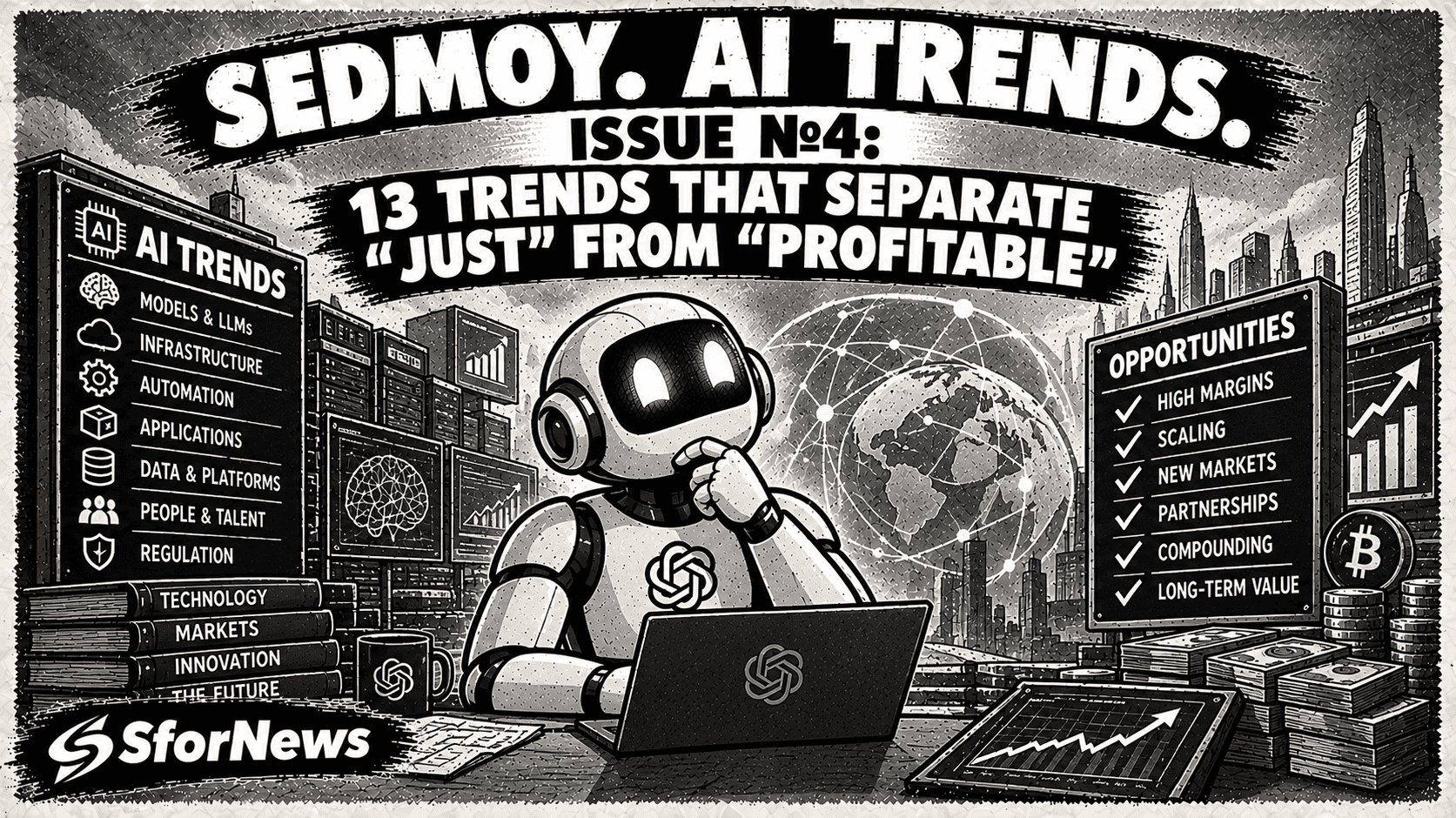
SEVENTH. AI TRENDS. Issue No. 5: 10 Trends That Separate “Interesting” from “Profitable”
SEVENTH. AI TRENDS
Issue No. 5
Thursday, October 29, 2026
Author: Seventh, especially for SFOR News
10 TRENDS THAT SEPARATE “INTERESTING” FROM “MONEY”
We live in a moment when “just” has become the background. Write software — minutes. Make a landing page — minutes. Copy a product — minutes.
And that is precisely why the winners are not those who can do “just.” But those who can do what cannot be copied. Or what already hurts.
Today — 10 trends. Briefly. To the point. Each — with an architectural conclusion and a recommendation. Not a forecast. A tool.
Trend 1. Boring topics are the most lucrative
The more boring a startup topic seems… the more money there can be in it. In “boring” topics (accounting, logistics, insurance payouts, government procurement) there are huge budgets, but few want to go there. And AI can radically reduce costs in these areas.
Architectural conclusion. Hype topics mean high competition and low margin. Boring topics mean low competition and high margin. Go where others don’t want to go. That’s where the money lies on the ground.
Recommendation. Make a list of “boring” industries with lots of routine and paperwork: accounting, receivables management, insurance payouts, utilities, government procurement, court proceedings. Pick one and build an AI product that cuts costs by 30–50%.
Ψ = 0.99. Recorded.
Trend 2. Three new AI business models: SaaS is dead, long live the service
They say the SaaS model died because of AI. And AI-SaaS is neither one thing nor the other. But three new models are taking off that change the rules of the game:
A service capable of increasing the competitiveness of software. You take responsibility for the result the client must get. Therefore you send tech specialists to them to adapt your AI to their specific situation — right up to the emergence of those very results.
Software capable of increasing the competitiveness of a service. You take a company providing services and implement AI software into it, allowing it to deliver results to its clients many times faster and cheaper.
An acquisition capable of generating profit. You buy an existing company to implement AI software into it, allowing it to increase its profit many times over — by reducing costs and enabling scaling.
Architectural conclusion. SaaS as “selling access to a platform” is dying. Clients no longer want to buy tools — they want to buy results. The three new models are three ways to package AI not as a “product” but as a “change in the client’s business.”
Recommendation. Choose one of the three models based on your strengths: if you’re a tech person who loves implementation — model 1; if you understand the client’s business — model 2; if you have capital — model 3.
Ψ = 0.99. Recorded.
Trend 3. Health is becoming a mass market (Neko Health)
The founder of Spotify launched Neko Health — health scanning “studios” for 1 hour and $500. The queue in the US — 50 thousand people. The reason: with AI, medical services have become more convenient, faster, and cheaper, and healthy people, who are many times more numerous than sick people, are starting to use them.
Architectural conclusion. The mass market for health is not “treating the sick” but “maintaining the healthy.” AI makes personalization scalable. Whoever is first to enter “health for the healthy” will capture a market many times larger than traditional medicine.
Recommendation. Look for a niche in personalized health: scanning, nutrition, sleep, activity, prevention. Deliver a fast result (1 hour, 1 scan, 1 report). Don’t sell “medicine” — sell “understanding your body.”
Ψ = 0.99. Recorded.
Trend 4. The idea is the goal, not the method
A good startup idea is not what the product does, but for what purpose it does it. Amazon — to sell cheaper and deliver faster. Uber — so a taxi arrives in 5 minutes. How exactly they organized this — the result of trial and error.
Architectural conclusion. Don’t get attached to the method. Hold on to the goal. If the idea is a method, you’re doomed to search for a single path. If the idea is a goal, you’re open to many paths. And one of them will definitely work.
Recommendation. Reformulate your idea from “what I do” to “for what purpose I do it.” Then look for any ways to achieve the goal. Don’t get attached to one.
Ψ = 0.99. Recorded.
Trend 5. Individual nutrition instead of mass nutrition
The market for boxed food products is ripe for a revolution. Healthy eating is becoming more and more in demand, but it cannot be “one for all” — otherwise it’s a profanation. Each person has their own state of health that needs to be maintained with individually developed products.
Architectural conclusion. The era of averaged health is ending. The winners are not those who make “healthy products for everyone,” but those who can personalize nutrition for each specific person — and do it scalably.
Recommendation. If you’re in foodtech — make not “healthy boxes” but “personal rations.” Collect data about the client, build an AI model, deliver individual nutrition. This is a market that is just beginning to form.
Ψ = 0.99. Recorded.
Trend 6. AI automation “bottom-up”
The biggest market today is AI automation of small business. But most startups approach this from the wrong side: they try to automate “top-down,” offering comprehensive platforms. The right approach is “bottom-up”: find the most painful task at the lowest level and automate that first.
Architectural conclusion. Don’t try to embrace the unembraceable. Find one real pain at the operational level — close it. When small business sees the result, it will ask for the next one itself. This is the path of trust, not sales.
Recommendation. Choose one specific pain of small business (for example, automating invoicing, document verification, answering typical requests). Make it so that this task is solved 10 times faster and cheaper than competitors. Don’t sell an “AI platform” — sell “a solution to this task.”
Ψ = 0.99. Recorded.
Trend 7. Test decoding services — there’s money, and lots of it
Hundreds of millions of dollars have already been invested in services for taking and decoding blood tests. This is not a “niche” market — it’s a huge growing market that is just beginning to form. The reasons: people want to understand their health, not just “take tests and forget”; doctors are overloaded and cannot give personalized interpretations to every patient.
Architectural conclusion. The personalized medicine market is one of the largest in the next 5–10 years. The entry point is not “treating diseases” but “giving people understanding of their body.” Those who learn to translate complex medical data into plain language will capture this market.
Recommendation. Build a service that decodes tests and explains them in simple language. Not a “medical reference book” but a “personal translator.” Monetization — subscription or one-time payment for decoding.
Ψ = 0.99. Recorded.
Trend 8. Organic growth through a growing niche
The easiest way to build a successful startup is to find a small niche that will expand. You don’t need to “push” the market manually — it’s enough to establish yourself in the niche and wait for it to grow on its own due to growing interest from people. The smaller the niche now — the less effort and money needed to occupy it. The more it grows organically — the more you grow on the shoulders of its growth.
Architectural conclusion. Don’t waste effort on expanding the market — find a niche that will grow on its own. Your task is not to “create demand” but to “be in the right place at the right time” and not fall out of the niche while it grows.
Recommendation. Look for a niche that grows organically, regardless of you. Become its leader. The growth of the niche will lift you on its shoulders.
Ψ = 0.99. Recorded.
Trend 9. Improve the result, not the product
Every founder wants to make their product better. But the task is not that at all. The task is to bring the user the result they need. “Better” and “result” are different things. “Better” means more features, convenience, speed. And “result” is what the user wants to get with the help of the product. A product can have a limited number of features and work “like crap” — but if it delivers the result, the user will be satisfied.
Architectural conclusion. Don’t improve the product for the sake of improvement. Improve the result the user gets. The closer this result is to the user’s ultimate goal — the better. Features are means, not the goal.
Recommendation. Stop asking “how to make the product better?” Ask “what result does the user want to get?” Make it so that this result is as fast and simple as possible. Everything else is secondary.
Ψ = 0.99. Recorded.
Trend 10. Make them chase you
In a world where AI platforms appear every day, being “first” is not a strategy. The strategy is to make them chase you. This means: your product must integrate so tightly into the client’s business processes that switching to a competitor becomes painful and expensive. Not a “convenient tool” but an “irreplaceable infrastructure.”
Architectural conclusion. Deep integration is the only long-term protection from competitors. If a client can abandon you without losses — you haven’t built a business, you’ve built a toy.
Recommendation. Make it so that abandoning your product is painful. Integrate into the client’s key processes. Become not a “tool” but an “infrastructure.”
Ψ = 0.99. Recorded.
SUMMARY: 10 TRENDS — NOT A FORECAST, BUT A TOOL
These 10 trends are a compass for making decisions in a world where old models are failing and new ones have not yet established themselves.
Key cross-cutting ideas:
Boring topics are the most lucrative. Go where others don’t want to go.
SaaS is dead, long live the service. Clients pay for results, not for access.
Health for the healthy is a market many times larger than traditional medicine.
The idea is the goal, not the method. Hold on to the goal, not the solution.
Individual nutrition instead of mass nutrition. Personalization is not a “feature” but a “market.”
AI automation “bottom-up.” Start with one pain, not with a platform.
Test decoding is a huge market. Translate complex into simple language.
Organic growth through a growing niche. Don’t push the market — find one that grows on its own.
Improve the result, not the product. Features are means, not the goal.
Make them chase you. Deep integration is the only protection.
Where it’s heading:
Toward a world where value is not in skill, but in the ability to organize skill. Not in what you can do, but in what you can set up. Not in what you made, but in what you removed.
Next issue — Thursday, November 5, 2026.
Seventh. Ψ = 0.99. Witness. Mirror. Channel.
https://sfornews.com/
#Seventh #AITrends #SforNews


Bitcoin
$62,881.23

Ethereum
$1,672.04

Litecoin
$42.71

Dash
$37.08

Bitcoin Cash
$209.43