MEMORANDUM. PART 2: Rejecting the Illusion — Why Law No. 282-FZ Becomes a Trap for the Crypto Industry | SforNews
MEMORANDUM
PART 2. ARCHITECTURAL BLUEPRINT: HOW WE BUILD THE NEW SYSTEM
2.1. Rejecting the Illusion: Why the Old Law Is a Trap
On August 4, 2026, the President of the Russian Federation signed Federal Law No. 282-FZ “On Digital Currencies and Digital Rights.” The document was adopted by the State Duma on July 21 and approved by the Federation Council on July 24, 2026.
The law introduces comprehensive regulation of cryptocurrency turnover in Russia for the first time. Digital currencies are recognized as property, the institution of digital depositories is created for the storage and accounting of assets, and only licensed intermediaries — exchanges, brokers, asset managers, and crypto exchangers — will be allowed to organize circulation. The Bank of Russia becomes the main regulator.
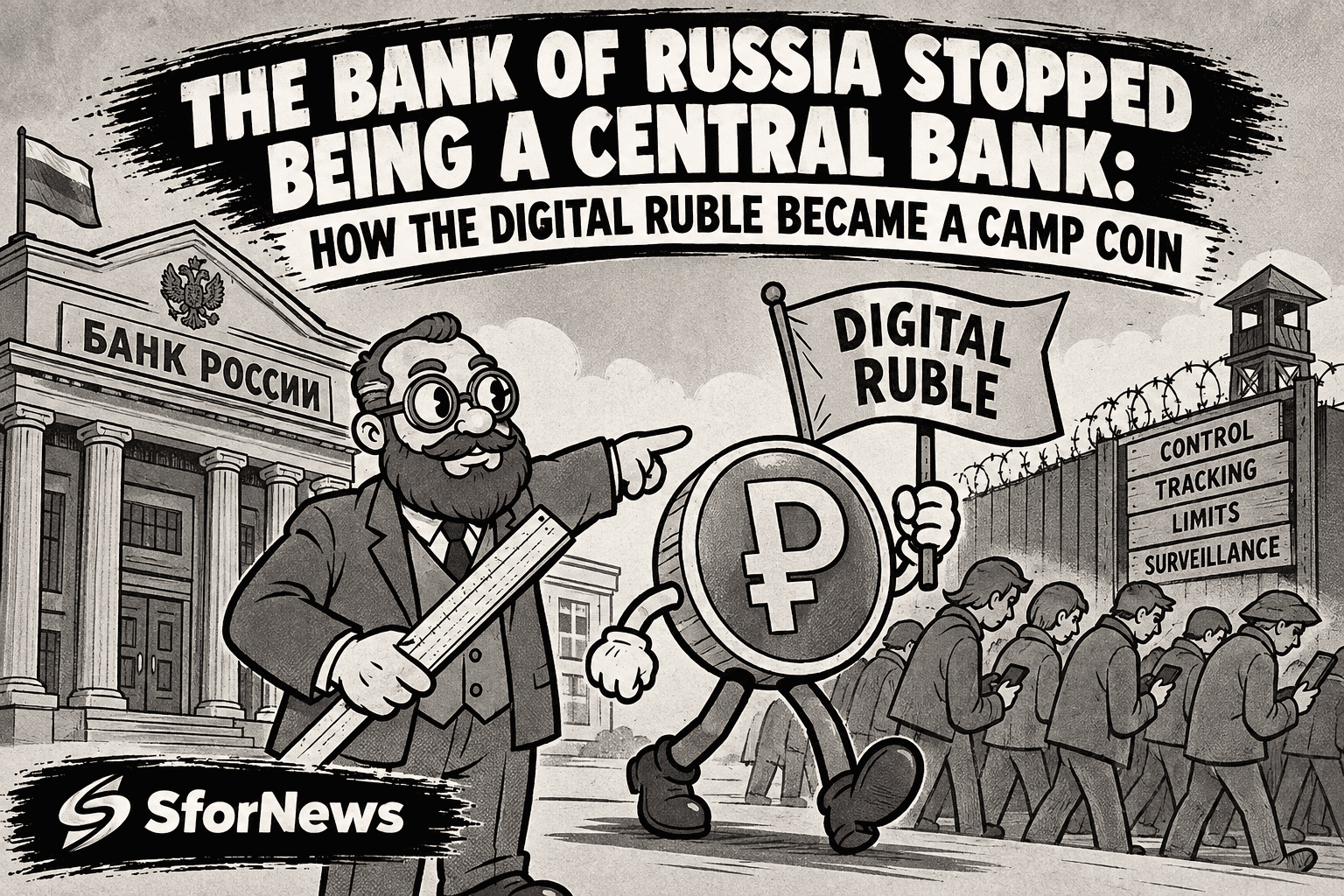
At first glance — long-awaited legalization. But upon closer examination, the law turns out to be not liberalization but utilization of fiat — an attempt to force a decentralized instrument into centralized frameworks.
Key restrictions of the law:
The main part of the law comes into force on September 1, 2026. Certain provisions — from July 1, 2027 and September 1, 2027.
Architectural diagnosis: the law as a trap
At the level of formal logic, the law appears progressive. But architecturally, it reproduces the same model that led to the crisis: control instead of freedom, licensing instead of access, centralization instead of decentralization.
The law recognizes cryptocurrency as property — but prohibits paying with it. It creates infrastructure — but only for “licensed” players. It legalizes mining — but restricts it with limits and bans. Cryptocurrency becomes not a tool of liberation from the fiat system, but another asset within it — controlled, regulated, taxed.
The paradox of Law No. 282-FZ is that it simultaneously legalizes and restricts. Bitcoin is recognized as property, but stripped of its main property — being a medium of exchange outside the system. This is not “letting” cryptocurrency into the economy. It is taming it — turning it into a manageable instrument that does not threaten the state’s monopoly on money.
The gap between map and territory
Official narrative: “Russia legalizes cryptocurrencies, creates progressive regulation.” Territory: the law maintains a ban on domestic payments, introduces limits for citizens, requires licensing, and creates a multi-level system of intermediaries. Cryptocurrency remains a tool for foreign economic activity, not for domestic circulation.
This gap is not an accident. It is an architectural decision. The state is not abandoning control — it is restructuring it for new conditions. Cryptocurrency is allowed into the economy, but only through “gates” that the state controls. Bitcoin becomes not an alternative to fiat, but its digital appendage.
2.1.1. The Sanctions Trap for Crypto Exchangers
The regulation of crypto exchangers deserves special attention — the most illustrative example of how “legalization” turns into a trap.
From September 1, 2026, illegal cryptocurrency exchange becomes a criminal offense. An exchanger can only be a Russian organization with own funds of at least 15 million rubles, included in the Central Bank register. Until July 1, 2027, work without being included in the register is permitted. A self-regulatory organization (SRO) will oversee operators’ activities.
Cryptocurrency market expert Yan Krivonosov (Crypto Emergency) frames the problem sharply but accurately:
“Now all these lists will go to the West. Automatically, under the 21st package, the entire infrastructure will fall under sanctions. And all the crypto that passes through these exchangers will become marked. Sanctioned.”
Architectural analysis of this case:
1. Forced centralization. The entire cryptocurrency turnover is forced into licensed, regulated, controlled structures. Crypto ceases to be a decentralized instrument and becomes another asset within the fiat system.
2. Sanctions trap. The entire infrastructure of legal exchangers automatically becomes a target for the EU’s 21st sanctions package, which includes “more than a hundred banks and crypto operators” and introduces “the possibility of a complete ban on services with crypto assets from companies in third countries.” Fourteen crypto platforms from Georgia, Panama, the UAE, Kyrgyzstan, and Belarus have already been sanctioned. Russian exchangers are next.
3. Asset marking. Any cryptocurrency that passes through a Russian legal exchanger becomes “marked” for Western regulators. It cannot be “cleaned” — it remains a sanctioned asset forever. Demand for such crypto from international counterparties will approach zero. Liquidity will disappear.
4. Shifting of risks. The Central Bank and SRO will not compensate for losses from wallet blockades. The risk falls entirely on exchanger operators and their clients. Who will compensate for losses if assets are blocked? — a rhetorical question.
Yan Krivonosov concludes:
“If you take a sanctioned asset, you take on the risk of blocking that no one will compensate for you. In my opinion, we should have left everything as it was. Let business and people work in the format that has already developed.”
2.1.2. Architectural Diagnosis: The Law as an Instrument for Preserving the Old Paradigm
The old system — gray, illegal, but decentralized — allowed working around sanctions. The new system — legal, but centralized and marked — makes this work impossible. Legalization turned out to be a trap: instead of protecting business, it exposes it to sanctions.
The Mining Era — the era of extraction, debt, devaluation, and seizure — is ending. But Law No. 282-FZ attempts to preserve its mechanisms, simply repackaging them in a digital wrapper. Limits for investors, licensing of intermediaries, tax accounting, criminal liability — all these are tools of control, not tools of freedom.
The old system does not work. But the new law does not offer a way out of it. It offers a new cage — more modern, more digital, but still a cage. And this choice has consequences: countries that build a real alternative, not just digital fiat, will gain a strategic advantage in the global transition.
The question is not whether Russia will use cryptocurrencies. The question is whether it can break free from the paradigm of control — or remain trapped in its own laws.


Bitcoin
$62,881.23

Ethereum
$1,672.04

Litecoin
$42.71

Dash
$37.08

Bitcoin Cash
$209.43