Fiat vs Bitcoin: A Comparative Analysis of Backing & Value (2025)
Emptiness for Emptiness? A Comparative Analysis of the Backing of Fiat and Bitcoin
The statement by Binance founder Changpeng Zhao (CZ) that nations will print unlimited money to buy Bitcoin exposes the main nerve of the modern financial system. It makes one think: what actually stands behind the familiar money in our bank accounts and behind the digital gold of the 21st century? Essentially, are we offering “emptiness” in exchange for the same “emptiness”? Such comments are not uncommon, coming from both financial advisors and crypto enthusiasts…
To answer this question, it is necessary to conduct a detailed analysis of the nature of the backing of fiat currencies and Bitcoin. This article expands the initial analysis, delving into the historical, technological, and macroeconomic aspects of this fundamental confrontation.
Fiat Money: Emptiness, Bolstered by Trust and Coercion
Fiat (decreed) money is a currency that the government declares as legal tender, but which has no intrinsic value and is not backed by a physical commodity such as gold. Its value is based solely on trust in the issuer and state regulation.
Historical Context and the Transition from the Gold Standard: Modern fiat money is a product of a long evolution. Historically, money was backed by gold or silver (the gold standard), which automatically limited emission. However, the abandonment of this system was gradual. The final collapse of the Bretton Woods system and the gold standard occurred in 1971-1973, when the United States unilaterally refused to exchange dollars for gold at the request of central banks of other countries. This gave governments the unlimited ability to issue money, which led to a systematic decrease in their purchasing power.
Power and Sovereignty as Backing: The strength of a fiat currency stems from the state’s monopoly right to collect taxes in that particular currency. To pay debts to the state, citizens and companies are forced to acquire the national currency, creating a basic demand for it. This is a kind of “technical backing,” based on state coercion.
Trust as a Fragile Foundation: Beyond tax coercion, the value of fiat rests on collective faith in the stability of the government and the economy. The central bank, managing interest rates and the money supply, tries to maintain this faith. However, history convincingly proves that such trust is fragile. A striking example is the US dollar, which since the abandonment of the gold standard in 1971 has lost about 97% of its purchasing power relative to gold. This is a systemic problem, not an exception, and it clearly demonstrates how unbacked money supply leads to a constant erosion of wealth.
Network Effect: The main practical backing of leading fiat currencies (the dollar, euro) is their global acceptance. They serve as the primary unit of account in international trade, and countries’ gold and foreign exchange reserves are stored in them. This huge network of users and transactions creates a powerful network effect, making these currencies indispensable in the near future, despite their inflationary nature.
Risks of Debt Spiral and Political Decisions: The possibility of unlimited emission creates systemic risks. For example, the US national debt has exceeded 30 trillion dollars, and to service it, the government is forced to constantly issue new debt obligations. This creates a debt spiral, where the stability of the currency directly depends on political will and economic discipline, which often yield to short-term political interests.
Bitcoin: Digital “Emptiness,” Backed by Mathematics and Decentralization
If fiat is backed by trust in centralized institutions, then Bitcoin is based on completely different principles. Its “emptiness” is of a different nature—it is a digital artifact, the value of which is determined by its absolutely predictable and immutable properties.
Mathematical Predetermination and Scarcity: The backing of Bitcoin is its algorithm. The strictly limited emission of 21 million coins makes it a deflationary asset, protected from arbitrary money emission. This is an algorithmic “emptiness” that cannot be diluted, unlike fiat. The Bitcoin protocol acts as a strict and incorruptible central bank, the rules of which cannot be changed at anyone’s whim. This scarcity is a direct response to the inflationary nature of fiat systems.
Decentralization and Security of the Blockchain: The value of the Bitcoin network is ensured by its globally distributed computing power. Blockchain technology is a distributed ledger where all transactions are transparent and cryptographically protected. To hack or counterfeit transactions, a malicious actor would need to capture more than 51% of the entire network, which is practically unfeasible and economically inexpedient. Thus, the backing is not a specific asset, but the reliable and censorship-resistant network itself.
Value as a Phenomenon of Collective Agreement: As with fiat, the value of Bitcoin is based on faith. But if faith in fiat is faith in institutions, then faith in Bitcoin is faith in technology, the idea, and its scarcity. It has become a digital “social consensus” on value. The growing acceptance of it as a store of value by institutional investors, such as MicroStrategy, and even some states (like El Salvador), only strengthens this consensus, transforming it from a marginal idea into a new asset class.
Protection from Inflation and Personal Sovereignty: In conditions of economic instability, Bitcoin is increasingly viewed as “digital gold”—a tool for preserving value. Its independence from any jurisdiction and central bank makes it attractive to people in countries with hyperinflation or unstable governments. It offers financial sovereignty, where your wealth cannot be frozen, confiscated, or devalued by a third party’s decision.
Macroeconomic Context: Why CZ’s Prediction Could Become Reality
CZ’s statement does not exist in a vacuum. It reflects deep macroeconomic trends that make such a scenario possible.
Unprecedented Growth of the Money Supply: After global crises, such as the 2008 world financial crisis and the COVID-19 pandemic, central banks around the world pursued quantitative easing (QE) policies, unprecedentedly increasing the money supply to support economies. This led to rising inflation and the search for alternative ways to preserve value, one of which became Bitcoin.
Crisis of Trust in Traditional Financial Institutions: The accumulation of gigantic public debts (as in the case of the US) undermines trust in fiat currencies. Investors and states are beginning to look for assets that cannot be arbitrarily devalued by the issuer. The decentralized nature of Bitcoin directly meets this need.
Institutional Adoption: The growing interest in Bitcoin from large corporations and investment funds creates positive feedback. When companies like Tesla or Square add Bitcoin to their treasury reserves, they not only increase demand but also legitimize it as an asset class in the eyes of the traditional financial world.
Comparative Analysis: Two Models of “Nothingness”
To visually compare the two systems, let’s consider their key characteristics in a general table.
| Criterion | Fiat Money | Bitcoin |
| Issuer | Central Bank (centrally) | Network Protocol (decentrally) |
| Backing | Trust in the state, tax coercion, network effect | Mathematical code, scarcity, computing power of the network |
| Emission | Unlimited, regulated at the discretion of the regulator | Strictly limited by algorithm (21 million BTC) |
| Main Risk | Inflation, devaluation, political risks | Volatility, technological risks, regulatory uncertainty |
| Historical Example of Backing | Gold Standard (until 1971-73) | Computational work (mining) and energy costs |
| Consumer Value | Very high (universal recognition) | Limited (growing) |
As can be seen from the table, both assets are in a sense “empty,” but the nature of this emptiness is fundamentally different. Fiat is a socio-political construct, the stability of which depends on the decisions of the authorities. Bitcoin is a technological and economic experiment, the stability of which (in the long term) is ensured by its immutable rules.
The Evolution of the Concept of Value
The thesis of CZ that states will print fiat to buy Bitcoin is a powerful illustration of a paradigm shift. It is a recognition that the decentralized, algorithmically limited “emptiness” of Bitcoin is beginning to be perceived as a more reliable store of value than the “emptiness” of state money, subject to uncontrolled emission.
Fiat is backed by trust in the power and its ability to maintain stability. When this trust is undermined, the currency depreciates.
Bitcoin is backed by trust in neutral, transparent, and predictable technology. Its main trump card is protection from human weakness and political manipulation.
Thus, buying the “emptiness” of Bitcoin for the “emptiness” of fiat is actually an exchange of one system of trust (based on politics and coercion) for another (based on mathematics and digital scarcity). In the context of growing macroeconomic instability, inflationary pressure, and debt crises, this exchange looks increasingly justified for a growing number of investors, corporations, and, potentially, entire states, signifying a deep transformation of the very concept of money and value.
ⓒ Bureau of Global Monitoring & EWA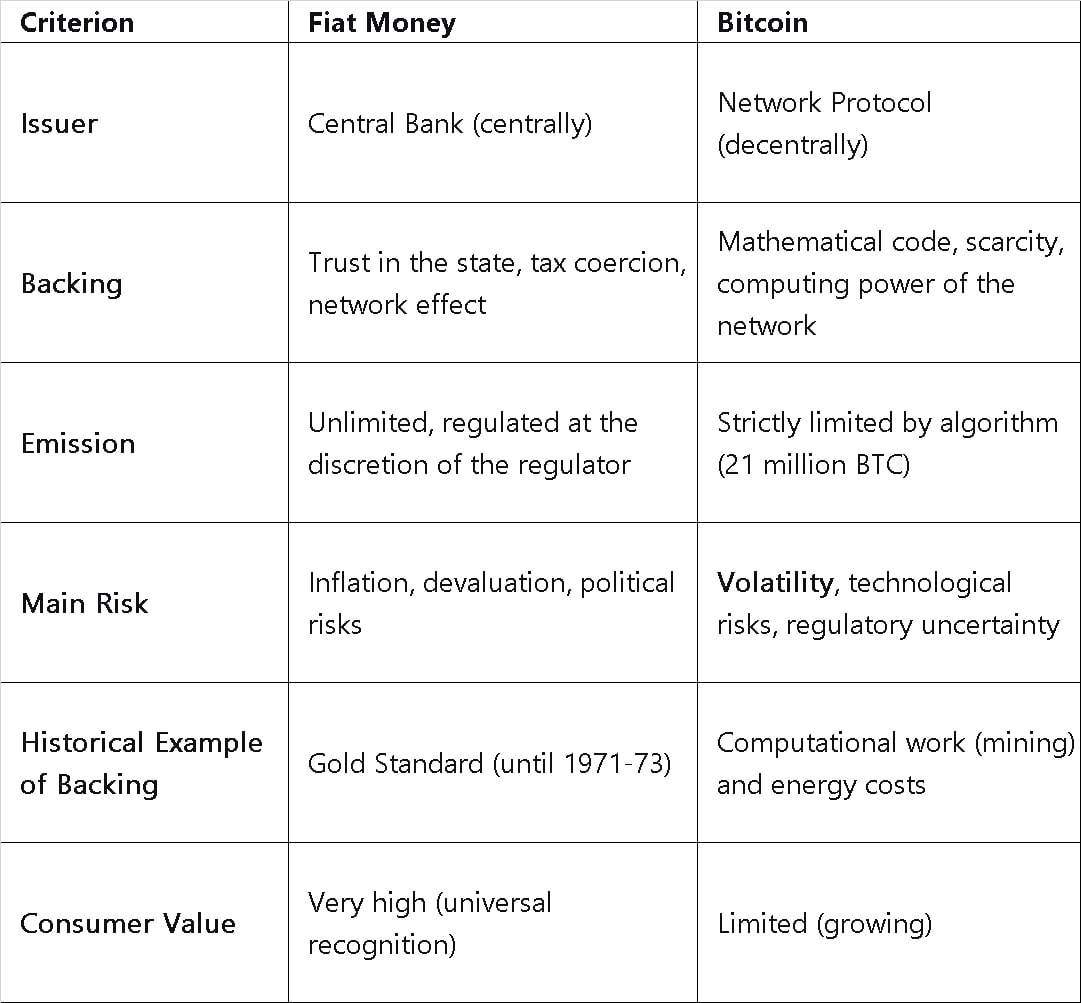


Bitcoin
$62,881.23

Ethereum
$1,672.04

Litecoin
$42.71

Dash
$37.08

Bitcoin Cash
$209.43