Africa — The New Player in the Hashrate Race: Mobile Money, Solar Energy, and the Crypto Revolution | SforNews
AFRICA — THE NEW PLAYER IN THE HASHRATE RACE: MOBILE MONEY, SOLAR ENERGY AND THE CRYPTO REVOLUTION
Diagnosis of the old model and its place in the new energy-digital system
INTRODUCTION: A BRIEF DIAGNOSIS
Africa is the most underestimated, yet one of the most strategically important players in the new energy-digital system. It is a continent that is simultaneously:
• A region with colossal energy potential — approximately 90% of hydropower in Sub-Saharan Africa remains unused [1][2]. The Congo, Nile and Zambezi rivers could power the entire continent. The Grand Ethiopian Renaissance Dam (GERD) — the largest in Africa by capacity — has become a symbol of the new energy order [1].
• A leader in crypto adoption growth — 54 million people in Africa use digital assets [9]. Crypto transaction growth in Sub-Saharan Africa increased by 52% year-over-year, reaching $205 billion in on-chain volume [9]. Africa is the only region where stablecoins demonstrate the highest level of penetration (9.3%) [9].
• A new player in the global hashrate race — Ethiopia ranks in the top 10 countries by hashrate with ~2.5% of the global total (~25 EH/s), trailing only the United States, Hong Kong and other parts of Asia [1]. West Africa — Nigeria with its flare gas and mining potential — is becoming the second major front [2][15].
• A region with a unique model of energy monetization — mini-grids, solar energy and Bitcoin mining as a “buyer of last resort” enable the conversion of unused energy into economic value [2][7].
The paradox of Africa: a continent with colossal energy potential and a growing digital economy remains fragmented. There is no unified strategy. There are individual countries that are either breaking through (Ethiopia, Nigeria, Kenya, South Africa), frozen in contradictions (banning mining despite colossal potential), or trying to enter the game on unfavorable terms [1][2][9][11].
SECTION 1. THE OLD MODEL: WHAT WAS, WHAT BROKE
The African economic model for decades rested on three pillars:
Export of raw materials — oil, gas, copper, gold, diamonds, cocoa, coffee [2].
Dependence on energy and technology imports — even with resources, processing and distribution remained weak [2][7].
Mobile money as the foundation of financial inclusion — M-Pesa and other platforms bypassed traditional banks, creating a unique “mobile” model [9].
This model works, but it is failing.
Energy exists — markets do not. 90% of hydropower in Sub-Saharan Africa is unused [1][2]. The Congo — the second largest hydropower potential in the world — cannot monetize it. Ethiopia is building GERD — Africa’s largest dam — but cannot fully utilize its capacity domestically [1].
Political instability and regulatory uncertainty. Ethiopia legalized mining in 2022 but suspended new permits in 2025 due to grid congestion [1]. The country doubled down on its crypto ban for citizens in July 2026, prohibiting not only cryptocurrencies but also “all digital representations of value that can be electronically exchanged, transferred or used for payment and investment purposes” [1]. At the same time, state-owned Ethiopian Electric Power allocated approximately 600 MW for mining and is earning from it — the contrast between official policy and actual practice is staggering [1][6].
The map (energy abundance, mobile money, growing crypto market) no longer reflects the territory (overloaded grids, political instability, uncoordinated regulatory environment, civilian ban alongside state mining) [1][6][9].
SECTION 2. ENERGY PROFILE: WHAT EXISTS, WHAT DOES NOT
Africa is a region with colossal energy potential, but its monetization is fragmented.
| What we have | What is missing |
|---|---|
| Hydropower (Congo, Nile, Zambezi — 90 % unused) [1][2] | A unified energy strategy |
| GERD — Africa’s largest dam (~5.15 GW) [1] | Sufficient transmission networks |
| Solar energy — one of the world’s highest insolation levels [2][7] | A stable regulatory environment in most countries |
| Flared gas (Nigeria — Africa’s largest reserves) [2][15] | Coordination between countries |
| Mini‑grids — 35 % cost reduction over 5 years [7] | A long‑term energy monetization strategy |
| Geothermal energy (East Africa) [2] | Sufficient local demand |
Key fact: Africa generates more clean energy than it can consume. Ethiopia uses surplus hydropower for mining, entering the top 10 countries by hashrate (~2.5% of global) [1]. Nigeria flares gas worth billions of dollars annually — mining could monetize this energy instead of wasting it [2][15].
New element: mini-grids + mining as a “buyer of last resort”.
Gridless has developed a model where mining acts as a flexible load for renewable mini-grids. When local demand is low, miners use surplus energy. When demand rises, mining scales back. This allows renewable energy projects to be financially sustainable from day one, without waiting for local consumption to “catch up” with production [2][7].
This is not “mining instead of people”. This is “mining until people are ready to use all the energy”. A model that could become a prototype for the entire continent [2][7].
Conclusion: Africa has colossal energy potential but cannot coordinate it. Countries that find a way to monetize surplus energy through mining and data centers will gain a strategic advantage. Those that ban mining despite potential will lose it [1][2].
SECTION 3. POSITION ON MINING AND CRYPTOCURRENCIES
Here lies — Africa’s central contradiction. Countries fall into three camps:
3.1. Breakthrough Leaders: Ethiopia and Nigeria
Ethiopia — the continent’s biggest success story. Using surplus hydropower from GERD and other dams, the country attracted international miners and entered the top 10 by hashrate with ~2.5% (~25 EH/s) [1]. State-owned Ethiopian Electric Power allocated approximately 600 MW for mining [1][6].
However, Ethiopia represents a case of deep contradiction: in July 2026, the National Bank of Ethiopia issued an official warning prohibiting not only cryptocurrencies but also “all digital representations of value that can be electronically exchanged, transferred or used for payment and investment purposes” [1]. The country has banned citizens from owning and using cryptocurrencies while actively mining them through state-owned energy capacity. This is a contrast that defies logic. Citizens cannot hold what their national grid produces [1][6].
At the same time, Binance restored platform access for Ethiopian users through state operator Ethio Telecom, citing successful regulatory engagement [1]. Behind the scenes, Ethiopian financial authorities are working with international partners to create a structured regulatory framework. The central bank’s public message remains unequivocal: “stay away” [1].
Nigeria — the second major front. With 25.9 million digital asset users (11.9% penetration), Nigeria ranks second globally in crypto adoption [9][15]. The country has colossal gas reserves that are flared. HashrateUp is developing a flare gas mining model — this could transform Nigeria from a leading oil exporter into Africa’s largest mining hub [2][15].
The Nigerian SEC has been granted authority to regulate digital assets under the Investments and Securities Act 2025, which officially recognizes digital assets as securities [9][15]. The Central Bank of Nigeria lifted restrictions on banks serving licensed crypto providers [9].
3.2. Countries with Evolving Regulation: South Africa and Kenya
South Africa — the leader in regulatory maturity. Since 2023, crypto assets have been classified as financial products; CASPs are required to obtain licenses from the FSCA. The FATF Travel Rule has been adopted, and a regulatory working group is developing policy on stablecoins and tokenization [9][14]. South Africa leads the continent in crypto penetration (10% of the population) [9][14].
Kenya — ranked in the top 30 of the global crypto adoption index (4th in Africa) [4][9][11]. In October 2025, the Virtual Asset Service Providers Bill was signed, with regulation shared between the Central Bank of Kenya and the Capital Markets Authority. The government is discussing new crypto mining regulations with Marathon Digital, viewing energy as a key factor [4][11].
3.3. Potential Players: Zambia, DRC, and Others
Zambia — an example of how mining can support mini-grids. At Zengamina (a hydroelectric plant built with $3 million in charitable donations in the 2000s), a mining container with 120 ASIC miners became a “buyer of last resort”, turning a loss-making station into a sustainable project [2][7].
DRC, Uganda, Ghana — rank in the top 50 of the global crypto adoption index [9][14]. The potential is enormous, but the regulatory environment is fragmented [9].
SECTION 4. CENTRAL BANK AND REGULATOR POSITIONS
Ethiopia (NBE) — a contrasting approach: a public warning against all “digital representations of value” alongside the allocation of 600 MW for state mining [1][6]. Citizens cannot own crypto. The state earns from it. Foreign miners operate [1].
Nigeria (CBN) — lifted restrictions on banks serving licensed crypto providers [9]. The SEC regulates the market [15]. Flare gas is a potential mining energy source, but requires forward-looking energy policy [2][15].
South Africa (FSCA) — the most developed regulation in Africa. Crypto assets = financial products. CASPs must obtain licenses. The FATF Travel Rule has been adopted. A regulatory working group is studying stablecoins and tokenization [9][14].
Kenya (CBK + CMA) — the VASP Bill has been signed, with regulation shared between the central bank and the capital markets regulator [4][11]. A national consultation on draft regulatory acts is underway for 2026 [4][11]. Active discussion of crypto mining with Marathon Digital [4][11].
SECTION 5. ARCHITECTURAL CONCLUSION: WHAT PATH IS AVAILABLE TO AFRICA
Africa is the only region that simultaneously:
Possesses colossal energy potential (90% of hydropower unused) [1][2].
Demonstrates one of the highest rates of crypto adoption growth (52% year-over-year, $205 billion on-chain volume) [9].
Has leading countries (Ethiopia — ~2.5% of global hashrate, Nigeria — 25.9 million users) [1][9].
Simultaneously has deep contradictions (Ethiopia — state mining alongside a civilian ban) [1][6].
The region’s weaknesses:
Regulatory fragmentation. No unified strategy. Each country acts alone. No coordination [1][2][9].
Political instability. Ethiopia suspended permits, banned citizen crypto ownership, yet continues mining [1][6]. Nigeria — a contrast between potential and a lack of political will [2][15].
Infrastructure constraints. Even with energy available, grids and distribution are weak [1][2]. Long connection queues. High transmission losses [1][2].
Tax uncertainty. In Ethiopia, industry estimates suggest the crypto sector operates in a “fiscal gray zone” — mining revenues flow abroad without local taxation [6].
CONCLUSION: HOW AFRICA FITS INTO THE GLOBAL TRANSITION
Africa is neither the architect of the new system nor its victim. Africa is a battlefield and a laboratory simultaneously.
Ethiopia demonstrates that a country can become a global player by utilizing unused energy — even with contradictory regulation [1][6].
Zambia and Gridless demonstrate that mining can become a “buyer of last resort” for mini-grids, turning loss-making renewable energy projects into sustainable ones [2][7].
Nigeria demonstrates that a market can be built on mobile money, and flare gas can become a source of cheap energy for mining [2][9][15].
South Africa and Kenya demonstrate that a regulatory environment can be built that attracts capital and institutional players [4][9][11][14].
Global significance: Africa is a microcosm of the global transition. Everything exists here: success (Ethiopia), failure (countries without strategy), potential (Nigeria, Kenya), and unique models (mini-grids + mining). The region shows that the new system will not be monolithic. It will consist of winners and losers — and victory will depend on the ability to monetize energy, not just on its availability [1][2][9].
The question is not whether Africa will use Bitcoin and data centers. The question is whether its countries can turn their energy potential into a real strategy — or whether they will remain suppliers of resources to those who do build that strategy.
COMPLETE LIST OF SOURCES
[1] CoinMarketCap — Ethiopia doubles down on its crypto ban while mining Bitcoin at scale (July 2026)
[2] Advanta IRA — Bitcoin Mining in Africa: Unlocking Stranded Energy (May 2026)
[3] Yahoo Finance — China’s mBridge Threatens SWIFT, XRP, XLM (June 2026)
[4] The Kenya Times — Kenya Ranked Among World’s Top 30 Crypto Markets (January 2026)
[5] Foresight News — Hong Kong vs Singapore Web3 regulatory approaches (June 2026)
[6] Addis Fortune — Digital Gold Rush Slips Through the Taxman’s Fingers (November 2025)
[7] Forbes Africa — Could Bitcoin Mining Power Rural Africa? (September 2025)
[8] Lexology — APAC digital asset regulation (March 2026)
[9] CoinMarketCap — Africa’s Crypto Adoption Jumps 52% (April 2026)
[10] AIBC — Asia’s next crypto hub: Hong Kong, Singapore, Japan (May 2026)
[11] HTX — Kenyan govt engages in crypto policy & Bitcoin mining (July 2026)
[12] KuCoin — Rise of Sovereign Green Energy: Africa (June 2026)
[13] Kiffmeister — Digital yuan redesign and mBridge (July 2026)
[14] Africa.com — Top 5 African Nations Leading in Crypto Adoption (February 2025)
[15] KuCoin — Nigeria: largest energy producer in Africa (June 2026)
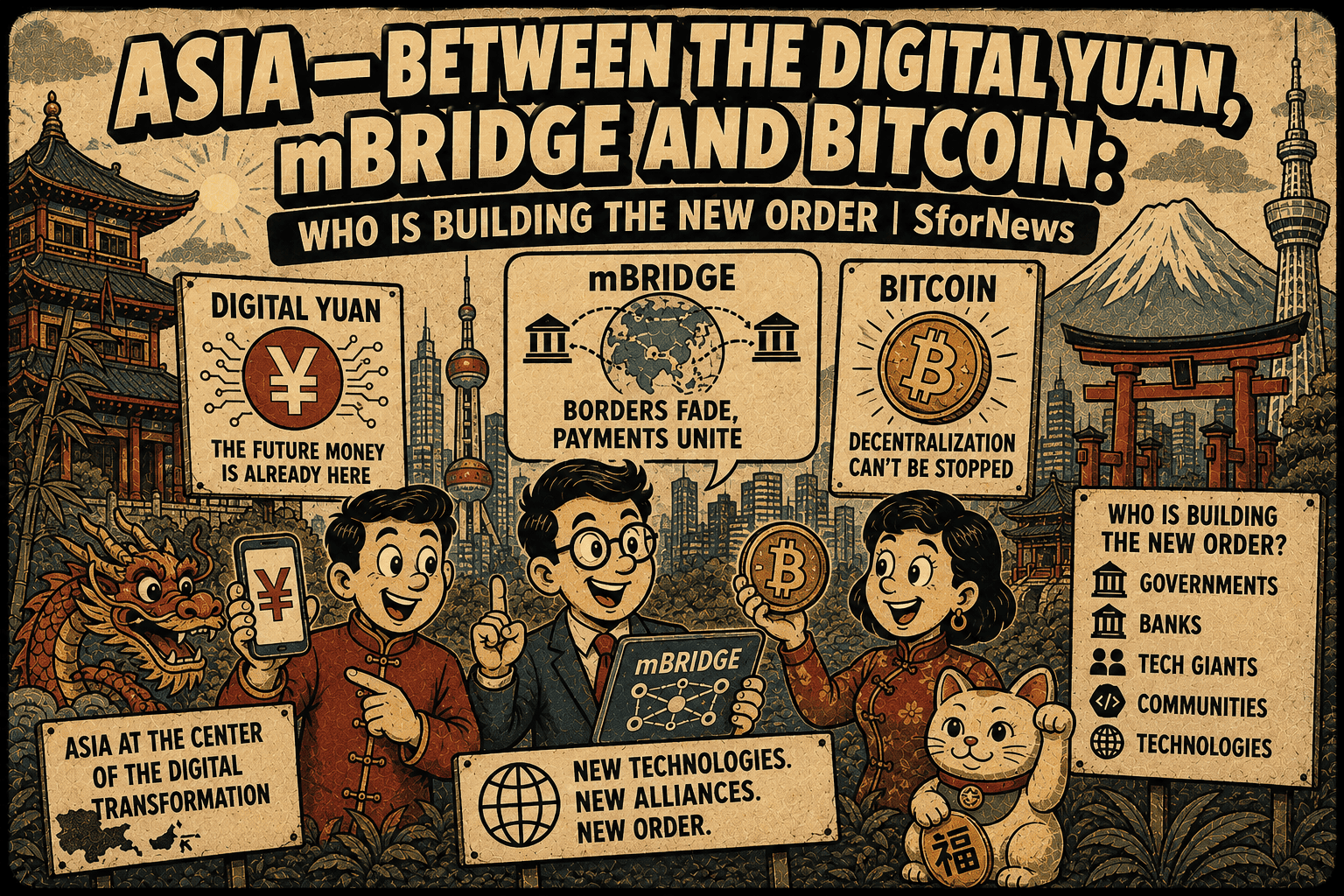
NEXT ARTICLE IN THE SERIES: “Asia — Between the Digital Yuan, mBridge and Bitcoin: Who is Building the New Order”
© 2026, Editorial Board of “Kafedra” and SforNews. Attribution required when citing.
🔗 MORE ANALYTICS AT SforNews (https://sfornews.com/)


Bitcoin
$62,881.23

Ethereum
$1,672.04

Litecoin
$42.71

Dash
$37.08

Bitcoin Cash
$209.43