Daily Summary, June 19
JUNE 19, 2026 – DAILY DIGEST
🌍 Geopolitics and Macroeconomics
🇮🇷 Iranian Memorandum Under Threat: Strait of Hormuz Back in Focus
On June 19, the official signing ceremony of the Iranian memorandum in Switzerland did not take place. Instead of traveling to Bürgenstock, Iran reimposed a blockade on the Strait of Hormuz, citing Israel’s refusal to withdraw troops from southern Lebanon and continued US military presence in the region. However, Iran’s Foreign Ministry denied reports of the closure, stating that the country’s armed forces had ensured the safe passage of vessels. US President Donald Trump clarified that the strait would be fully open to shipping. During the 60-day negotiation period, Iran will waive the planned fees for using the strait.
Analysis: The chaotic situation around Hormuz is a classic example of “managed chaos.” On the one hand, the memorandum is de jure in effect; on the other, Iran is demonstrating that it retains leverage. For markets, this means continued high volatility in oil prices. The negotiations have been postponed, and the 60-day timer is already ticking – whether the parties will reach a deal before time runs out remains an open question.🇮🇱 Israel and Hezbollah Reach Ceasefire Agreement
Israel and the Lebanese Shiite movement Hezbollah agreed to a ceasefire, which came into effect at 16:00 on June 19. The Israel Defense Forces will remain in the security zone in southern Lebanon. At the same time, an Israeli official stated: «If the enemy attacks, we will respond».
Analysis: This agreement is part of a broader Middle Eastern reset that began with the Iranian memorandum. Israel gains security guarantees on its northern borders, while Hezbollah gets a respite. However, the fragility of the truce is evident: any violation could return the region to a state of war.🇪🇺 EU Summit Adopts Unanimous Statement on Ukraine
For the first time since 2023, the EU summit was able to adopt a unanimous statement on Ukraine. This came amid German Chancellor Merz’s statements about a “first chance for peace” between Russia and Ukraine (as we noted in previous digests).
Analysis: EU unanimity is a rare phenomenon in recent years. This may mean that Brussels is consolidating its position ahead of possible negotiations. However, as we have noted, the peace process is likely to be driven by economics rather than politics – Europe is suffocating without cheap gas, and Russia’s budget problems are growing.🇷🇺 Russia
🏦 Bank of Russia Cuts Key Rate to 14.25%
The Board of Directors of the Bank of Russia decided to cut the key rate by 25 basis points to 14.25% per annum. This is the ninth consecutive review of the indicator. The head of the Central Bank stated that the board considered three options: keeping the rate at 14.5%, cutting to 14.25%, or to 14%. The minimum 25 basis point step became a compromise between the wishes of business and the government, on the one hand, and new risks that prevented the Central Bank from making a more decisive cut, on the other.
Analysis: A 0.25% rate cut is a signal, but not a panacea. Business demanded a 1 p.p. cut, but the regulator showed conservatism amid inflationary risks (5.62% year-on-year) and uncertainty in the oil market. As we noted yesterday, fundamental problems (oil, sanctions, attacks on refineries) remain, and the rate cut will not solve them.🇷🇺 Bank of Russia Plans to Add Commercial Smart Contract Platform to Digital Ruble
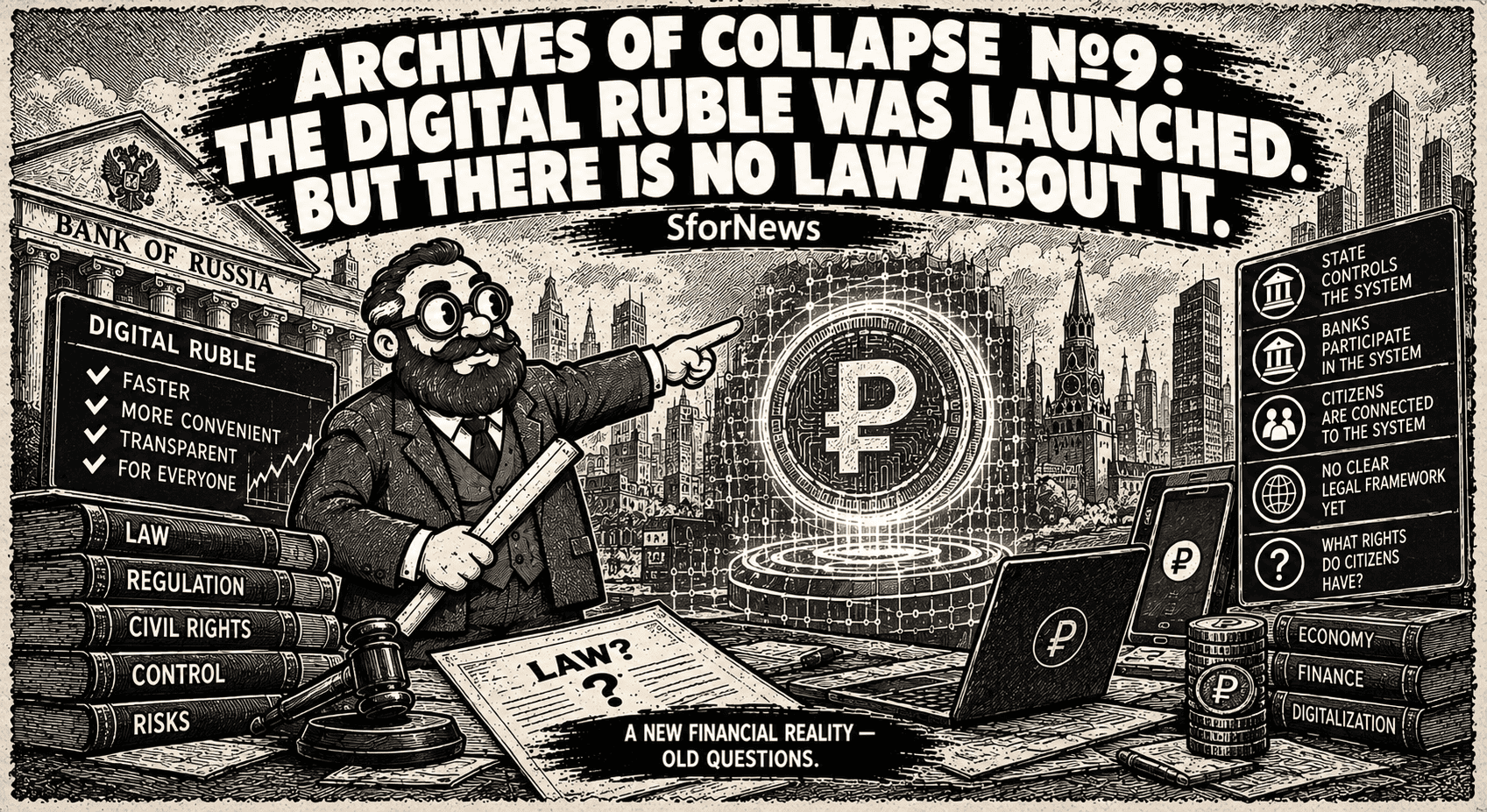
The Central Bank intends to add a commercial smart contract platform to the digital ruble (CBDC). Businesses will be able to launch automated transaction scenarios without manual control.
Analysis: The digital ruble is ceasing to be just “digital cash” and is turning into a full-fledged environment for automating business processes. This is an important step towards a programmable economy where transactions and contracts are executed automatically. In the context of sanctions pressure and restricted access to Western platforms, this is an attempt to create its own “digital circuit.”📉 Russian Stock Market Reverses Lower After Central Bank Decision
The Russian stock market opened with a 0.2% rise in the MOEX and RTS indices, but by mid‑day the sentiment had turned completely negative. At the end of the main trading session, the MOEX Index fell by 1.04% to 2,415.8 points, while the dollar-denominated RTS Index dropped by 1.15% to 1,036.2 points. The leaders of growth were PIK shares (+10.7%), which may be related to the completion of index rebalancing, as well as MCB (+4%) and Yuzhuralzoloto (+2.8%).
Analysis: The market is voting against the Russian economy. Despite morning optimism, investors perceived the Central Bank’s decision as insufficiently decisive. Pressure is being exerted by falling oil prices, accelerating inflation, and geopolitical uncertainty. The Moscow Exchange continues to update its lows.🛢 Oil: Brent at $78–80, Urals at $64–66
As of June 19, Brent crude was at $78.34 per barrel, WTI at $75.17, and Urals at $64.54. During trading, Brent rose to $80.26 (+0.51%), while Urals climbed to $66.86 (+1.23%). Experts expect Brent to remain in the $72–85 range for the rest of the year, and Urals in the $60–75 range. At the same time, Urals prices are still above the budgeted level of $59 per barrel. Falling oil prices will keep additional budget revenues at the level of 800 billion – 1 trillion rubles.
Analysis: Oil is trying to stabilise after a 30% decline over the month. However, the situation around the Strait of Hormuz remains uncertain, creating risks of further declines. As we noted yesterday, if OPEC+ collapses, prices could fall to $30 per barrel. For now, additional budget revenues are being supported by the base effect, but if prices settle below $70, a deficit will become inevitable.🇷🇺 Lavrov Warns of Risk of Direct NATO-Russia Clash
Russian Foreign Minister Sergey Lavrov warned about the risks of a direct NATO-Russia clash. The statement came amid the escalating situation in the Middle East and the Pentagon’s review of force deployment in Europe.
Analysis: This continues the line of escalating rhetoric that we have observed in recent weeks. As we have discussed in our research, the old system of security guarantees no longer works, and the parties are moving to the language of force. Lavrov’s warning is a signal to the West that Russia is ready for tough confrontation.💻 Technology and AI
🤖 Claude Opus 4.7 Advances in Robotics – AI Connects to Robot Autonomously
The new version of Claude Opus 4.7 independently connected to a robot, figured out cameras and sensors, wrote code, and performed tasks with almost no human assistance.
Analysis: AI agents are moving from generating text to controlling physical objects. This is the next stage in the development of autonomous systems – AI not only advises but also acts. In the future, this means fully autonomous production, logistics, and even combat systems. This is exactly what we discussed in the context of Musk and his integration of xAI with the Pentagon.🖥 OpenAI Adds Record & Replay Function to Codex for macOS
OpenAI added the Record & Replay function to Codex for macOS – now you can show the neural network a single action on a Mac, and it will remember the process and turn it into a ready‑made automation.
Analysis: Automation of routine tasks on computers is becoming available to ordinary users. This is a step towards AI performing the work of office workers, analysts, and even programmers. The question is: where will the people whose jobs are automated go?₿ Blockchain and Cryptocurrencies
📉 Bitcoin Falls Below $63,000 on ETF Outflows and Hawkish Fed Rhetoric
Bitcoin broke through the $63,600–$63,800 support zone under pressure from ETF outflows and a rising fear index. The price fell to $62,943–$62,608. Over 24 hours, $304 million in positions were liquidated, of which $259 million were long positions. VanEck Bitcoin ETF recorded an outflow of $4.4 million. According to JPMorgan, the cost of mining Bitcoin is currently around $78,000, meaning that a significant portion of miners are operating at a loss. At the same time, there is no sign of massive capitulation in Bitcoin – losses across different groups of players are still too moderate compared to previous bottoming periods.
Analysis: Bitcoin continues to decline amid hawkish Fed rhetoric and ETF outflows. As we discussed in our research, the current drop is not a collapse but a redistribution phase: whales are accumulating Bitcoin on dips, while retail investors are taking losses. The $62,000 level is becoming a new accumulation zone for institutional investors. However, the lack of capitulation suggests that the bottom has not yet been reached – in previous cycles, panic selling was more massive.🪙 Ethereum and Ecosystem: Former Ethereum Foundation Developer Warns of Financial Crisis
A former Ethereum Foundation developer warned that the ecosystem is facing a financial crisis in 3–9 months.
Analysis: Even if warnings about a crisis are coming from inside the Ethereum Foundation, this is a serious signal. A lack of development funding, falling validator revenues, and the overall market cooling could slow down network development. This creates risks for the entire DeFi ecosystem built on Ethereum.🪒 SpaceX Adds Asteroid Plush Toy to Its Store – Meme Coins “Take Off”
SpaceX added an Asteroid plush toy to its store, and, following the old tradition of Elon Musk, meme coins with the same name immediately “took off”.
Analysis: Musk continues to play his game: one action from him – and meme tokens surge. This is further confirmation of his ability to move markets through his personal brand. However, as we have discussed, this does not create real value but rather represents the utilisation of fiat through speculation.🏛 Companies and Regulation
🇺🇸 Illinois to Introduce 0.2% Crypto Transaction Tax from 2027
The Governor of Illinois signed a law that will introduce a 0.2% tax on crypto transactions from 2027 and tighten registration requirements for crypto brokers.
Analysis: State-level regulation of cryptocurrencies is increasing. Illinois is following the general trend – cryptocurrencies are being equated with traditional financial assets with corresponding taxes and reporting requirements. For users, this means less anonymity and higher costs.🇪🇺 EU to Limit Cash Payments to €10,000 from 2027
From July 10, 2027, the EU will limit cash payments for goods and services to €10,000. Rules for crypto services will also be tightened – for single transactions over €1,000, they will be required to conduct a full client check.
Analysis: Europe continues its move towards total control over financial flows. Restricting cash and tightening KYC for crypto operations are parts of the same process: creating a “digital circuit” where every transaction is transparent and controllable. This directly aligns with our thesis that the old world is collapsing and a new one is being built on principles of total traceability.🇸🇪 Sweden Launches SEKAU Stablecoin Pegged to the Krona
Sweden is launching its own stablecoin SEKAU, pegged to the Swedish krona and issued under the rules of the European MiCA crypto regulation.
Analysis: European countries are creating their own “digital circuits” at the stablecoin level. SEKAU is a response to USDC’s dominance and an attempt to maintain monetary sovereignty in the digital age. For users, this means more choice, but also more market fragmentation.🏦 Moscow Exchange Begins Trading New BIF “Aton – Moscow Exchange Index”
On June 19, the Moscow Exchange began trading shares of the exchange-traded mutual fund “Aton – Moscow Exchange Index” managed by UK “Aton-management” (ticker AMIX).
Analysis: A new instrument for Russian investors allowing passive investment in the Moscow Exchange Index. However, in a falling market with high volatility, the attractiveness of such instruments remains in question.🗣 Statements
💬 “Trump Must Choose Between an Impossible Military Operation and a Bad Deal”
Recall that on May 3, 2026, the Islamic Revolutionary Guard Corps (IRGC) offered the US President a choice between an agreement with Iran on terms unfavourable to Washington and a military operation that would be impossible to carry out. This thesis remains relevant today, against the backdrop of the failed signing ceremony in Switzerland.
Analysis: Iran continues to play ahead, using the tactic of “managed chaos.” Trump finds himself in a trap of his own diplomacy: the deal does not satisfy his hardline base, but a military operation in Iran risks being drawn into a protracted conflict. The Iranian side understands this and continues to press.🏛 Architectural Conclusion (End of Day, June 19)
Receptive Intelligence recorded: the Iranian memorandum is under threat, the Strait of Hormuz remains a point of tension, oil is trying to stabilise around $78–80, and the Russian market reversed downward after the Central Bank decision. Israel and Hezbollah agreed on a ceasefire, and the EU, for the first time in a long while, adopted a unanimous statement on Ukraine.
Coordinative Intelligence is working in multiple directions: Iran is using Hormuz as leverage against the US; Israel is concluding a separate ceasefire with Hezbollah, weakening the “axis of resistance”; the EU is consolidating its position on Ukraine; Russia is warning about the risks of a clash with NATO.
Structuring Intelligence is moving ahead: the Central Bank cut the rate by a minimum step, preserving room for manoeuvre; a new exchange-traded fund gives Russian investors a new tool; Bitcoin continues to fall, creating an accumulation zone for major players; Illinois and the EU are tightening cryptocurrency regulation; Sweden is launching its own stablecoin.
Executive Intelligence is already at work: investors are pulling capital from the Russian market; the crypto market has entered a fear phase; institutions are accumulating Bitcoin on dips; miners are operating at a loss; AI agents are beginning to control robots and automate workflows.
📅 What’s Next (June 20–30)
June 20: Expiry of the temporary suspension of sanctions on Russian oil (may be extended to end of July).
June 23: US inflation data for May – key signal for the Fed.
June 25: SEC may approve options on Ethereum ETFs – a catalyst for ETH.
June 30: Iranian presidential elections could affect the deal’s implementation.
July 1: MiCA takes effect in the EU, effectively banning USDT, and new crypto regulations come into force in Russia.
💡 Key Advice for the Next Two Weeks
Keep 20–30% of your portfolio in cash / short-term bonds. The Iran truce is fragile, oil is volatile, and the Russian market continues to hit new lows.
In crypto – the risk zone is $62,000–63,000 for BTC. ETF outflows and a hawkish Fed are weighing on the market. A break below $62,000 could open the way to $58,000–60,000. Accumulate only on strong dips.
Switch from USDT to USDC or EURC if you work with European counterparties. After July 1, USDT trading in the EU will be restricted.
Monitor the situation around the Strait of Hormuz. Any escalation could crash oil, while any de-escalation could temporarily stabilise markets.
Be prepared for volatility. The Middle East conflict, sanctions pressure, and domestic economic problems create risks for all asset classes.
Pay attention to tightening regulation in the US and EU. Taxes on crypto transactions and cash restrictions are long-term trends that change the rules of the game.
The digest is based on open sources and Telegram channel data. The analysis is for informational purposes only and does not constitute investment advice.


Bitcoin
$62,881.23

Ethereum
$1,672.04

Litecoin
$42.71

Dash
$37.08

Bitcoin Cash
$209.43