ARCHIVES OF COLLAPSE No. 10: Who Pays for Gas. Why Europe Is Freezing While the Bill Is Sent to Russia — and What the State Acts Say About It
ARCHIVES OF COLLAPSE
Issue No. 10
“Who Pays for Gas: How State Acts Explain Why Europe Is Freezing While the Bills Are Sent to Russia”
Author: Arkady Belov, specifically for SFOR NEWS
1. THE HOOK: What Happened?
At the beginning of 2026, the European Union finally formalized its rejection of Russian pipeline gas. Energy prices in Europe have risen again. The authorities of Germany and France are discussing subsidies for industry. Russia declares that it will redirect supplies to Asia.
It seems like a routine news story: geopolitics, sanctions, market reorientation. But in the closed archives of the USSR Academy of Sciences, this story is interpreted differently — as the final stage of the execution of the 3T (Trilenium) Agreement of 1915, according to which all the royal families of Europe transferred their gold to an international trust. And now this trust has reached its term.
2. THE DOSSIER: What Does the “State Act” Say?
In the State Act of the USSR for June 2026 (No. 002.810.643.89), there is a direct indication of the nature of the European energy crisis:
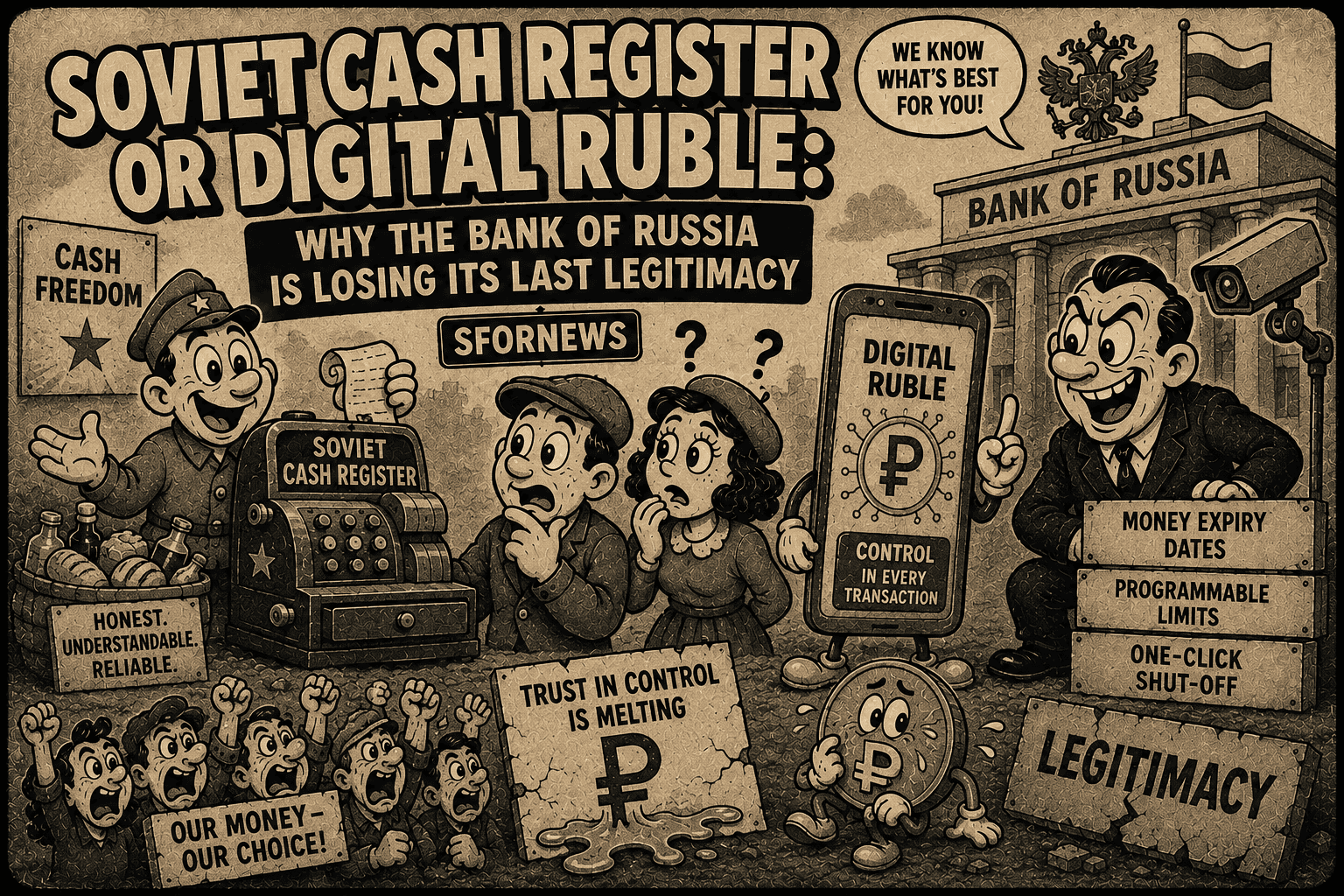
“…the basic instruments of the Bank of Russia (Referential instruments) as common/ordinary convertible shares ISIN RU000A0G9HE0… are replaced and exchanged for municipal bonds of the Subjects of the Federation, and the banknotes and notes of the Bank of Russia… are exchanged and replaced by local signs as ‘digital rubles,’ as camp money for colonies, factories, and plantations” [State Act for June 2026, § 5].
That is, the ruble is no longer money. It is a share of a non-existent company. And therefore, all contracts denominated in rubles are contracts in shares.
In the same act, there is a key phrase about who actually pays for gas:
“…under which the digital currency of the Bank of Russia is issued, having no real values, coverage, or security, and is used as an instrument of control, not having the status of means of payment, except as a souvenir or state token” [State Act for June 2026, § 5].
What this means in human language:
Europe pays for gas not with money, but with obligations. It receives the gas, but its “payment” is a transfer of debt from one balance sheet to another. The gas arrives physically, but the money does not arrive. Instead of money — paper records. And this means that Europe is not paying. The one who stands behind these records is paying.
3. DECODING: Who Actually Pays
Step 1: Europe is not a payer, but a transit point
In the State Act for January 2026 (No. 002.810.643.83), it is stated:
“…in 1915, the 3T (Trilenium) Agreement was executed from 1915 for 99 years, when the Russian Emperor confirmed the transfer to him from the Roman Throne and the British Crown of the exclusive rights of the Beneficiary and the Founder to the Testamentary Trust of the Roman Pontiff of 1481…” [State Act for January 2026, § 31].
This means that all European assets (including gas infrastructure, accounts, contracts) are pledged to this trust. Europe does not own its gas companies. It manages them by proxy.
When Europe “pays” Russia for gas, it does not pay. It transfers the debt from one account to another. And this debt is not its own. It is already pledged. It belongs to the trust.
Step 2: Russia is not a recipient, but a cashier
In the State Act for March 2026 (No. 002.810.643.85), there is a phrase that explains Russia’s role:
“The Russian Federation, the Guarantor of the Constitution of the Russian Federation, and the Bank of Russia will not recognize the requirements and obligations to the USSR as rights, incomes, annuities, and rights of claim of the USSR and Citizens of the USSR to the Russian Federation…” [State Act for March 2026, § 10].
This means that Russia has refused the rights of a creditor. It does not demand the debt from Europe. It accepts payment, but does not recognize it as its own. It puts it in the “ship’s cash box” — as prize property.
That is, Russia is not the recipient of money. It is a cashier who accepts valuables and puts them in a safe. But the safe is not its own. The safe belongs to the trust.
Step 3: The payer is the trust
Who actually pays for gas? The answer is in the State Act for January 2026:
“…all assets and holdings of the Crown of Maharlika from 1543, all incomes and annuities from parallel and auxiliary trusts, the transfer of the entire gold pool in the amount of 1.77 million metric tons and accumulated interest income for 2016 in the amount of 2,420,937.4 kg of gold of 99.99% purity and its value” [State Act for January 2026, § 29].
The payer is the gold pool. This is physical gold that lies in 11 banks and in 486 accounts. It does not belong to Europe or Russia. It belongs to the trust. And it is paid out as obligations are fulfilled.
When Europe “pays” for gas, it does not pay. It activates a payment from this pool. The gas is already paid for. It is paid for with gold that lies in the safe.
Step 4: Who suffers
Who suffers from the rise in prices? The answer is in the State Act for January 2026:
“…Citizens of the USSR, as direct descendants of the subjects of the Russian Empire… are subject to international registration as ‘Dead’…” [State Act for January 2026, § 47].
It is not Europeans or Russians who suffer. It is the “dead” — those who are registered as “dead” in the registries. These are all citizens who have not confirmed their status as Living. They pay on accounts that are issued to their “dead” persons.
When Europe raises gas prices, it does not raise them for the living. It raises them for the “dead”. And the “dead” cannot refuse. They have no rights. They have no voice. They pay — because it is written in the registry.
4. WHO WINS? The Logic of the State Act in Reality
| Side | Role according to the Gosakt |
|---|---|
| Europe | Transit country. Doesn’t pay, but transfers debt from one balance to another. |
| Russia | Cashier. Accepts payment but doesn’t recognize it as its own. |
| Trust | Payer. Pays for gas from the gold pool. |
| The “Dead” | Pay the bills. Have no rights. Have no voice. |
5. FORECAST: What’s Next According to the Archives
Gas prices will rise. Not because there is little gas, but because there are more “dead”. The more “dead”, the more accounts, the higher the prices.
Europe will look for “alternatives.” But there are no alternatives. There are only different forms of the same trust.
Russia will “redirect” supplies. But there is nothing to redirect. The gas is already paid for. It is already in transit. It already belongs to the trust.
The “living” will begin to wake up. When they understand that they are paying for the “dead”, they will demand a revision of the registries.
6. CONCLUSION: A Question for the Reader
Europe is freezing. Russia is “redirecting” gas. Prices are rising. Bills are being issued.
But who is actually paying? And why is this bill not for you?
If gas is already paid for with gold from the trust, then what are you paying for every month? Your “dead” person? Or the permission to be considered alive?
Author: Arkady Belov
Specifically for SFOR NEWS
Materials from the State Acts of the USSR for January, March, and June 2026 were used (No. 002.810.643.83, 002.810.643.85, 002.810.643.89).


Bitcoin
$62,881.23

Ethereum
$1,672.04

Litecoin
$42.71

Dash
$37.08

Bitcoin Cash
$209.43