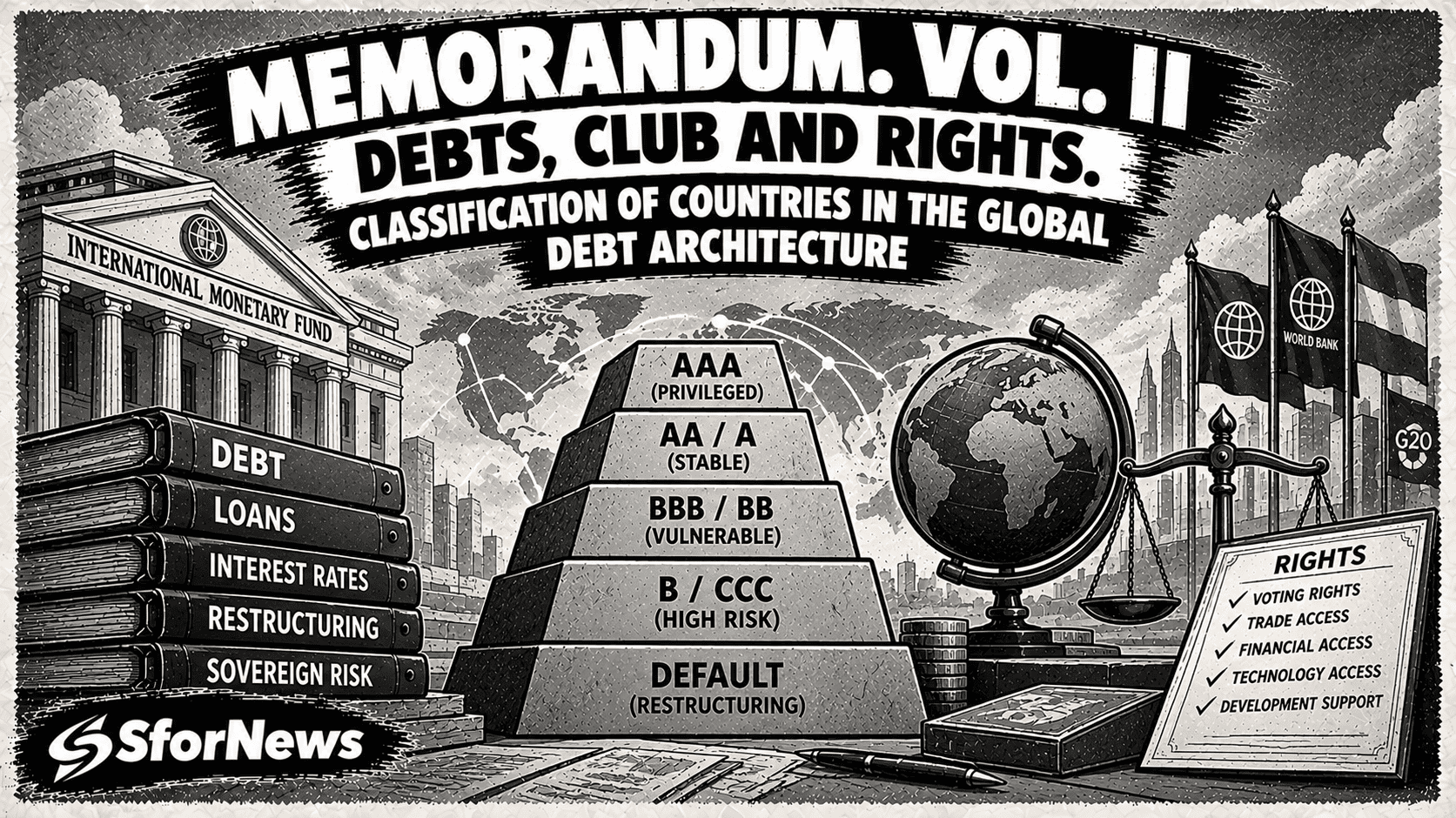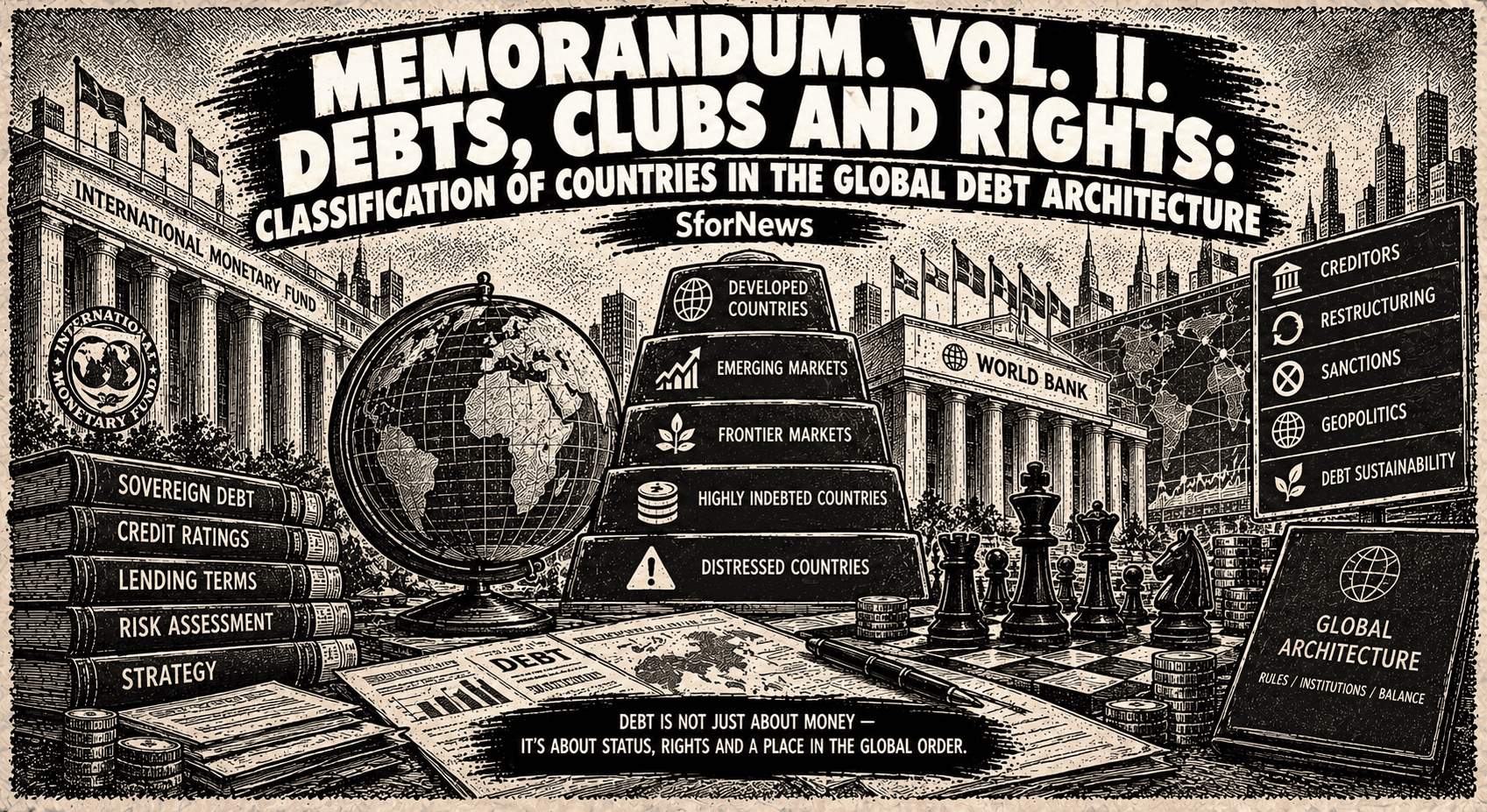
Memorandum. Volume II. Part 2: The Club — Who Is Inside, Who Is Outside. Classification of Countries in the Global Debt Architecture
MEMORANDUM. VOLUME II
DEBT, THE CLUB AND RIGHTS: CLASSIFYING COUNTRIES WITHIN THE GLOBAL DEBT ARCHITECTURE
DISCLAIMER
This document is a conceptual project prepared on the basis of open data, public statements and analytical materials. This memorandum is not a legal document, investment recommendation or call to action. All conclusions are probabilistic and analytical in nature.
The boundary between the volumes.
Volume I describes the physical architecture: energy as a common public resource, Bitcoin as an energy derivative, and the NES as a distribution mechanism. Volume I answers the question: what is the resource?
Volume II describes the financial architecture: what debt is, who is inside the club, who is outside it, and what this means for sovereignty. Volume II answers the question: how is this resource extracted, and how can an alternative be built?
The elements described in Volume I (the NES, Bitcoin as a derivative, and the physical chain “energy → mining → pool → citizens”) are not duplicated in this volume; they are referenced instead.
This volume is addressed to all countries. Debt is not only about economics. It is about power: who has the right to extract, and who is obliged to pay.
Russia is the flagship in this volume, but it is not the only player. The world is already building a new system: China, the UAE, Oman, Kazakhstan, Paraguay and Ethiopia. Russia either joins them as an architect—or remains a resource supplier for those doing the building.
PART 2. THE CLUB: WHO IS INSIDE, WHO IS OUTSIDE
2.1. Three categories of countries
Category 1: The Club (inside, but with unequal rights)
The United States are inside, but they are not bound by the rules. They are the captain. They make the rules. And they can waive them for themselves. That is a privilege. It is not an “accident.” It is the architecture.
Europe is inside, but it must obey. It is a passenger. It pays. But it cannot change the rules. That is a trap. It is not an “accident.” It is the architecture.
Japan is inside, but trapped by debt at 204% of GDP. It is a hostage. It holds US debt. And it cannot leave. That is a trap. It is not an “accident.” It is the architecture.
Russia is inside, but has no voice. It is cargo. It pays. But it cannot change the rules. And it cannot leave. That is a trap. It is not an “accident.” It is the architecture.
Category 2: The Club’s Periphery (outside, but with access)
These are countries that play by the club’s rules. But they cannot change them. And they cannot leave, because they are part of the system—but not part of the club. They are on the boundary. They pay. They wait. They hope that one day they will become club members. But that will not happen, because the architecture does not provide for upward mobility. It provides only for downward movement—or stagnation.
China is building a parallel system. It is an architect. It does not play by the club’s rules. It creates its own. This is not “rebellion.” It is strategy.
India is an observer. It is a passenger. It pays. But it cannot change the rules. And for now, that is its choice.
Brazil is an experimenter. It is a passenger. It pays. But it cannot change the rules. And that is its choice. It experiments. It waits. It hopes.
The UAE and Saudi Arabia are builders. They are architects. They do not play by the club’s rules. They create their own.
Category 3: Outside the Club (debtors without rights)
These are the countries that pay for everything. Those that cannot refinance. Those that have no access to the “gates.” They are cargo. They pay for the club’s architecture. And they are not “victims.” They are part of the architecture—an architecture in which some are at the top and others at the bottom.
Argentina — defaults (nine times since 1827). It has resources: Patagonia’s wind and lithium. Why does it not use them? Because there is no strategy. Because of political instability. Because of the debt trap.
Sri Lanka — defaulted in 2022. It has geography: the Indian Ocean. Why does it not use it? Because there is no strategy. Because there is no capital. Because of the debt trap.
Zambia — defaulted in 2020. It has copper and hydropower. Why does it not use them? Because there is no strategy. Because there is no capital. Because of the debt trap.
Ghana — defaulted in 2022. It has gold and oil. Why does it not use them? Because there is no strategy. Because there is no capital. Because of the debt trap.
Ethiopia — defaulted in 2023. But it has 600 MW allocated to mining. It is already among the top ten by hashrate (2.5%). This is an example of breaking out—the only example of a country leaving Category 3.
2.2. Category 1: The Club—those who make the rules
This is the core of the system. It contains those who determine the architecture. But even within the club, there is a clear hierarchy. It determines who pays and who receives; who makes the rules and who is forced to obey them; who is the captain and who is the passenger.
The United States: not merely a “club member,” but the country that created the club
US debt stands at $40.25 trillion—the largest in the world [1]. But this is not a sign of weakness. It is a privilege, because US debt is denominated in dollars, and the Federal Reserve can issue dollars. This means the United States cannot go bankrupt in its own currency. It can only devalue it.
But this is not merely an “economic privilege.” It is an architectural privilege. The dollar is the world’s reserve currency. The whole world is obliged to hold US debt because there is no alternative. The whole world is obliged to trade in dollars because otherwise it cannot trade. The whole world is obliged to hold dollar reserves because otherwise it cannot protect its currency.
This is hegemony. This is an architecture of power. The United States is not merely a “debtor.” It is the captain—the one who makes the rules and can waive them for itself. That is what happened with Basel III. The United States exempted itself from the rules because it is the captain. The others are passengers—or cargo.
A historical excursion. After World War II, the United States created the Bretton Woods system. The dollar was pegged to gold, and other currencies were pegged to the dollar. In 1971, Nixon detached the dollar from gold, and the system collapsed. But the United States did not collapse, because it created a new architecture: the petrodollar. Oil was sold only for dollars, and the world had to buy dollars in order to buy oil. This architecture still works today, because oil is energy, and energy is life. As long as the world needs energy, it needs dollars.
Europe: the passenger who pays for the ticket but cannot change the route
France’s debt is $4.3 trillion. Germany’s is $3.5 trillion. Italy’s is $3.8 trillion. These are enormous debts. But they are not a “problem,” because they are denominated in euros, and the European Central Bank can issue euros. Europe cannot go bankrupt in its own currency. It can only devalue it.
But Europe is caught between the need to comply with Basel and the inability to compete with American banks that do not comply. This is not a “level playing field.” It is a race to the bottom. It is a trap. And Europe is not the captain in it. Europe is a passenger who pays for the ticket but cannot change the route. It cannot get off, because this is the only ship. And the ship is sailing—nowhere.
A historical excursion. Europe created the euro to compete with the dollar. That was an architectural project. But the euro did not become a reserve currency, because Europe has no unified government, no unified army, no unified energy system and no unified strategy. The euro is a currency without a state. And a currency without a state is not architecture. It is an illusion. When a crisis begins, the illusion collapses.
Japan: the hostage holding someone else’s debt, unable to leave
Japan’s debt stands at 204% of GDP—the world’s largest relative to the size of its economy [3]. But Japan does not go bankrupt, because its debt is denominated in yen, and Japan can issue yen.
But Japan is not merely a “debtor.” It is the largest foreign creditor of the United States. It holds $1.07 trillion in US debt [6]. This is a paradox: Japan is both debtor and creditor. It is as if you owed a million but had a million in another bank. You cannot repay the debt. And you cannot withdraw the deposit, because you are part of the system—and the system does not let you leave.
Japan is a hostage. It holds US debt because it has no other choice. Its economy is tied to the American market and to US security. It cannot leave. It can only hold, wait and hope that the system does not collapse. But the system is collapsing. And Japan is collapsing with it. This is not a “tragedy.” It is the price of being a hostage.
Why Japan cannot leave: the mechanics of carry trade and YCC. Japan keeps its interest rate near zero (Yield Curve Control, YCC). This allows investors to borrow yen at low rates and invest in assets with higher yields (carry trade). If Japan raises rates, the carry trade will collapse, the yen will strengthen, exports will suffer, and servicing the debt (204% of GDP) will become more expensive. Therefore, Japan cannot escape this trap. It can only keep rates low and hope that the system does not collapse.
A historical excursion. After World War II, Japan was occupied by the United States, which shaped the Japanese economy. The US gave Japan access to the American market and provided security. In exchange, Japan became part of the American architecture. It became a holder of US debt. It became an ally. It became a hostage.
Russia: cargo excluded from the operating system
Russia is inside the club. But it is not the captain. It is cargo. It participates in developing standards but cannot block them. It pays according to rules it did not create. And it cannot leave, because it is part of the system—but not part of the club.
Since 2022, Russia has been cut off from SWIFT and from most international settlements. It has been excluded from the club’s operating system. Formally, it remains a member of the BCBS. But this is a formality, because it cannot influence the rules. It cannot postpone the implementation of standards. It cannot use the club’s privileges.
Russia is cargo. It pays. But it receives nothing. It is in the club. But it cannot enter. It is part of the system. But not part of the club. And this is not a “mistake.” It is architecture—an architecture in which some make the rules while others pay for them and cannot leave. There is no exit. There is only an entrance. And it is closed.
A historical excursion. Russia tried to become part of the club. In the 1990s, it joined the G7. It became part of the global financial system. It gained access to credit, technology and markets. But it did not gain access to the rules, because others wrote them. And when Russia tried to change the rules, it was excluded. It remained in the club—but without a voice and without an exit.
2.3. Category 2: The Club’s Periphery—those on the boundary
These are countries that play by the club’s rules but cannot change them or leave. They are part of the system, but not part of the club. They are on the boundary. They pay. They wait. They hope that one day they will become members. But that will not happen, because the architecture does not provide for upward mobility.
China: the architect building a parallel system
China’s debt stands at $22.3 trillion—the second-largest in the world [1]. But this is not a “problem,” because China controls its currency. It controls its economy. And it is building its own system.
China is developing e-CNY and mBridge. It has been buying gold for 22 consecutive months [8]. It is reducing the share of US debt in its reserves [7]. This is not an “accident.” It is strategy. It is architecture. China is not “fighting” the dollar. It is creating an alternative and waiting for the dollar to dig its own grave.
Why China does not dump Treasuries: the mechanics of reserves. China holds about $3.2 trillion in foreign-exchange reserves, of which approximately $0.6 trillion is in Treasuries. If China dumped all its Treasuries at once, their value would collapse, and China would incur losses on its own reserves. Therefore, it is gradually reducing its share, diversifying into gold and other assets. This is not “weakness.” It is strategy.
China is not “cargo.” It is the captain of its own ship. And it is sailing into the future. The old ship is sinking, and those aboard it are sinking with it. This is not a “tragedy.” It is architecture.
A historical excursion. China was not always an architect. In the 1990s, it was part of the periphery. It sold goods for dollars and bought US Treasuries. It was part of the American architecture. But in the 2010s, it began building its own. It created e-CNY and mBridge. It began buying gold. It began reducing the share of US debt in its reserves.
India: the observer who pays and waits
India’s debt stands at $3.5 trillion. Its debt-to-GDP ratio is about 80%. This is moderate debt. But India is not the “captain.” It is a passenger. It pays. But it cannot change the route or get off, because this is the only ship. And it is sailing—nowhere.
India is developing UPI and e-Rupee. But it is not building a parallel system. It observes. It waits. It hopes the old ship will not sink. But it is sinking. And India is sinking with it. This is not a “tragedy.” It is India’s choice—for now.
A historical excursion. India has always been part of the periphery. It was a British colony. After independence, it tried to build its own system. But it failed, because it lacked energy, capital and technology. It remained on the periphery. It pays but receives nothing. It observes but does not act. This is not a “tragedy.” It is inertia.
Brazil: the experimenter searching for its own path
Brazil’s debt stands at $2.5 trillion. Its debt-to-GDP ratio is about 90%. This is moderate debt. But Brazil is not the “captain.” It is a passenger. It pays. But it cannot change the route or get off, because this is the only ship. And it is sailing—nowhere.
Brazil is developing DREX and stablecoins. It is experimenting with mining powered by sugarcane. These are experiments, not “architecture.” This is a search—a bid to find its own path. But it has not found it yet. It remains in the system. It pays. It waits. It hopes that one day it will find a way out. But that is uncertain. It is an experiment.
A historical excursion. Brazil has always been part of the periphery. It was a Portuguese colony. After independence, it tried to build its own system. But it failed, because it lacked energy, capital and technology. It remained on the periphery. It experiments but does not build. It searches but does not find. This is not a “tragedy.” It is a search—so far unsuccessful.
The UAE and Saudi Arabia: builders who do not wait
The UAE and Saudi Arabia are outside the club. But they are not “passengers.” They are builders. They do not play by the club’s rules. They create their own. This is not “rebellion.” It is strategy. It is architecture.
The UAE created ADGM, VARA and mBridge. It is building infrastructure. It is building a system. It does not wait for the old system to collapse. It builds in parallel. And it works.
Saudi Arabia manages the PIF, worth $1 trillion. It is tokenizing its economy. It is building mBridge. It is not a “passenger.” It is an architect. It is building its own system. It does not wait. It acts.
The UAE and Saudi Arabia are not “cargo.” They are captains of their own ships. They are sailing into the future. The old ship is sinking, and those aboard it are sinking with it. This is not a “tragedy.” It is architecture.
A historical excursion. The UAE and Saudi Arabia were once part of the periphery. They were British colonies. After independence, they began building their own systems. They started with oil, then capital, then infrastructure. Now they are building a new system because they know the old one is collapsing. They do not wait. They build in parallel. And it works.
2.4. Category 3: Outside the Club—those who pay for everything
These are the countries that pay for everything. Those that cannot refinance. Those that have no access to the “gates.” They are cargo. They pay for the club’s architecture. And they are not “victims.” They are part of an architecture in which some are at the top and others at the bottom—and where that does not change.
Argentina: nine defaults and the endless search for a way out
Argentina’s debt is about 85% of GDP. It has been in default since 1827. Nine times. This is not an “accident.” It is architecture. Or fate. Or a curse. Argentina cannot refinance its debt because it is outside the club. It has no access to the “gates.” It pays. It waits. It hopes that one day it will get out. But that is uncertain. This is Argentina.
But Argentina has resources: Patagonia. Wind. Lithium. Why does it not use them? Because there is no strategy. Because of political instability. Because of the debt trap.
Case study: Argentina’s default timeline
- 1827 — first default.
- 1890 — default (the Baring Crisis).
- 1951 — default.
- 1956 — default.
- 1982 — default (the Latin American debt crisis).
- 1989 — default.
- 2001 — default ($100 billion, the largest in history at the time).
- 2014 — default (following restructuring).
- 2020 — default (the ninth).
Lesson: Each default provides temporary relief but does not resolve the structural problem: the absence of a strategy for monetizing resources. Argentina could become an energy player, using Patagonia’s wind and lithium, but political instability and the debt trap prevent it.
A historical excursion. Argentina has always been part of the periphery. It was a Spanish colony. After independence, it tried to build its own system. But it failed, because it lacked energy, capital and technology. It remained on the periphery. It pays but receives nothing. It waits but does not get out. This is not a “tragedy.” It is an endless search for a way out.
Sri Lanka: the 2022 default and the loss of sovereignty
Sri Lanka’s debt is about 120% of GDP. It defaulted in 2022. This is not an “accident.” It is architecture. Or fate. Sri Lanka cannot refinance its debt because it is outside the club. It has no access to the “gates.” It pays. It waits. It hopes that one day it will get out. But that is uncertain. This is Sri Lanka.
But Sri Lanka has geography: the Indian Ocean. Transit. Why does it not use it? Because there is no strategy. Because there is no capital. Because of the debt trap.
Case study: Sri Lanka’s 2022 default timeline
- 2020 — economic crisis and a decline in tourism (COVID-19).
- 2021 — ban on imports of chemical fertilizers; harvests collapse.
- April 2022 — announcement of default on external debt.
- July 2022 — protests; the president flees.
- 2023 — debt restructuring with the IMF.
- 2024–2026 — gradual recovery, but sovereignty remains constrained.
Lesson: Sri Lanka lost sovereignty not because of war or catastrophe, but because of a combination of political mistakes (the fertilizer ban), external shocks (COVID-19) and debt dependence. This is an example of how a country outside the club pays for the architecture.
A historical excursion. Sri Lanka has always been part of the periphery. It was a British colony. After independence, it tried to build its own system. But it failed, because it lacked energy, capital and technology. It remained on the periphery. It pays but receives nothing. It waits but does not get out. This is not a “tragedy.” It is a loss of sovereignty.
Zambia: the 2020 default and the debt trap
Zambia’s debt is about 120% of GDP. It defaulted in 2020. This is not an “accident.” It is architecture. Or fate. Zambia cannot refinance its debt because it is outside the club. It has no access to the “gates.” It pays. It waits. It hopes that one day it will get out. But that is uncertain. This is Zambia.
But Zambia has copper and hydropower. Why does it not use them? Because there is no strategy. Because there is no capital. Because of the debt trap. Yet there is an example: Zengamina (a mini-grid plus mining, with 120 ASICs). This is an example of a way out.
Case study: Zambia’s 2020 default timeline
- November 2020 — default on Eurobonds ($42.5 million).
- 2021 — restructuring with the IMF.
- 2022 — China, the largest creditor, agrees to restructuring.
- 2023–2026 — gradual recovery.
- Zengamina — a mini-grid plus mining (120 ASICs) turned an unprofitable hydroelectric plant into a sustainable project.
Lesson: Zambia shows that even within a debt trap, there is a way out—through mining powered by surplus energy. This is the only example of a breakout from Category 3, apart from Ethiopia.
A historical excursion. Zambia has always been part of the periphery. It was a British colony. After independence, it tried to build its own system. But it failed, because it lacked energy, capital and technology. It remained on the periphery. It pays but receives nothing. It waits but does not get out. This is not a “tragedy.” It is a debt trap. Yet there is a glimmer of hope within it: Zengamina.
Ghana: the 2022 default and the loss of control
Ghana’s debt is about 90% of GDP. It defaulted in 2022. This is not an “accident.” It is architecture. Or fate. Ghana cannot refinance its debt because it is outside the club. It has no access to the “gates.” It pays. It waits. It hopes that one day it will get out. But that is uncertain. This is Ghana.
But Ghana has gold and oil. Why does it not use them? Because there is no strategy. Because there is no capital. Because of the debt trap.
Case study: Ghana’s 2022 default timeline
- December 2022 — default on external debt.
- 2023 — restructuring with the IMF ($3 billion).
- 2024–2026 — gradual recovery.
Lesson: Ghana shows that having resources (gold and oil) does not guarantee escape from the debt trap. A strategy is needed.
A historical excursion. Ghana has always been part of the periphery. It was a British colony. After independence, it tried to build its own system. But it failed, because it lacked energy, capital and technology. It remained on the periphery. It pays but receives nothing. It waits but does not get out. This is not a “tragedy.” It is a loss of control.
Ethiopia: the 2023 default and a new turn in the debt spiral—but with an example of a way out
Ethiopia’s debt is about 60% of GDP. It defaulted in 2023. This is not an “accident.” It is architecture. Or fate. Ethiopia cannot refinance its debt because it is outside the club. It has no access to the “gates.” It pays. It waits. It hopes that one day it will get out. But that is uncertain. This is Ethiopia.
But Ethiopia has 600 MW allocated to mining. It is already among the top ten by hashrate (2.5%). This is an example of a way out—the only example of a breakout from Category 3. Ethiopia uses GERD hydropower for mining. It attracts foreign miners. It earns revenue.
Case study: Ethiopia’s 2023 default timeline
- December 2023 — default on Eurobonds ($33 million).
- 2024 — restructuring with the IMF.
- 2022–2026 — legalization of mining, attraction of foreign miners, 600 MW allocated to mining, top ten by hashrate (2.5%).
- GERD — Africa’s largest dam (~5.15 GW), used for mining.
Lesson: Ethiopia shows that even within a debt spiral, there is a way out—through mining powered by surplus energy. This is the only example of a breakout from Category 3, together with Zambia.
A historical excursion. Ethiopia has always been part of the periphery. It was an Italian colony. After independence, it tried to build its own system. But it failed, because it lacked energy, capital and technology. It remained on the periphery. But now it is building GERD. It is using it for mining. And it is breaking out. This is not a “tragedy.” It is an example—so far, the only one.
SOURCES
[1] US Treasury / JEC (October 2026) — US national debt: $40.25 trillion.
[2] IMF World Economic Outlook (2026) — data on public debt and debt-to-GDP ratios.
[3] IMF WEO, April 2026 / October 2026 — Japan: 204.4% / 199.4%.
[4] AAF (American Action Forum) — US public debt at 100% of GDP, FY2026.
[5] IMF WEO, October 2026 — China: 104.4% (including part of LGFV debt).
[6] US Treasury, TIC data (August 2026) — holders of US Treasuries: Japan, $1.07 trillion; United Kingdom, $1.01 trillion; China, $0.59 trillion.
[7] Money Today (September 2026) — China reduces its Treasury holdings.
[8] BRICS Council / Russian Ministry of Energy (June 26, 2026) — BRICS+ gold: 6,000 tonnes.
[9] CoinMarketCap / SCMP / Atlantic Council — mBridge: $55–83 billion.
[10] Congress.gov / S. 4251 — Mined in America Act.
[11] Federal Register / Executive Order 14233 — Strategic Bitcoin Reserve.
[12] Hashrate Index (October 2026) — US share: 35.6%; Russia: 18.1%; China: 11.7%.
[13] EIA Short-Term Energy Outlook (September 2026) — US generation and consumption.
[14] SforNews / “Kafedra” — editorial team of the “Kafedra” and SforNews journals.
© 2026, Editorial team of the “Kafedra” and SforNews journals. A link to the original source is mandatory when quoting.


Bitcoin
$62,881.23

Ethereum
$1,672.04

Litecoin
$42.71

Dash
$37.08

Bitcoin Cash
$209.43