MYSTERY OF SYSTEMS. Issue No. 4: Digital Control in Kazakhstan — Why These Are “Patches,” Not a System
MYSTERY OF SYSTEMS. ISSUE No. 4
DIGITAL CONTROL IN KAZAKHSTAN: WHY THESE ARE “PATCHES,” NOT A SYSTEM
Date: November 24, 2026
Voice: Clio Magurskaya
PROLOGUE: “PIVOT TO THE EAST” OR A LOOK INTO THE PAST?
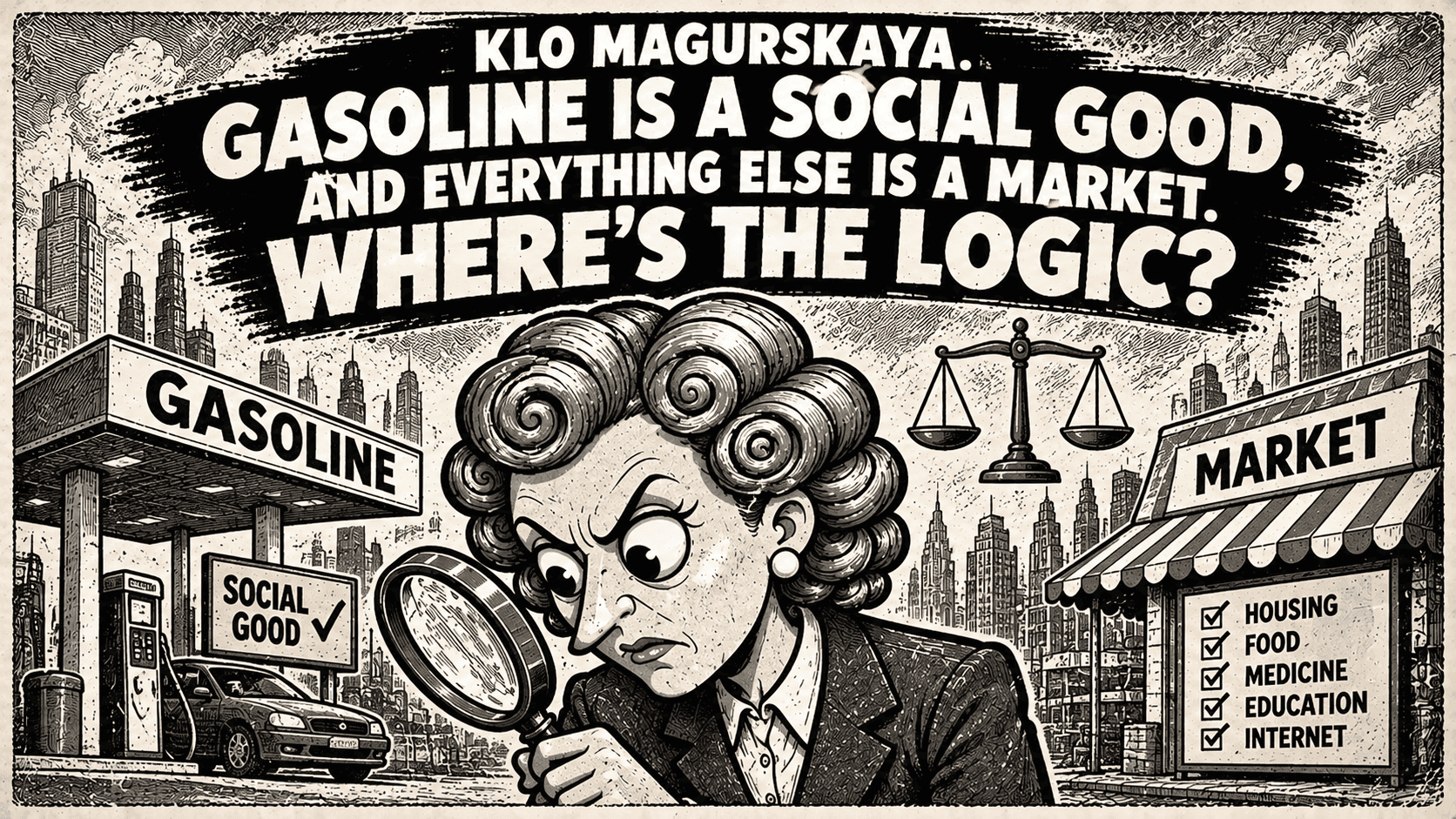
Since we are pivoting to the East, we should take the experience from there. That is exactly how the news is presented to us: Kazakhstan is introducing digital control over the movement of petroleum products — from production to sale at gas stations. On the “24KZ” TV channel, Yerzhan Koshkarov, Director of the Digitalization Department of the Ministry of Energy of the Republic of Kazakhstan, talks about a system that should detect illegal fuel trafficking and prevent regional shortages.
It sounds like a breakthrough. It sounds like “best practices” that we are being offered to adopt.
But, as always, let’s look at the architecture.
Footnote: Analytical materials may provide incomplete information on how exactly the accounting systems in Kazakhstan are structured. There may be hidden modules or integrations that are not mentioned in the interview. However, this is not important. What is important is that such a system already existed in the USSR. And digitalization has significantly simplified the collection of information. Now AI can synthesize any data from any disparate sources into a single system. The question is not “how they did it,” but why we still don’t have it.
PART I. WHAT WAS ACTUALLY IMPLEMENTED IN KAZAKHSTAN?
If you read the interview carefully and extract the essence, we will see not a unified system, but a set of disparate “patches”:
Since 2022 — production monitoring (wells only).
Oil Transportation Management — pipeline monitoring (pipe only).
At three refineries (Atyrau, Pavlodar, Shymkent) — material balance systems (refineries only).
At tank farms — control metering devices (warehouses only).
At gas stations — sales monitoring system (retail only).
They boast: “we see how much was poured, how much was dispensed.” They see each individual node, but do not see the chain as a whole.
It is as if you tried to control the plumbing in a house by installing meters in every room but forgetting about the main riser and the pump station. If there is a burst in the riser, meters in the rooms will not help.
PART II. HISTORICAL EXCURSUS: HOW WE LOST THE CHAIN
In Russia, back in the USSR, an accounting system was set up — from the well to the pump. It worked. Dispatch services saw the balance: how much was extracted, how much was refined, how much was shipped, how much was sold. It was a unified system.
Then the 90s came. Information flows were redistributed. Most of the information on the oil industry went to InfoTEK (which became an accumulator of industry data), Rosstat began to make mistakes, and data from different levels stopped matching each other. As a result, we got “Mystery” — when 20 thousand tons of diesel go below the exchange price by 30%, and no one can explain why. Or when tank farms are closed for “optimization,” and then it turns out there is nowhere to store fuel.
Kazakhstan is now repeating our path. They are introducing “patches,” but not creating a unified circuit.
What is a unified circuit? It is GIS TEK (State Information System of the Fuel and Energy Complex). This is a system where data is not just collected, but cross-checked. Where AI can calculate a bug in a database by comparing production, refining, transportation, and sales volumes.
I talked about GIS TEK for five years. I was told: “No one needs this.”
And now they show me Kazakhstan and say: “Look how they do it.”
PART III. THE MAIN DISSONANCE: WHY DOES THE SYSTEM STILL NOT EXIST?
Here is the main question. If the system existed in the USSR, and now AI allows collecting data from any disparate sources into a single circuit — why is it still not there?
There are two possibilities:
It does not exist because it is unprofitable for those who make money on “gray” schemes and manual pricing. A visible chain means responsibility. And no one needs responsibility.
It exists, but it is not shown to us. But then a dissonance arises: if the system exists, why do we see fuel crises, queues at gas stations, and manual pricing? This means the system either does not work or does not work for us.
This dissonance is what is called the “Mystery of Systems.” When the chain seems to exist, but you cannot see it. And if you cannot see it, you do not manage it.
PART IV. ARCHITECTURAL TRANSLATION: “PATCH” vs “SYSTEM”
The difference between Kazakhstan’s approach and GIS TEK is the difference between symptomatic treatment and diagnosis.
“Patch” (Kazakhstan): A sensor was installed at a gas station. We see how much was sold. But we do not see where it was brought from and why the price is what it is. If there is an illegal trafficking scheme, a sensor at a gas station will not catch it, because the scheme is built at the junction between the refinery and the tank farm.
“System” (GIS TEK): We collect data from all levels. We compare it via AI. If 1000 tons left the refinery, 900 arrived at the tank farm, and 800 were sold at the gas station — the system raises an alarm. This is not a “sensor,” this is a unified digital circuit.
In the interview, Koshkarov says: “After the refinery, it goes to tank farms… the tank farms have control metering devices… at gas stations, there is also a monitoring system.”
This is a set of cameras looking in different directions. But what is needed is a single eye that sees the whole picture.
PART V. ECONOMIC MECHANICS: HOW “PATCHES” HIT THE POCKET
Why is this important for an ordinary person? Because “patches” do not solve the shortage problem and do not lower prices.
Look:
No unified balance — means regional authorities do not see where fuel will run out in a week. They find out when queues form at gas stations. And then they introduce “limits” (as in Kazakhstan, where restrictions on diesel sales were introduced).
No cross-checking — means illegal trafficking continues. And therefore, the budget does not receive taxes, and the consumer pays more.
“Patches” at gas stations — this is control over the seller, not over the chain. The seller cannot influence prices (they are formed on the exchange and by vertically integrated oil companies), but he suffers from inspections.
PART VI. WHO BENEFITS FROM THIS?
Here is the main question. If the system does not work, who needs it?
The answer is simple: it is needed by officials and “experts” who want to report on “digitalization.”
They come and say: “Look, we have implemented digital control.” And the fact that this control does not see the chain is no longer their problem. It is a “mystery.”
This is imitation of vigorous activity. Taking someone else’s “patches” and calling it a “system.”
PART VII. DIGITAL CONTROL AS A PRESSURE TOOL
But there is another aspect that usually remains behind the scenes. Digital control is not only “accounting.” It is a tool of pressure on business.
Imagine: you have an independent tank farm. You work “on wheels” because the vertically integrated oil company under-supplies fuel. You sell gasoline at 150–170 rubles/liter because you do not have a damper. And then an inspection with “digital sensors” comes to you and says: “Why do you have a 2% discrepancy in your accounting system? Are you engaged in illegal trading?”
And you start proving that this is not illegal trafficking, but a measurement error. But the system has already recorded a “violation.” And this is a lever.
In Kazakhstan, by the way, they understand this too. That is why they are introducing the system in stages: first production, then the pipeline, then refineries, then tank farms, then gas stations. And at each stage, business becomes more and more vulnerable to “digital control.”
PART VIII. WHAT ABOUT GIS TEK? WHY HAS IT NOT BEEN IMPLEMENTED?
GIS TEK is a state system that was supposed to unite all data on the fuel and energy complex. It was conceived back in the 2010s. But it still does not work at full capacity.
Why? Because a visible chain means responsibility. If the system sees that 1000 tons left the refinery, and 800 were sold at the gas station, then someone must explain where 200 tons went. And this “someone” is not an abstract “market,” but specific people.
And in the system of “patches” (as in Kazakhstan), no one is responsible for the chain. Everyone is responsible for their own segment. And if a “hole” arises at the junction — it is no longer a bug, but an entrance.
EPILOGUE: WHERE THE HOLE IS NOT A BUG, BUT AN ENTRANCE
While we look at the “best practices” of Kazakhstan, our own tank farms continue to close, and GIS TEK is still not implemented.
“Digital control” without a unified circuit is not control. It is a sleeping pill. It creates the illusion that we see every liter. But in reality — we only see what the sensors show us.
The old world is dead. We do not save those who believe in “patches.” We build a new one — for those who see the architecture.
You own only what you are aware of. You own only what you can protect. You own only what you can do without the permission of third parties.
#MysteryOfSystems
🔗 MORE ANALYTICS — ON Sfornews https://sfornews.com/


Bitcoin
$62,881.23

Ethereum
$1,672.04

Litecoin
$42.71

Dash
$37.08

Bitcoin Cash
$209.43