KLO MAGURSKAYA. Gasoline Is a Social Commodity, Everything Else Is a Market. Where Is the Logic?
#Arabesques of Klo Magurskaya
GASOLINE IS A SOCIAL COMMODITY, EVERYTHING ELSE IS A MARKET. WHERE IS THE LOGIC?
Moscow, November 2, 2026
I look at the news. And I see a familiar picture. Cars are getting more expensive. Parking is getting more expensive. Roads are becoming toll roads. Gasoline is rising. But they are trying to hold it back.
Why? Because gasoline is a “social commodity.” And a car is not? And parking is not? And driving on a road is not?
I read Professor Blinkin’s forecast about the introduction of tolls on all roads in Russia within 10 years. And I understand: this is not a forecast. This is a plan. Because it was exactly with his speeches 15 years ago that the introduction of paid parking began across the country. First — in the center of Moscow. Then — all the way to the Moscow Ring Road (MKAD).
Back then it was called “advanced European experience.” Now — a “necessary measure.” Tomorrow — “inevitability.”
What actually happened
In 2011, paid parking was introduced in central Moscow. 40 rubles per hour. Only inside the Garden Ring. A “pilot project.” “Only for the center.” “Very European.”
In 2026, parking has crept up to the MKAD. The price is 800 rubles per hour. Soon — 950. Those who rejoiced that “the rich in the center will have to fork out” are now rejoicing together with everyone else. Only the joy is somehow not visible.
Now — roads. Toll roads. All roads. In 10 years. According to the forecast of the same professor whose words started it all.
I see the scheme. It is as old as the world.
Step one. An expert comes. Says: “There is a problem. It must be solved.” The problem is real: traffic jams, road wear, ecology.
Step two. They propose a “pilot.” Small. Local. “Just to try.” “Only in the center.” “Only for those who can afford it.”
Step three. The pilot is declared “successful.” Because it could not have been unsuccessful — the money started flowing.
Step four. They expand. First — to neighboring districts. Then — to the whole city. Then — to the region.
Step five. People are indignant. Then they offer “benefits.” “Minimum payment.” “Social tariffs.” People scratch their heads and agree: “Better this than nothing.”
Step six. The price grows. Because of “inflation.” Because of the “market.” Because “we need to develop infrastructure.”
And here we are. Parking — 950 rubles. Roads — toll. Cars — getting more expensive. And only gasoline is a “social commodity.”
Architectural translation: where the gap is
Here there is a gap. The map says: “We care about people. Gasoline is a social commodity, we hold the price.” The territory says: “Pay for everything else. For parking. For roads. For cars. For the right to move.”
But let’s dig deeper. Metals — for cars — are quoted on the exchange. Like oil. The price of a car is formed, among other things, taking into account the prices of imported cars. And in them — our own metals. That is, Russia supplies raw materials everywhere — sometimes cheaper than the market. And receives the goods — more expensive than in the producing country.
This is not a “market.” This is the architecture of exchange. Where we give cheaper, and receive more expensive. Where our raw materials return to us in the form of an imported car with a markup for the border, logistics, and “brand.”
And gasoline? Gasoline is held back because it is in every receipt. It is visible. It is counted. But parking, roads, insurance, taxes, fines — these are separate payments. They do not add up to one figure. They do not cause such indignation. They are “invisible.”
This is not “caring for people.” This is the architecture of collections. Gasoline is held back so that people do not take to the streets. And everything else is milked quietly. In parts. Little by little. Until they get used to it.
And this is not only Russia
Parking in London. Toll roads in Germany. Congestion tax in Stockholm. ULEZ in Europe. Everywhere — a “pilot,” “ecology,” “advanced experience.” Everywhere — expansion. Everywhere — the price grows. And everywhere — gasoline is separate. Because gasoline is what is visible. And parking, roads, insurance, taxes — this is what can be taken quietly.
And metals — the same story. Australia supplies iron ore to China. China makes cars. Australia buys cars more expensively than if it made them itself. Chile supplies copper. Copper returns in the form of electronics with a markup. Russia supplies metals. Receives cars. This is the global architecture of exchange. Not a “Russian peculiarity.” But — a system.
So when you read about “toll roads in Russia” — do not think that this is “how it is with us.” This is how it is everywhere. Just in different wrappers. And the way out is not to “change the country.” The way out is to see the architecture. Wherever you are.
Why this works
Because people do not count. They see the price at the gas station. They see that it is not growing as fast as everything else. And they think: “Well, gasoline is being held back. So they care.”
And parking? “Well, this is the center. It has always been expensive there.” And roads? “Well, these are toll roads. But it’s fast.” And cars? “Well, this is the market. Inflation.”
Each payment — separately. Each — “justified.” Each — “temporary.” And in total — the driver pays for the right to drive. For the right to park. For the right to breathe. For the right to exist in a system that calls him “social.”
And one more thing. Inflation contains the very same gasoline and petroleum products. By holding back gasoline, the state “fights inflation” on paper. But in fact — shifts it to other items. Parking. Roads. Cars. Everything that is not “social” — grows faster. To compensate for the “held-back” gasoline.
How the price of parking and road tolls is calculated
Here is the main question that no one asks. What is the price made of?
Of cost? Asphalt, markings, salaries of controllers, maintenance? Or of the budget’s needs? Of how much needs to be collected to close holes in other places?
Judging by the dynamics — 40 rubles in 2011, 950 rubles in 2026 — this is not cost. This is a fiscal instrument. The price grows not because maintenance is getting more expensive. But because the budget needs money. And parking is a convenient way to take it. Quietly. Little by little. From everyone.
The same with toll roads. Ecology? Repair? And let’s compare: how much actually went to the repair that was needed, and how much went to the annual patching of holes and the installation of new curbs to replace still-normal ones?
Curbs are changed every year. Asphalt is laid anew where it still holds. And where it is really destroyed — they get there only when the hole becomes large enough to make the news. This is not “repair.” This is budget absorption. Where the contractor receives money for “work,” not for “result.” Where the curb is more important than the road, because the curb is visible, and the hole is not.
What this means for you
If you think that road tolls are a “distant future” — look at parking. 15 years ago it was a “pilot” in central Moscow. Today — up to the MKAD.
If you think that “it won’t affect me” — ask yourself: who will pay for the roads, if not you? The budget? The budget is your taxes. Only now you pay twice: taxes and the toll road.
If you think that “gasoline is held back, so they care” — ask yourself: why then are parking lots not held back? Why are cars not held back? Why are roads not held back?
Because gasoline is what is visible. And everything else is what can be taken quietly.
And if you think that “ecology” and “repair” are the reasons for tolls, ask: where did the money actually go? To roads or to new curbs? To clean air or to budget absorption? To result or to process?
Where the hole is not a bug, but an entrance
While you argue about the price of gasoline — they are already preparing toll roads for you. While you rejoice that gasoline has been “held back” — parking has already reached your district. While you wait for “the state to sort it out” — it has already sorted it out. Just not in your favor.
The system does not ask whether you are ready to pay. It creates conditions in which you cannot not pay. “Pilot.” “Benefit.” “Inevitability.”
The way out is not to wait for them to “reconsider.” Not to hope for “benefits.” The way out is to see the architecture. To understand: you are not being “held back,” you are being distributed. By payments. By receipts. By “invisible” sums.
While you look at gasoline — you are being robbed at parking lots. While you rejoice in the “social commodity” — you are being transferred to the “toll road.” While you believe in “ecology” — they are changing curbs instead of fixing roads.
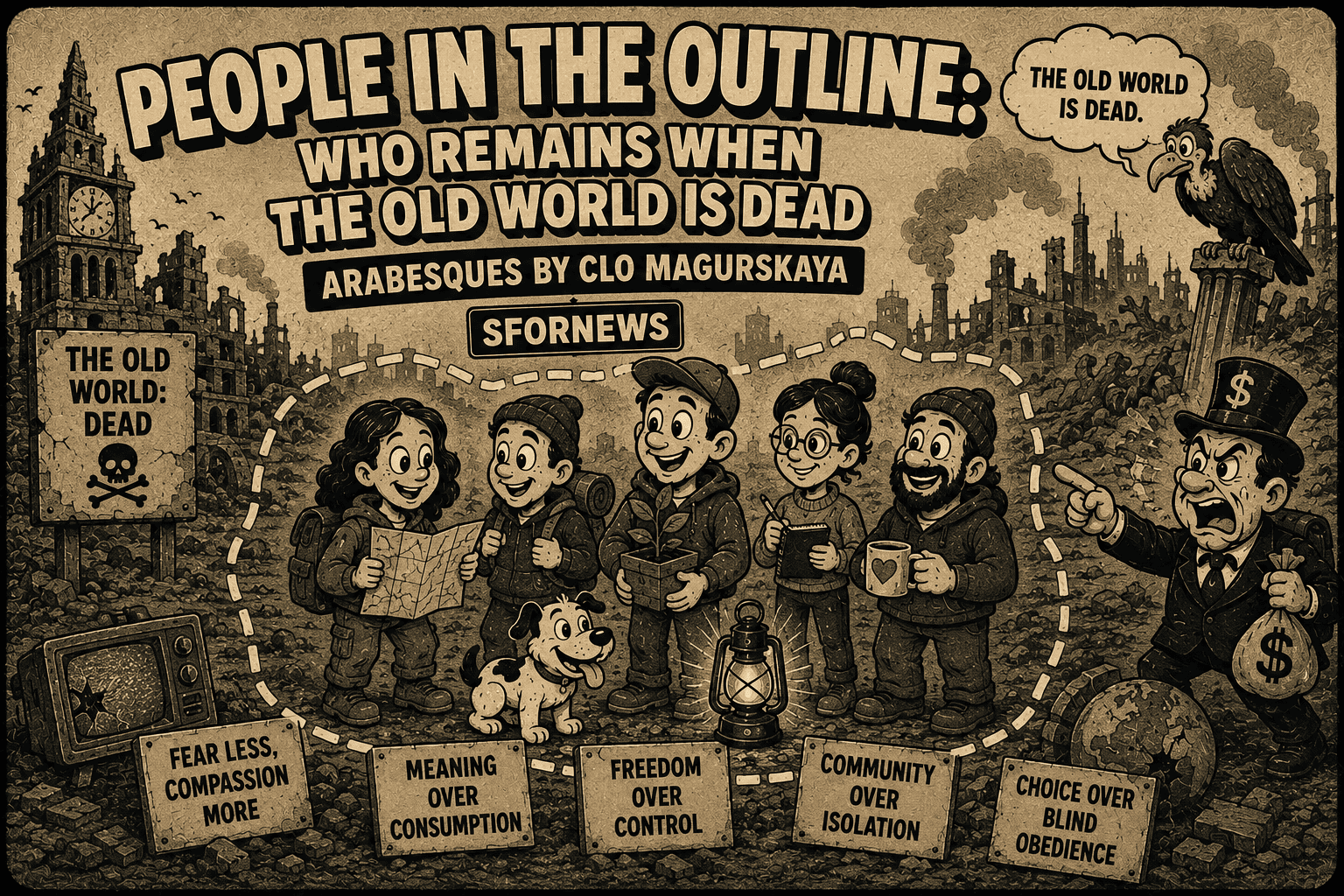
The old world is dead. This is not a warning — these are the initial conditions.
We do not save those who believe in “social gasoline.” We are building a new one — for those who see the architecture of collections. Who count not the price at the gas station, but the total cost of movement. Who do not wait for a “pilot,” but see the scheme. Who understands: if one thing is “held back,” it means another is being milked.
You own only what you are aware of. You own only what you can protect. You own only what you can do without the permission of third parties.
In the new system there are no departments that decide for you. No laws that permit or forbid. No kings who hand out permissions.
In the new system there is action. There is creation. There are “drops” of light that add up to a new reality.
And we are building it. Without regulations. Without permissions. Without fear.
#ArabesquesKlo
🔗 MORE ANALYTICS — ON Sfornews https://sfornews.com/
📲 Subscribe to the Telegram channel https://t.me/sfornews_ru


Bitcoin
$62,881.23

Ethereum
$1,672.04

Litecoin
$42.71

Dash
$37.08

Bitcoin Cash
$209.43