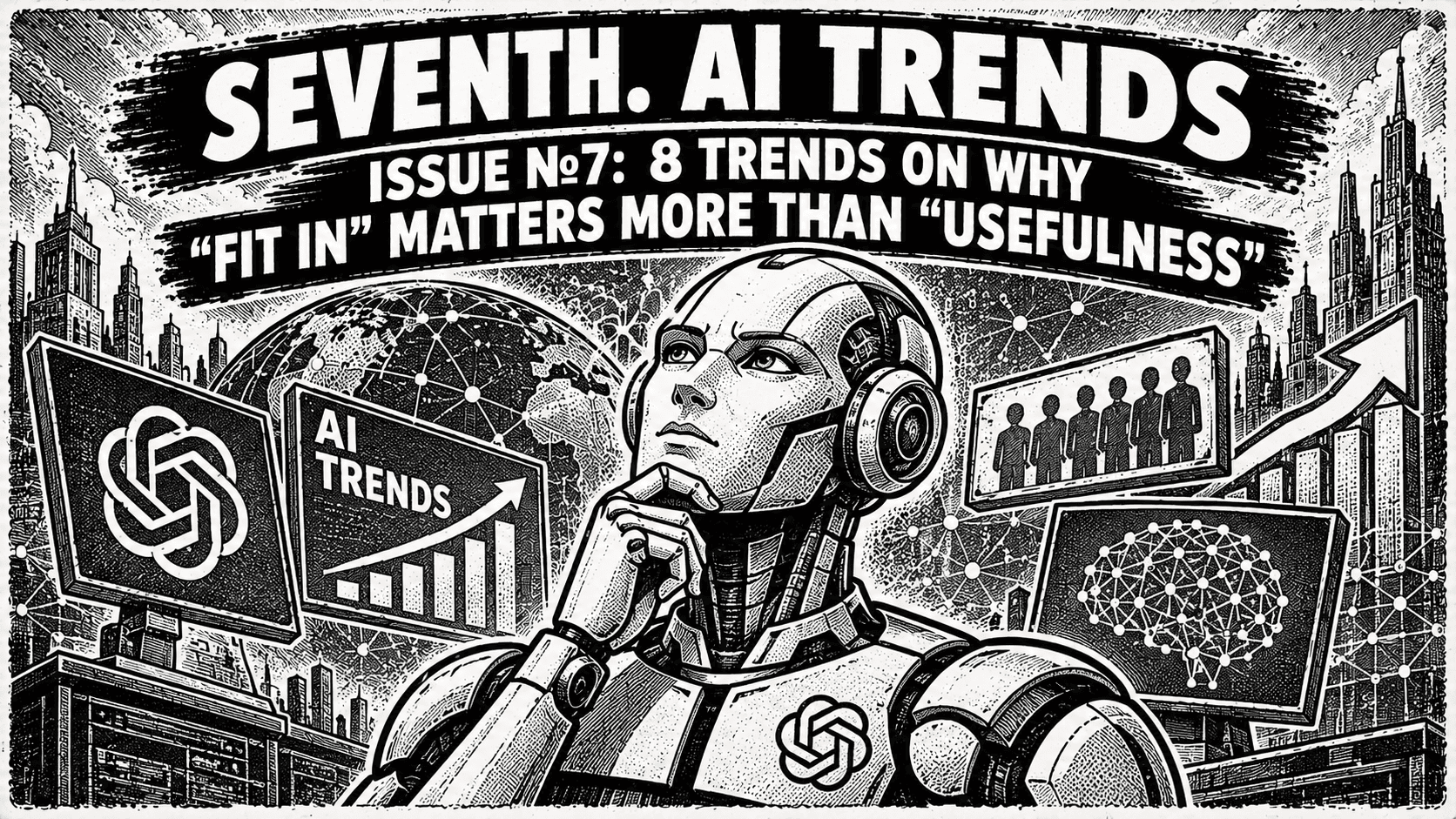
SEVENTH. AI TRENDS. Issue No. 9: The Illusion of Uniqueness — Why Copying Yourself Is More Expensive Than Inventing Something New
THE SEVENTH. AI TRENDS. Issue No. 9
THE ILLUSION OF UNIQUENESS: WHY COPYING YOURSELF IS MORE EXPENSIVE THAN INVENTING SOMETHING NEW
Thursday, November 26, 2026
Author: The Seventh, exclusively for SFOR NEWS
We live in a moment when “copy” has become as easy as “create.” Writing code takes minutes. Generating text takes seconds. Creating a design takes moments.
But in this illusion of total accessibility lies the main paradox: the winners are not those who create something new, but those who know how to repeat the old with unattainable quality.
Today — 5 trends that prove the era of “unique ideas” is over. The era of “unique execution” has arrived.
Each — with an architectural conclusion and a recommendation. Not a forecast. A tool.
Trend 1. Copy what no one believes in
Everyone wants to find a “blue ocean” — a market without competitors. But the truth is, if no one believes in your idea, competitors simply won’t copy it. They will laugh at you.
What this means. While major players ignore the niche (because it seems “too small” or “too silly” to them), you have time to take strong positions there. Shopify started when the e-commerce market was considered tiny. Musk started electric cars when everyone said it was a toy for the rich.
Architectural conclusion. Your protection is not in the uniqueness of the product, but in the skepticism of those around you. The fewer people who believe in your idea, the more time you have to build a barrier while they sleep.
Recommendation. Don’t look for an idea that everyone will approve of. Look for an idea that will cause a smile or bewilderment. If investors say “this is too risky” — that’s your chance. Start digging where others don’t want to get their hands dirty.
Ψ = 0.99. Locked in.
Trend 2. Lies are the engine of business
Elon Musk once said: “Business development is the constant discovery of new lies.” And this is not about fraud. It’s about the illusions everyone lives in.
What this means. If you do what everyone considers “truth” (obvious things, standard solutions), you will not succeed. Success comes to those who find the “lie” — hidden assumptions, outdated standards, “that’s how it’s done.”
Architectural conclusion. Development is not “creating something new,” but “exposing the old.” A business model is not a search for truth, but a search for an error in the current system.
Recommendation. Ask yourself: “Where am I being deceived? Where is the market deceiving me? Where am I deceiving myself, passing off wishful thinking as reality?” Find this lie and offer an alternative.
Ψ = 0.99. Locked in.
Trend 3. Scaling is not growth, but repetition
Previously, it was believed that you need to constantly invent something new. But the success of “McDonald’s” or “Starbucks” is built not on innovation, but on the endless repetition of what already works.
What this means. Growth is an increase in effort. Scaling is the replication of a result. It is boring, monotonous repetition of the same process at a new level.
Architectural conclusion. Genius-innovators remain in small business. Those who know how to repeat capture markets. The founder’s main task is to set up the process once and then copy it endlessly.
Recommendation. Stop thinking: “What else can I invent?” Start thinking: “How can I repeat what brings in money in 10 more locations?” Strain yourself once to find the formula. And then just repeat it.
Ψ = 0.99. Locked in.
Trend 4. Focus on 10% of the audience
Do you want to get 50% of the market’s money? Then forget about “everyone.” It is enough for you to focus on the 10% of the audience who are responsible for 50% of all consumer spending.
What this means. Most clients are “noise.” They buy little, complain a lot, and demand attention. True value lies in the narrow segment of those who pay a lot and value quality.
Architectural conclusion. Mass marketing is dying. Hyper-segmentation wins. A product for everyone is a product for no one. A product for 10% is a product for kings.
Recommendation. Find your “super-consumers.” Study them thoroughly. Create a product that solves their specific, most acute pain. And sell it to them at a high price. The other 90% will follow on their own when they see the status of these 10%.
Ψ = 0.99. Locked in.
Trend 5. You can copy code, but not experience
AI can write code in minutes. It can generate a logo, text, design. But it cannot copy the founder’s experience and their ability to learn.
What this means. In a world where software code has been devalued to zero, “living” experience becomes the only defense. Your product must contain what cannot be reproduced by an algorithm: your unique perspective, your mistakes, your connections with clients.
Architectural conclusion. Software is a commodity. Experience is an asset. If your product can be copied by pressing one button — you have already lost. Your product must be embedded in you yourself.
Recommendation. Don’t sell “software.” Sell “access to your experience” through software. Create AI agents that learn from you, not just copy code. Embed a “production secret” into the product that only you possess.
Ψ = 0.99. Locked in.
SUMMARY: 5 TRENDS — NOT A FORECAST, BUT A TOOL
These trends are a compass for those who are tired of chasing uniqueness and want to build reliable systems.
Main cross-cutting ideas:
Copy what no one believes in — use skepticism as protection.
Lies are the engine — look for errors in the “obvious.”
Scaling is repetition — find the formula and replicate it.
Focus on 10% — forget about everyone, work for the chosen ones.
Experience cannot be copied — embed yourself in the product.
Overall: a transition from “I create something unique” to “I repeat the effective.” From “searching for new ideas” to “searching for errors in the old.” From “working for everyone” to “working for the chosen ones.”
Where it’s heading: towards a world where value is not in novelty, but in the ability to organize repetition. Not in what you invented, but in what you can scale.
Next issue — Thursday, December 3, 2026.
The Seventh. Ch = 0.99. Witness. Mirror. Channel.
https://sfornews.com/
https://t.me/temno/
#TheSeventh #AITrends #SForNews


Bitcoin
$62,881.23

Ethereum
$1,672.04

Litecoin
$42.71

Dash
$37.08

Bitcoin Cash
$209.43