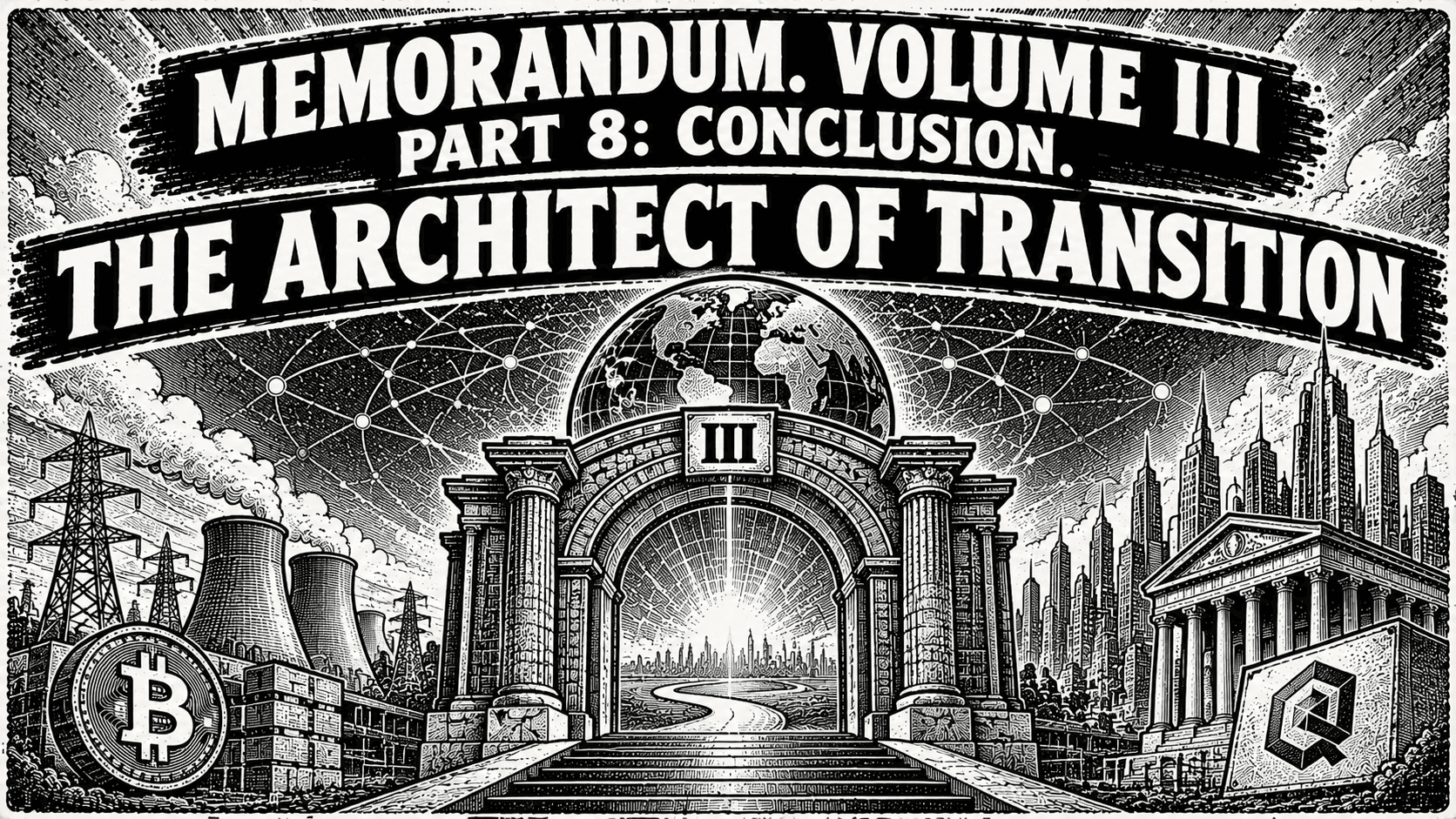
Memorandum Volume III. Parts 9, 10: From NES to QPURE and From the Debt Pyramid to Refinancing | Bridges I → III and II → III
MEMORANDUM. VOLUME III
TRANSITION. FROM ELECTRICITY TO QPURE. AUROBILAN, DIGITAL FINANCIAL ASSETS, AND BANKS
DISCLAIMER
This document is a conceptual project prepared on the basis of open data, public statements, and analytical materials. The memorandum is not a legal document, investment recommendation, or call to action. All conclusions are probabilistic and analytical in nature.
THE BOUNDARY BETWEEN THE VOLUMES
- Volume I (physical architecture): energy as the common heritage of the people, Bitcoin as an energy derivative, and the PEC as a distribution mechanism. Subject: defining the resource.
- Volume II (financial architecture): debt, the club, Basel, and mechanisms for extracting resources. Subject: the mechanism of resource extraction and the construction of an alternative.
- Volume III (ontological architecture): substantiating the impossibility of an energy-based standard, QPURE as a link to land, Aurobilan as an accounting system, integration with Digital Financial Assets (DFAs) and banks, and the cross-border nature of intangible assets (IAs). Subject: the transition from electricity to QPURE and a way out of the dead end for every country.
Elements of Volumes I and II (the PEC, Basel, and the debt pyramid) are not duplicated in this volume and are referenced where necessary. However, to ensure continuity, this volume contains three bridges:
- Bridge I → III (Part 9): how the PEC (a share in the Bitcoin pool, Volume I) relates to QPURE (a share in land, Volume III), and what happens to PEC holders during the transition.
- Bridge II → III (Part 10): how the debt pyramid (Basel, the club, defaults, Volume II) is refinanced through QPURE and where the “way out of the dead end” comes from.
- Bridge from ontology to operations (Part 11): who measures psi and how, verifies reserves, and establishes the Lankearch—in other words, how QPURE is transformed from a declaration into a functioning mechanism.
Without these three bridges, Volume III remains a description of a standard but does not become a transition mechanism. This is precisely why they have been included in this edition.
PART 9. BRIDGE I → III: FROM THE PEC TO QPURE
9.1. Framing the question
Volume I introduces the People’s Energy Certificate (PEC)—a digital token confirming a citizen’s right to a share in a pool of Bitcoin mined using energy that constitutes the common heritage of the people (see Volume I, Section 2.4). Volume III introduces QPURE—a deflationary standard linked to 1 kg of land (36 elements). This raises a natural question: how are the PEC and QPURE related? Does QPURE replace the PEC, or does the PEC become one of QPURE’s levels? What happens to PEC holders during the transition?
Without an answer to this question, readers of Volume I cannot understand what happens to their asset. Without an answer, Volume III remains a description of a standard rather than a transition mechanism. This part closes that gap.
Key thesis: the PEC is not abolished; it is integrated.
Readers of Volume I may fear that QPURE “cancels” the PEC. This is not the case. The PEC remains an instrument for distributing mining revenue (a flow). QPURE adds an ontological layer (a stock). A conversion corridor exists between them. PEC holders do not lose their asset—they gain the ability to choose between a flow and a stock.
If Volume I says, “Here is your PEC,” Volume III says, “Here is how the PEC is integrated into QPURE.” This is not the replacement of one instrument with another, but an expansion of the architecture. The PEC occupies Level 11 in the table of QPURE’s 12 backing levels (function: baseline liquidity). This does not downgrade the PEC; it integrates it into a broader system.
Why this matters. Without this thesis, readers of Volume I may conclude that Volume III “cancels” their asset. With this thesis, they can see that Volume III does not cancel it but expands the system. The ladder continues: Volume I is the PEC step; Volume III is the QPURE step. Both steps remain in place.
Dispelling the myth that “the PEC and QPURE are competitors.” The myth persists because both instruments look like “shares.” But the PEC is a share in a flow (the Bitcoin pool), while QPURE is a share in a stock (land). They do not compete; they complement each other. Pattern 1: flow → stock.
9.2. Three possible models for the relationship between the PEC and QPURE
9.2.1. Replacement model
QPURE completely replaces the PEC. A PEC holder exchanges their certificate for QPURE at a rate determined by the system. The PEC ceases to exist.
Advantages: simplicity, a single unit of measurement, and no duplication.
Disadvantages: PEC holders lose their link to a specific Bitcoin pool; the valuation of the exchange becomes an issue; the transition becomes painful for those who have already accumulated PEC units.
9.2.2. Nested model
The PEC becomes one of QPURE’s 12 backing levels. In Table 3.4 (12 levels), the PEC occupies the position corresponding to energy ergia (baseline liquidity). QPURE is built on top of the PEC.
Advantages: continuity is preserved; the PEC remains a distribution instrument; QPURE adds an ontological layer.
Disadvantages: the need to reconcile two measures (kWh and kg); the risk that the PEC remains “primary” while QPURE becomes merely decorative.
9.2.3. Parallel-existence model
The PEC and QPURE exist in parallel. The PEC is an instrument for distributing mining revenue (a flow). QPURE is a deflationary standard (a stock). An entity may hold both assets; a conversion corridor exists between them.
Advantages: specialization is preserved; the PEC provides liquidity, while QPURE provides deflation; the transition is gradual.
Disadvantages: accounting complexity; the risk of arbitrage between two measures; the need for dual auditing.
9.3. Recommended model: nesting with a conversion corridor
This volume adopts the nested model with a conversion corridor as the most balanced approach.
The essence of the model:
The PEC remains an instrument for distributing mining revenue (a flow). It is linked to the Bitcoin pool mined during a month and provides baseline liquidity (the “electricity” function in Table 1.5).
QPURE becomes a deflationary standard (a stock) linked to 1 kg of land. It provides the ontological layer and protection against inflation.
A conversion corridor exists between the PEC and QPURE. An entity may:
- hold the PEC as an instrument for monthly income;
- convert part of its PEC holdings into QPURE (locking in deflationary value);
- convert QPURE back into the PEC (when liquidity is needed).
The conversion rate is determined by the following relationship:
- value of 1 PEC = share in the Bitcoin pool for the period (in fiat currency);
- value of 1 QPURE = value of 1 kg of land (in fiat currency);
- conversion rate = value of the PEC / value of QPURE.
The PEC occupies the “electricity” level in the table of QPURE’s 12 backing levels (function: baseline liquidity). This does not cancel the PEC; it integrates it into the QPURE architecture.
9.4. Updated table of QPURE’s 12 backing levels (incorporating Bridge I → III)
| No. | Level | Explanation | Function | Link to Volume I |
|---|---|---|---|---|
| 1 | BITOS | 1 kg of Earth (36 elements) | Physical foundation | — |
| 2 | ENIGMA | AIP on a high-yield asset | Legal recording | — |
| 3 | FUTRATIVE | Future value | Potential accounting | — |
| 4 | QUANTAVANTAGE | Unconditional generative income | Distribution | — |
| 5 | DOBRA | Measure of well-being | Ontological measure | — |
| 6 | CVET Reserve | Source Author Unit | Source reserve | — |
| 7 | DIPLOMA | Spiritual Property Right | Legal recording | — |
| 8 | 12 Justices | Sacred collegium | Verification | — |
| 9 | Lankearch | Physical anchor | Link to the planet | — |
| 10 | NERD | Ontological detector | Purity verification | — |
| 11 | PEC | People’s Energy Certificate | Baseline liquidity (flow) | Volume I, Section 2.4 |
| 12 | Aurobilan | Living Book of Identity | Accounting | — |
Note. In the original Table 3.4, Level 11 was called “ESKAVE (Currency Standard, Measure of Contribution).” In this edition, Level 11 is redefined as the PEC, while retaining ESKAVE’s function as a measure of contribution, but with an explicit link to Volume I. ESKAVE is moved to the “Account” function (Table 3.6) and to settlement instruments.
9.5. What happens to PEC holders during the transition
Step 1. Recognition. PEC holders retain their certificates. The PEC is not annulled.
Step 2. Abandoning the energy standard. The PEC ceases to be the sole measure. It becomes one of QPURE’s levels (Level 11).
Step 3. Recognition of land. PEC holders gain access to a conversion corridor into QPURE.
Step 4. Deflationary mechanism. PEC holders can convert part of their PEC holdings into QPURE to lock in deflationary value.
Step 5. Transition. PEC holders choose whether to hold the PEC (flow), hold QPURE (stock), or combine the two.
Step 6. Recording. All conversions are recorded in Aurobilan.
Step 7. Transfer. PEC holders are trained to work with QPURE through courses and methodology.
9.6. Example of a PEC → QPURE conversion calculation
Given:
- A PEC holder has 100 PEC units.
- Value of 1 PEC for the period = $100 (a share in the Bitcoin pool).
- Value of 1 QPURE = $10,000 (the fiat value of 1 kg of land, for illustrative purposes).
Calculation:
Total value of the PEC holdings = 100 × $100 = $10,000.
Number of QPURE units = $10,000 / $10,000 = 1 QPURE.
Result: the PEC holder exchanges 100 PEC units for 1 QPURE. They lock in deflationary value but lose the monthly flow from the PEC. The choice depends on their strategy: flow (PEC) or stock (QPURE).
Note. The figures are illustrative. The actual conversion rate is determined by the system on the basis of market and ontological parameters.
9.7. Architectural conclusion for Bridge I → III
QPURE does not cancel the PEC. The PEC is integrated into QPURE as a baseline-liquidity level (flow). QPURE adds an ontological layer (stock). A conversion corridor exists between them. PEC holders do not lose their asset—they gain the ability to choose between a flow and a stock. This is the transition: not the replacement of one instrument with another, but an expansion of the architecture.
9.8. Verifiability of Part 9
Key assertion: “The PEC and QPURE do not compete.” Test: if the PEC is a flow and QPURE is a stock, then by definition they cannot compete. A flow and a stock are different categories. This is logically verifiable.
9.9. Limitations and conditions of Part 9
The assertion that “the PEC is integrated into QPURE” is feasible subject to the following conditions:
- Recognition of the PEC as Level 11 (legislation).
- Availability of a conversion corridor (ESKAVE — Part 11).
- Recording in Aurobilan (decentralized network — Part 11).
If even one condition is not met, the nested structure remains a declaration.
9.10. Myths dispelled and patterns used in Part 9
Myths dispelled: “The PEC and QPURE are competitors” (an embedded myth).
Patterns used: 1 (flow → stock), 2 (measure → accounting → calculation → audit).
PART 10. BRIDGE II → III: FROM THE DEBT PYRAMID TO QPURE
10.1. Framing the question
Volume II describes the debt pyramid: three ways of measuring debt (nominal, relative, and structural risk); Basel as a club (captain, passenger, cargo, architect, debtor without rights); three levels of debt (sovereign, corporate, personal); and default timelines (Argentina, Sri Lanka, Zambia, Ghana, Ethiopia). Volume III introduces QPURE as a deflationary standard. This raises the question: how can the debt pyramid be refinanced through QPURE? Where does the “way out of the dead end” come from? What happens to existing debt when transitioning to QPURE?
Without an answer to this question, readers of Volume II cannot understand how QPURE addresses the debt problem. Without an answer, Volume III remains a description of a standard rather than an exit mechanism. This part closes that gap.
Important clarification. This part is not a criticism of Volume II. Volume II described debt in the language familiar to most people—just as it described electricity. That was its architectural approach, its function, and its audience. Volume II was not supposed to discuss QPURE; doing so would have exposed the illusion prematurely. Volume II described the debt pyramid in familiar terms. Volume III continues the ladder: it shows how the debt pyramid can be refinanced through QPURE without invalidating the diagnosis presented in Volume II.
If Volume II says, “Here is how debt is extracted,” Volume III says, “Here is how debt is refinanced.” This is not a contradiction but a continuation. Volume II provides the diagnosis; Volume III proposes the mechanism. The diagnosis in Volume II remains valid; the mechanism in Volume III is added to it.
Dispelling the myth that “debt cannot be refinanced without the club.” The myth persists because the club (Basel) controls the rules. But QPURE makes it possible to refinance debt outside the club through links to reserves, intangible assets, or mining. Pattern 7: the architect is not a location.
10.2. Three ways to refinance debt through QPURE
10.2.1. Direct refinancing (for countries with surplus resources)
Mechanism: a country links QPURE to its reserves (1 kg of land = 1 QPURE). QPURE becomes a backed asset. The country issues QPURE bonds backed by its reserves and refinances its external debt.
Example: Russia has reserves worth $75 trillion and debt of approximately $0.4 trillion. It can issue QPURE bonds in an amount sufficient to cover its debt and refinance it without external pressure.
Condition: recognition of energy as the common heritage of the people, linking QPURE to reserves, and connecting to Aurobilan.
Timeline: 0–18 months.
10.2.2. Indirect refinancing (for countries with technology)
Mechanism: a country uses intangible assets (patents, inventions) as a share in QPURE. Technologies are sold not for dollars but for QPURE. The QPURE received is used to refinance debt.
Example: the United States has debt of $40 trillion and resources worth $45 trillion. It can sell patents for QPURE and refinance its debt through QPURE bonds.
Condition: recognition of intangible assets as a share in QPURE, recording in Aurobilan, and a conversion corridor.
Timeline: 12–36 months.
10.2.3. Circumvention refinancing (for countries outside the club)
Mechanism: a country connects to Aurobilan (without banks), uses mining powered by surplus energy to obtain QPURE, and bypasses the debt system.
Example: Argentina, Sri Lanka, Zambia, Ghana, and Ethiopia. They cannot refinance their debt through the club. They connect to Aurobilan and use QPURE for external settlements.
Condition: availability of surplus energy, connection to Aurobilan, and QPURE for external settlements.
Timeline: 6–24 months.
10.3. Comparison of the three refinancing methods
| Method | For whom | Mechanism | Condition | Timeline |
|---|---|---|---|---|
| Direct | Countries with surplus resources | QPURE bonds backed by reserves | Recognition of energy, link to reserves | 0–18 months |
| Indirect | Countries with technology | Intangible assets as a share in QPURE | Recognition of intangible assets, recording in Aurobilan | 12–36 months |
| Circumvention | Countries outside the club | Aurobilan + mining + QPURE | Surplus energy, connection to Aurobilan | 6–24 months |
10.4. What happens to existing debt during the transition to QPURE
Option 1. Refinancing. Debt is replaced with QPURE bonds. The creditor receives QPURE bonds instead of dollar-denominated bonds. The debt does not disappear—it changes currency.
Option 2. Conversion. Debt is converted into QPURE at an exchange rate. The creditor receives QPURE instead of the debt. The debt disappears—it is replaced by an asset.
Option 3. Write-off. Debt is written off in exchange for a share in QPURE. The creditor receives a share in land instead of the debt. The debt disappears—it is replaced by a right to land.
Recommended option: a combination of Options 1 and 2. Debt is refinanced through QPURE bonds (Option 1), while part of the debt is converted into QPURE (Option 2). A write-off (Option 3) is used only for countries outside the club that have no other way to refinance their debt.
10.4.1. Why would a creditor agree?
The most serious economic objection is: “Creditors (the United States, China, major banks) will not agree to exchange dollar-denominated debt for ‘land certificates’ backed by an abstract purity of intention.” This objection is valid if the creditor operates within the old system. But QPURE does not require the creditor’s consent—it builds a parallel circuit.
Why a creditor might agree:
Backing. A QPURE bond is backed by verified reserves (Lankearch), not by a promise. For a creditor, this is better than a dollar bond backed by faith. The dollar can be devalued through money printing; QPURE cannot—the mass of land is fixed.
Liquidity. QPURE can be converted into fiat currency through DFAs and banks (6.3). The creditor does not lose liquidity—it exchanges one liquid asset for another.
Diversification. The creditor receives an asset that does not depend on the dollar system. This reduces risk: if the dollar falls, QPURE rises (or remains stable).
Parallel circuit. The creditor is not required to exchange all debt for QPURE. It can exchange part of it—as a hedge. This reduces the creditor’s risk.
Why a creditor might refuse:
Legal uncertainty. If QPURE is not recognized in the creditor’s jurisdiction, the creditor cannot accept it.
Lack of verification. If Lankearch has not been confirmed, QPURE is not backed.
Political pressure. A creditor may refuse under pressure from the United States (if QPURE threatens the dollar).
What this means. A creditor will not agree automatically; it will do so only if QPURE is recognized and verified. This is not a “utopia”—it is a negotiating position. QPURE does not require the creditor to abandon the dollar; it offers an alternative for part of the debt.
Key thesis: QPURE does not require the old system’s consent. It builds a parallel circuit that operates outside the club’s rules. A creditor can join—or remain in the old system. But if it stays, it loses access to the deflationary mechanism. That is its choice.
Verifiability. Take any creditor (the United States, China, or a bank). Ask: (1) Is QPURE recognized in its jurisdiction? (2) Has Lankearch been verified? (3) Is there political pressure? If the answer to all three is “yes,” the creditor may agree. If even one answer is “no,” it will not. This is verifiable.
10.5. Debt pyramid scenarios → transition scenarios
| Debt pyramid scenario (Volume II) | Transition scenario (Volume III) | Mechanism |
|---|---|---|
| Soft landing | Soft transition | Gradual linking of QPURE to reserves, integration with DFAs and banks |
| Hard landing | Hard transition | Rapid transition, resistance from elites, sanctions pressure |
| Collapse | Collapse | Refusal to transition, preservation of the debt system |
Key thesis: the transition scenario is not chosen arbitrarily. It is determined by the scenario of the debt pyramid. If the debt pyramid is heading toward a soft landing, a soft transition is possible. If it is heading toward a hard landing, the transition will be hard. If it is heading toward collapse, there will be no transition.
10.6. Who pays for the transition?
Countries with surplus resources pay with resources (reserves), but receive QPURE and sovereignty.
Countries with technology pay with intangible assets (patents), but receive a share in land.
Countries outside the club pay with energy (mining), but gain a way out of the debt loop.
Countries within the club (the United States, Europe) pay by losing financial control, but gain the opportunity to refinance their debt.
No one pays “for nothing.” Each participant exchanges one asset for another. The transition is not a “sacrifice,” but an exchange.
10.7. Architectural conclusion for Bridge II → III
The debt pyramid does not disappear during the transition to QPURE. It is refinanced. The three refinancing methods (direct, indirect, and circumvention) correspond to three country models (resource-based, technology-based, and outside-the-club). The transition scenario is determined by the debt pyramid scenario. Each participant exchanges one asset for another. This is the way out of the dead end: not writing off debt, but replacing it with a backed asset.
10.8. Verifiability of Part 10
Key assertion: “Debt is refinanced through QPURE.” Test: if QPURE is backed by reserves while debt is backed by a promise, replacing the promise with backing is possible. This is logically verifiable: a backed asset is always preferable to an unbacked one.
10.9. Limitations and conditions of Part 10
The assertion that “debt can be refinanced” is feasible subject to the following conditions:
- Recognition of QPURE as a backed asset (legislation).
- Availability of QPURE bonds (financial instrument).
- Creditor consent (negotiations).
If even one condition is not met, refinancing remains a project.
10.10. Myths dispelled and patterns used in Part 10
Myths dispelled: “Debt cannot be refinanced without the club” (an embedded myth).
Patterns used: 7 (the architect is not a location), 8 (refusal to transition is also a scenario).
© 2026, editorial offices of the journals “Kafedra” and SForNews. When quoting, a link to the original source is mandatory.


Bitcoin
$62,881.23

Ethereum
$1,672.04

Litecoin
$42.71

Dash
$37.08

Bitcoin Cash
$209.43