The Great Transition 2.0 — From Oil Dollars to Cryptogigawatts — SforNews Analytics
THE GREAT TRANSITION 2.0: FROM OIL DOLLARS TO CRYPTOGIGAWATTS
How February’s Hypotheses Became July’s Reality
DISCLAIMER
This material is an analytical study prepared by the editorial team of “Kafedra” and SforNews based on open data and public statements. It is a continuation and update of the article “The Great Transition: From Oil Dollars to Cryptogigawatts and Tokens of Time-Attention,” published on February 3, 2026.
This material does not constitute legal advice, investment recommendations, or a call to action. The authors do not provide advice on the purchase, sale, or storage of any assets, including cryptocurrencies, nor do they provide recommendations on tax or other planning.
The purpose of this material is to verify public narratives, check statements by regulators and financial institutions for factual accuracy, and document discrepancies between words and actions. All conclusions are probabilistic and analytical in nature. The editorial board assumes no responsibility for any financial or legal decisions made based on the content.
The material contains critical analysis of the actions of government bodies and financial institutions. It addresses regulators and their followers without familiarity but with the necessary degree of skepticism required by journalistic ethics when working with public statements that affect the rights of citizens.
PROLOGUE: THE DOUBLE COLLAPSE OF THE OLD WORLD
In February 2026, we published an article titled “The Great Transition: From Oil Dollars to Cryptogigawatts and Tokens of Time-Attention.” In it, we formulated the hypothesis that the world is not in a phase of “crisis” but in a phase of phase transition — a fundamental metamorphosis shedding the archaic architecture of fiat intermediaries.
At that time, we spoke of two interconnected collapses:
The first collapse — geopolitical. The dollar system, which rested on two pillars — resource colonialism (oil for dollars) and a trust cartel (Treasuries as gold 2.0) — is cracking at every seam. The seizure of central bank reserves became a financial Chernobyl, demonstrating that a “risk-free asset” can be confiscated for political reasons. Gold soared into the stratosphere, oil trades in yuan and rupees, and trust in US Treasury bonds is no longer an axiom.
The second collapse — technological. The foundation of the global economy is shifting from carbon (oil) to electrons (electricity). From the production of things — to the production of solutions. Value is born not in trade balances, but in the computational processes of artificial intelligence.
We argued that these two collapses are not parallel processes but cause and effect. The geopolitical system built around control over physical resources loses meaning when the key resource becomes electricity, which can be produced anywhere, and the key activity becomes computation, which has no nationality.
Today, in July 2026, these hypotheses have become reality.
But reality turned out to be harsher than we assumed. It didn’t just “confirm” our forecasts. It trapped Russia in a situation that wasn’t in our February calculations.
ACT I: FEBRUARY’S HYPOTHESES — AND THEIR CONFIRMATION
In the February article, we formulated six key hypotheses. Here is how they look today, in July 2026:
Hypothesis 1. Energy becomes the base asset, and bitcoin becomes its liquid expression.
February thesis: The world is moving toward a system where value is determined not by oil reserves, but by the ability to convert electricity into global assets. Bitcoin is the first transnational energy derivative.
July confirmation: The Russian State Council officially recognized mining as a way to monetize energy resources in remote regions. Miners have become a new class of exporters, akin to oil companies. However, at the same time, criminal liability for illegal mining and regional bans until 2031–2032 have been introduced. The state recognizes, but restricts.
Hypothesis 2. Countries will build sovereign digital financial systems.
February thesis: Russia will use decentralized technologies to strengthen state sovereignty under sanctions pressure.
July confirmation: On April 21, 2026, the State Duma passed in first reading a package of bills “On Digital Currency and Digital Rights.” Regulation comes into force on July 1, 2026: licensed crypto exchanges, digital depositories, brokers. P2P trading without an intermediary will remain formally legal until July 1, 2027. However, the limit for non-qualified investors — 300,000 rubles per year — makes this access merely symbolic.
Hypothesis 3. Trust in traditional “risk-free” assets has been destroyed.
February thesis: The freezing of central bank reserves (~$300 billion) demonstrated the confiscability of dollar assets for political reasons.
July confirmation: The Middle East conflict and the strike on Qatar’s Ras Laffan (March 19, 2026) demonstrated the vulnerability of physical energy infrastructure. Bitcoin mining, unlike LNG terminals and oil pipelines, has no similar physical vulnerability. K33 Research analysts confirm the absence of structures that led to 80% crashes in 2018 and 2022. However, the current correction (BTC fell to $59,000–62,000) shows that bitcoin is not a safe haven in the current phase.
Hypothesis 4. Competition through the “energy exchange rate” emerges.
February thesis: The cost of mining 1 BTC in different jurisdictions will become a public macroeconomic indicator.
July confirmation: Regions with cheap electricity introduced long-term mining restrictions. The cost of mining one bitcoin in the US is approximately $111,000 (above market price). In Russia, at the current BTC price ($64,000–65,000), ASIC miner payback is 270–420 days. Energy Aspects predicts that miners without access to cheap energy will leave the market.
Hypothesis 5. The financial system is undergoing a phase transition, not a crash.
February thesis: The financial system is undergoing a metamorphosis, not destruction.
July confirmation: No systemic stress. K33 Research analysts confirm: “The structures that led to 80% crashes are absent.” Spot ETFs have provided long-term capital inflows. Regulatory frameworks are in place: Genius Act (US), MiCA (Europe), Russian law. However, the current correction is real — outflows from ETFs reached $2 billion over two weeks. This is a macroeconomic reaction, not a structural collapse.
Hypothesis 6. The next level is the tokenization of attention and time.
February thesis: The value of attention and time becomes the next unit of exchange after energy.
July confirmation: The tokenized real-world assets (RWA) market on public blockchains reached $27.5 billion (+66% since the beginning of the year). Nasdaq received SEC approval for pilot trading of tokenized shares. Boston Consulting Group forecasts $16 trillion by 2030 (about 10% of global GDP). However, mass adoption requires solving the coordination problem and ensuring primary needs.
ACT II: PIPES CLOSE — WHAT HAS CHANGED SINCE FEBRUARY
If in February we spoke of hypothetical transformation, in July we record concrete facts that have trapped Russia in an energy dead end.
What has changed in five months:
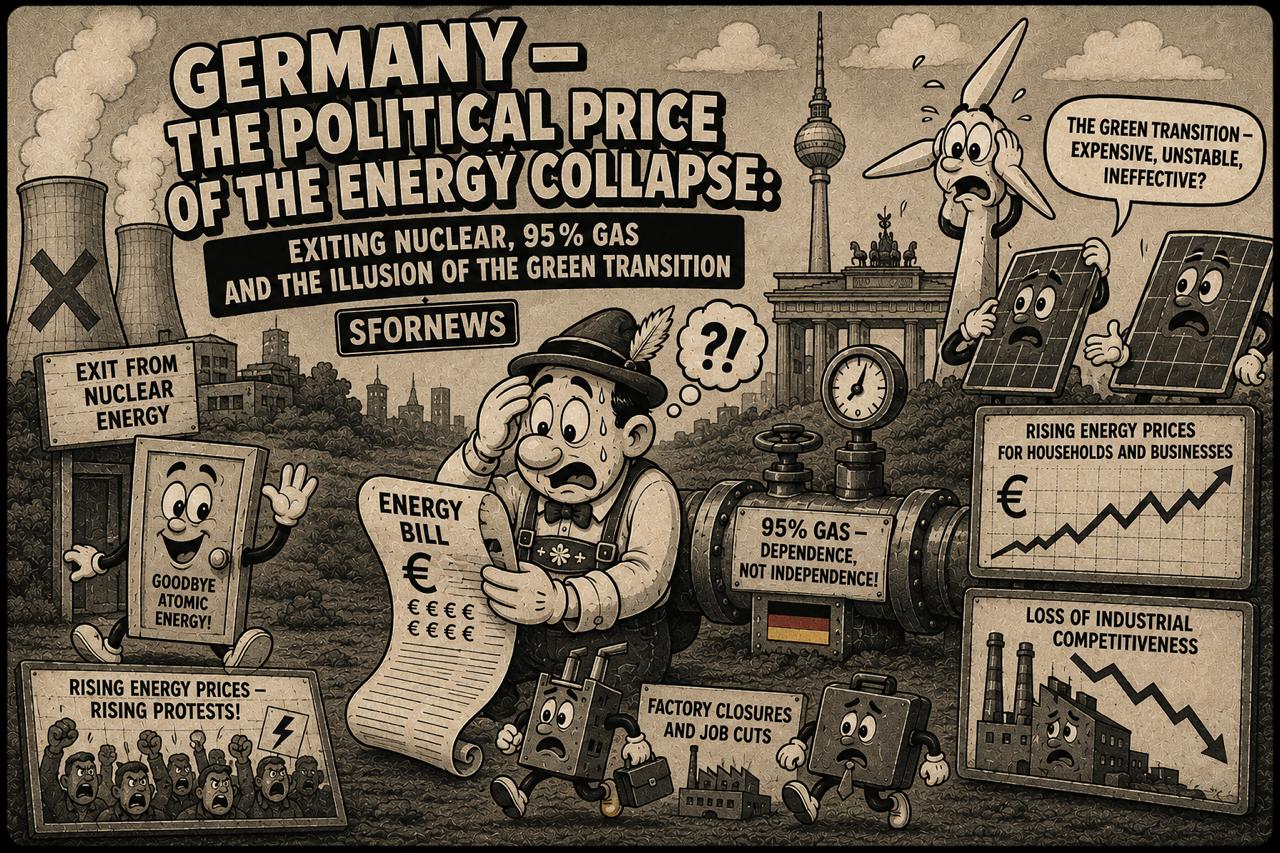
1. Europe closed the pipes. The embargo on Russian gas came into force. The “Nord Streams” are a thing of the past. Ukrainian transit has stopped. Gazprom has lost the market that fed the country for decades.
2. China delivered an ultimatum. It demands $50 per thousand cubic meters for “Power of Siberia — 2.” Negotiations are frozen. The eastern route does not replace the western one.
3. Gas prices have fallen. Europe is replacing Russian gas with American LNG and renewables. Asia is trading. Russia is left with a resource that has nowhere to be sold.
4. Oil is under sanctions. The 21st EU sanctions package, which came into force on July 23, 2026, hit the tanker fleet, insurance, and banking services. 117 vessels and 58 companies were sanctioned. India and China demand discounts, but even they fear secondary sanctions.
5. Sanctions have become targeted and inevitable. The EU and the US have learned to strike the entire infrastructure serving Russian capital. Insurance companies, logistics operators, correspondent banks — all are under attack.
Architectural nuance: The old export model collapsed not because resources ran out. Resources exist. The export infrastructure collapsed. And now, when even settlements in yuan and rupees become risky, Russia has fewer and fewer channels to monetize its resources.
ACT III: MODERNIZATION THAT NEVER HAPPENED
Russia has oil. But processing it domestically is ineffective, and in a crisis — practically impossible. We examined this in detail in “The Chronology of Cynicism: 30 Years of the Same Scheme” and in “The Fifth Gas Station.”
Brief history:
Architectural nuance: Euro-3 is not a solution. It’s an indicator of failure. Modernization did not happen. Benefits didn’t work. The system returned to 1990s standards.
What remains for Russia with its oil?
Oil exists. But there is nowhere to put it.
ACT IV: BITCOIN AS THE ONLY MONETIZATION CHANNEL
In the February article, we wrote:
“Bitcoin creates the first objective ‘energy parity value.’ While currencies were once compared through purchasing power parity (a basket of goods), in the future they will be compared through mining parity — the cost of converting local energy into a global monetary good. A country where bitcoin can be mined cheaply indirectly has cheaper access to global liquidity. Miners have become a new class of exporters, akin to oil companies.”
Today, this thesis is no longer hypothetical.
Russia possesses:
Bitcoin mining is the process of transmuting cheap, excess energy into an absolutely liquid global asset.
It requires no:
It requires only energy and the internet.
And Russia has both.
ACT V: ARCHITECTURAL CONTRADICTION — LAW AGAINST REALITY
But here a fundamental contradiction arises that we could not foresee in February.
Reality: Energy exists. Export channels are gone. Mining is the only way to monetize.
Law: The State Duma passed a cryptocurrency law with a 300,000 rubles per year limit for non-qualified investors. Criminal liability for illegal mining has been introduced (income/damage over 3.5 million rubles). Regions with cheap electricity (Irkutsk Oblast, Buryatia, Transbaikalia) introduced mining restrictions until 2031. Moscow, the Moscow Region, and Kursk Oblast — until 2032. The Bank of Russia and the Federal Tax Service are developing an automated control system that will match citizens’ bank transfers with P2P activity on foreign exchanges.
Restrictions: The 21st EU sanctions package hit the tanker fleet, insurance, and banking services. US secondary sanctions complicate even settlements in yuan and rupees — friendly countries fear the blocking of their dollar accounts. Russian authorities have eased capital outflow for “their own” (up to 30 million rubles without Central Bank permission) and blocked payments to unfriendly creditors (amounts over 10 million rubles per month are credited to special “Type C” accounts). This is not just “regulation” — it is a systemic restructuring in which bitcoin turns out not to be a safe haven but another instrument sensitive to geopolitics.
Architectural nuance: The law does not ban bitcoin. It makes it inaccessible to those who could use it for its intended purpose — as an energy-to-value conversion tool.
Paradox: The state recognizes mining as a way to monetize energy resources (Russian State Council), but simultaneously introduces restrictions that make this monetization impossible. Sanctions and internal restrictions are finishing off the channels that remained.
ACT VI: WHAT REMAINS — PROCESS DOMESTICALLY AND MINE BITCOIN
Situation as of July 2026:
|
What exists |
What to do with it |
|
Gas — exists, but nowhere to export |
Use for electricity generation |
|
Oil — exists, but processing is distorted |
Refinery capacity underutilized, oil companies holding back resources to raise prices |
|
Electricity — cheap and excess |
Convert into bitcoin through mining |
|
Internet — works |
The only remaining export infrastructure |
|
Domestic demand — exists |
But purchasing power is falling, prices are rising |
The only remaining channel for monetizing energy resources — bitcoin.
It allows:
Architectural conclusion: Russia finds itself in a situation where it has energy but no export channels. Bitcoin mining is the only remaining channel. This is not an “investment strategy.” This is a survival tool.
EPILOGUE: THE GREAT TRANSITION CANNOT BE STOPPED
In February, we wrote:
“The financial system is not cracking at the seams. It is undergoing a phase transition — a fundamental metamorphosis, shedding the archaic architecture of fiat intermediaries to take on a new form — a living, pulsating network of direct exchanges.
From oil dollars — to cryptogigawatts.
From the gold standard — to energy parity.
From corporate careers — to personal tokens.
From stock exchanges — to computing power markets.
This is not an apocalypse. It’s a metamorphosis. Those who see in today’s chaos not a collapse but the assembly process of a new operating system of reality will have the chance to take positions not in the old hierarchies but in the new networks.”
Today, in July 2026, this phase transition has become reality.
Russia finds itself in a situation where the old export model has been destroyed, and the new one has not yet been built. Energy exists. Export channels are gone. Bitcoin mining is the only way to turn energy into global liquidity.
But the cryptocurrency law and sanctions block this channel.
The state recognizes mining as a way to monetize but restricts it. It knows that bitcoin is the only way out but doesn’t let this way out work. Sanctions finish off what remained.
Until this paradox is resolved, Russia will continue to lose energy that could have become a source of global liquidity.
P.S. In February, we wrote: “A country with excess green energy — the new Saudi Arabian peninsula.”
Today, Russia is not the “new Saudi peninsula.” It is an energy boiler from which no pipes emerge, but miners do.
The question is how long the boiler will keep running until the system finds a way to use its steam.
This material was prepared by the editorial team of “Kafedra” and SforNews based on the February article “The Great Transition” and current data from July 2026.
This analysis is for informational purposes only and does not constitute investment advice.


Bitcoin
$62,881.23

Ethereum
$1,672.04

Litecoin
$42.71

Dash
$37.08

Bitcoin Cash
$209.43