Who pays for the knowledge behind AI? The economic downside of the digital signature
Who pays for the knowledge behind AI? The economic downside of the digital signature
By Antonio Georgopalis
Expert Financial European Affairs
August 13, 2026
Behind the discussion about AI watermarks and digital provenance lies a larger economic question. As more and more AI systems can demonstrate where their output comes from, the question of who is entitled to compensation for the human content on which those systems are trained inevitably becomes as well. A recent $1.5 billion settlement between Anthropic and a group of authors shows that this is no longer a theoretical discussion — and the US, the EU, and Russia are now giving three very different answers to that question.
Two revenue models side by side
Until now, users have primarily paid for access to AI models — via subscriptions or API usage. Globally, however, the discussion is growing regarding a second model: licensing, whereby AI companies pay rights holders for the use of books, journalistic articles, images, and other protected works as training material. In the future, this could allow two different types of rights to coexist: the right to use an AI model, and the right to remuneration for the material with which that model was developed.
The case that turned the tide
The trigger is an American lawsuit, Bartz v. Anthropic, filed in 2024 by authors Andrea Bartz , Charles Graeber , and Kirk Wallace Johnson on behalf of a broader group of writers and publishers. Judge William Alsup ruled in June 2026 that training Claude on copyrighted books falls under fair use in itself — but that Anthropic acted unlawfully by downloading more than 7 million books via piracy sites such as Library Genesis and Pirate Library Mirror and storing them in a central library. A separate lawsuit was scheduled for damages resulting from that piracy.
In July 2026, Anthropic settled that case for $1.5 billion, the largest known settlement in a copyright case ever. Of the estimated 500,000 works involved, rights holders will receive approximately $3,000 per title after deduction of costs; more than 91 percent of the cases had already been claimed by the end of July. Judge Araceli Martínez-Olguín — Alsup had since retired — gave the settlement final approval.
Important nuance: the settlement concerns illegally obtained copies, not training as such.
That distinction is just as important economically as it is legally. The judge ruled that training on legally obtained copyrighted material can fall under fair use . What cost Anthropic dearly was not the training itself, but the manner in which the material was collected. The case therefore does not constitute a general ruling that payment must be made for every form of AI training — but it does show that the economic value of training data is increasingly being called into question, and that rights holders are willing to litigate for it.
What does this have to do with watermarks and provenance?
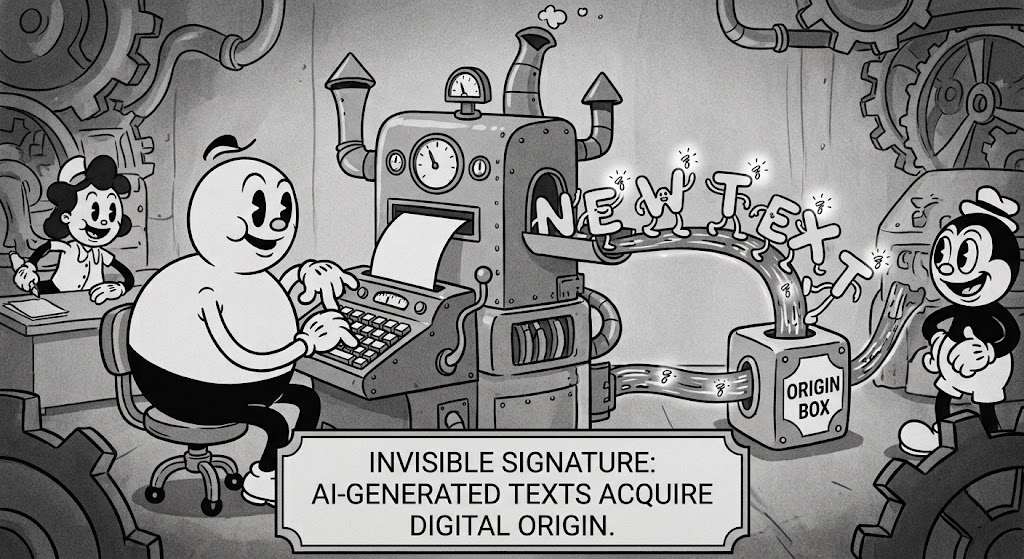
The infrastructure currently being built around watermarks and digital origin registration — such as the C2PA standard and Anthropic’s unobservable text marking — is primarily intended to make AI output identifiable. However, the same technical logic can eventually be used to better document which sources were fed to an AI system and what role those sources played in the final result. That is still largely a vision for the future today, but it is no coincidence that transparency regarding output and transparency regarding training data are developing within the same timeframe: both are part of the same broader demand for origin and accountability.
What this could mean for Europe
The settlement is an American case and does not directly bind European courts. However, it does change the negotiating position of European publishers, authors, and media companies vis-à-vis AI companies: there is now a precedent for the potential costs of piracy of training data, and a concrete compensation amount per work as a reference point. For European rights holders considering licensing or litigation, this is a tangible fact where previously there was primarily uncertainty.
At the same time, the core question remains open: fair use — and with it, the question of whether training on legally obtained material is subject to a duty to pay compensation — is an American doctrine without a direct European equivalent. Under European copyright law and the text and data mining exceptions, the discussion is different. What does hold true everywhere, however, is the trend: as AI systems become better able to demonstrate what they have learned and from whom, it becomes more difficult to continue evading the demand for compensation.
And in Russia? An opposite route
For a large part of the readership, this is not a distant issue : there is specific Russian legislation that regulates precisely this question — and which takes a fundamentally different path than the US and the EU. Law No. 243-FZ (see Part 1 for context) contains, in addition to rules on labeling and sovereign/national designs, an explicit regulation for the use of copyrighted material in the training of AI models.
Developers of sovereign and national AI models may use such material for training without the permission of the rights holder, provided that it concerns a legally obtained copy of the work, or that the material has been made publicly accessible and is not technically blocked against use.
No opt -out for rights holders, no fair- use assessment — only the question of whether access to the material was legal.
This is a fundamentally different approach than in the EU and the US. The European text and data mining exception (Article 4(3) of the Copyright Directive, to which the AI Act refers) gives rights holders an opt -out: they can indicate that their work may not be used for AI training, and providers must respect this. In the US, there is no statutory exception; there, cases are assessed on a case-by-case basis under the fair use doctrine — as in the Anthropic case mentioned above. Russia has neither of these instruments. As long as access to the material has been obtained legally, use for training is permitted, without compensation and without the possibility for the rights holder to block it.
What does remain is an obligation to provide information — but this is directed at the user of the AI output, not at the rights holder of the training material: providers of AI models must inform users about who holds the rights to the generated content and under what conditions it may be used and stored. The original author of a book, article, or photograph used as training material receives no comparable information or claim in this context.
These provisions — like the labeling obligation — do not enter into force until 1 March 2027; the general provisions of the Act have already been in effect since 1 September 2026. Concrete liability and sanction measures for violations still need to be established through secondary regulations, so not everything has been finalized on this point yet.
For Russian authors, publishers, and other rights holders, this concretely means that the legal leverage Western authors currently use—such as in the Anthropic settlement—does not exist in Russia itself in the same way against Russian AI developers. A work that is legally online and is not technically restricted can, in principle, be used without permission and without compensation to train a Russian AI model, provided that model wishes to qualify for sovereign or national status.
That is explicitly a choice of industry policy: the law is intended to give Russian developers a training data advantage over Western competitors who do have to deal with opt -outs and lawsuits.
The question that remains
The discussion on AI and provenance is therefore no longer solely about the question of “who wrote this text?” It is equally about the question of who contributed to the knowledge upon which that text is based, and who should be paid for it. Meanwhile, the US, the EU, and Russia offer three different answers to this question: litigation on a case-by-case basis under fair use , a statutory opt -out for rights holders, or a statutory exemption for domestic developers without an opt -out and without compensation. As the technical infrastructure for provenance registration matures, this question will become harder to postpone — in none of the three jurisdictions.


Bitcoin
$62,881.23

Ethereum
$1,672.04

Litecoin
$42.71

Dash
$37.08

Bitcoin Cash
$209.43