The invisible signature: AI texts gain a digital origin
The invisible signature: AI texts gain a digital origin
By Antonio Georgopalis
Expert Financial European Affairs
August 13, 2026
Anyone reading an article, legal analysis, translation, or email today finds it increasingly difficult to determine with certainty whether the text was written entirely by a human. For computers, however, it is becoming the exact opposite: it is becoming easier to recognize indications of AI use. What began as a technical quest for ways to detect AI texts is growing into something much larger: a digital infrastructure in which more and more information about the origin and history of content can be recorded. Europe is attempting to steer this development legally, American technology companies are developing the technical means, and meanwhile, Russia is building its own national AI ecosystem. This could have major consequences for journalists, translators, lawyers, publishers, and other professionals.
The invisible digital signature
A language model does not generate text completely randomly. For each subsequent word or word part, it calculates which possibilities are most likely to fit what preceded it. By very subtly influencing those choices, an AI system can incorporate a recognizable statistical pattern into its text.
For the reader, virtually nothing changes. The text looks normal and contains no visible logo or warning. However, a special computer system can search for the underlying pattern and thus find clues that the text was generated by AI.
Google has developed a technology with SynthID to make AI-generated content recognizable. Anthropic, the company behind Claude, announced on August 11, 2026, that new Claude models—launched on or after August 2, 2026—will also provide AI-generated text with an imperceptible, machine-readable mark. Anthropic refers to this as an “ imperceptible watermark”: a watermark that is imperceptible to humans, does not affect meaning or readability, and travels with the text when copying and pasting.
However, that does not mean that such a watermark is an infallible AI detector. Its reliability depends on the length of the text and what happens to it afterwards: thorough rewriting, translation, or mixing with other text can reduce recognizability. Therefore, the absence of a detectable watermark does not prove that a text was written by a human either.
The watermark should be viewed as a technical trace — not as conclusive proof.
Europe: transparency becomes a legal obligation
Article 50 of the European AI Act has been applicable since 2 August 2026. The European Commission has published guidelines for this. The rules provide, among other things, for transparency obligations for AI systems that generate synthetic audio, images, video, or text: providers must ensure that AI output is marked in machine-readable form and can be detected as artificially generated or manipulated.
Important nuance: the law does not prescribe that every AI text must necessarily be provided with a specific type of invisible watermark. It prescribes the result—recognizability—and leaves the technical method open. Watermarks are only one possibility. Moreover, the European approach explicitly links this transparency obligation to risks such as deception and manipulation of the information ecosystem.
America: the technology behind that transparency
On the other side of the Atlantic, American technology companies are developing the technology intended to make this transparency possible. Anthropic is currently the most visible example of this: once AI-generated text is copied from a chatbot and published elsewhere, it is virtually impossible for an ordinary reader to determine the origin — unless a technical trace such as a watermark makes it possible. For files, Anthropic also uses techniques for digital provenance registration.
What is digital provenance?
Here, proof means the origin and history of digital content. A watermark introduces a hidden, recognizable pattern into the content itself. Provenance goes further: it records information about the origin of a file, how it was created, and what modifications it underwent afterwards.
The most important technical initiative here is C2PA ( Coalition) . for Content Provenance and Authenticity ), which is developing an open standard to capture and verify information about the origin and modifications of digital content — using cryptographically signed data, so that it can be verified whether that information belongs to the content and has not been altered unnoticed along the way. C2PA calls this Content Credentials .
A watermark essentially says: “this content contains a hidden technical signal that may indicate AI generation.” Provenance, on the other hand, says: “this is the verifiable digital history of this content.” The two techniques complement each other.
From a single AI detector to a digital history
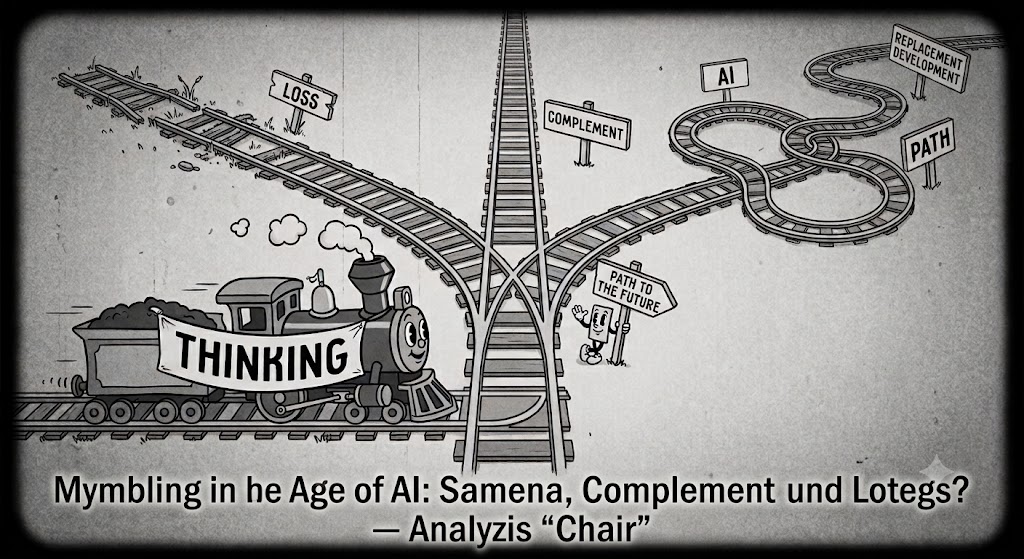
The future likely will not consist of a single program that looks at a text and responds with “AI” or “human.” Rather, a combination of techniques will emerge: hidden watermarks, metadata, cryptographic signatures, Content Credentials , and other forms of digital provenance tracking. The goal is not only to know who or what created something, but also what happened to that content afterward. This broadens the discussion beyond AI detection alone—ultimately, it is about digital authenticity.
Russia chooses a different route
Russia is also working on its own legal and technological framework for artificial intelligence. On July 26, 2026, Federal Law No. 243-FZ was officially published, titled “On the Support of the Development of Artificial Intelligence Technologies in the Russian Federation.” The law introduces, among other things, the categories of national and sovereign AI models: a sovereign model must be fully developed, trained, and hosted by a Russian party within Russian data centers; a national model must also be developed by a Russian party, but may contain foreign open-source components.
The general provisions of the Act enter into force on September 1, 2026. Specific parts — including the labeling of AI-generated content, rules regarding the use of copyrighted material for training, and the obligations for developers of sovereign and national designs — will not follow until March 1, 2027. A transitional period applies to existing systems until September 1, 2032.
The Russian approach differs clearly from the European one. While the EU focuses strongly on transparency and recognizability of AI content, Russia emphasizes technological independence, national infrastructure, and state control over the development and application of large AI models. It is therefore incorrect to simply regard Russian regulations as a Russian version of the European AI Act.
Can AI also enter the courtroom in Russia?
A Russian court will not automatically reject a procedural document simply because it was drafted using AI — there is no general rule for this. However, Russia has taken a step towards transparency regarding the use of AI in legal practice: the Russian Supreme Court clarified in May 2026 that a party providing information obtained using AI to the court must notify the court of this. This concerns information submitted as evidence — not every pleading or memorandum drafted using AI.
That distinction is crucial: a lawyer using AI to create a preliminary draft is not automatically in the same situation as someone presenting AI-generated information as evidence. Nevertheless, the development is significant—Russian jurisprudence no longer treats the use of AI solely as a technical tool, but also as something regarding which transparency toward the court may be required under certain circumstances.
The responsibility remains with the lawyer.
A lawyer can use AI to draft a first draft of a pleading, petition, or legal advice. That does not in itself invalidate the document. The problem arises when the lawyer forgets that AI is merely a tool: a language model can produce an incorrect article of law, misrepresent a judgment, or fabricate a non-existent ruling. When such an error ends up in a procedural document, the lawyer cannot defend themselves with “the AI wrote it” — professional responsibility remains with the lawyer .
Not only: “Did you use AI?” But above all: “What human control did you exercise over the AI output?”
In the future, a watermark may potentially serve as an indication of how a document was created. However, it does not in itself prove that a lawyer has committed a professional error.
Professional secrecy: another and potentially greater risk
For the legal profession, there is a risk that is more fundamental than digital marking. When a lawyer enters confidential information from a client file into an AI system, the question arises as to what happens to that information: where is it processed, who has access to it, how long is it retained, and what safeguards exist? That problem is separate from the watermark — a watermark indicates the origin of a text, not which confidential information was entrusted to the system during generation.
The translator between different AI worlds
Translators also face this issue. Suppose an international organization has an English-language report translated into Russian by an American AI model, after which a human translator checks and publishes the text. Is the AI origin still recognizable? Not necessarily: translation and thorough rewriting can affect forms of AI watermarking, although the development of more robust techniques makes it possible for markings to be more difficult to remove in the future.
The relevant question therefore shifts from “did AI do the translation?” to “what human contribution was made to the final result?” — relevant to quality, liability, transparency, and potential copyright issues.
Copyright: who is actually the author?
It is too simplistic to state that a text created with AI automatically lacks copyright protection. The assessment depends on the jurisdiction and the extent to which a human has made creative choices. The U.S. Copyright Office, for example, takes the view that the use of AI as a tool does not automatically exclude protection: where sufficient human creative input is present, protection may exist, whereas material generated purely by AI without sufficient human control falls outside of it. That assessment is made on a case-by-case basis.
A writer who uses AI to gather ideas and subsequently develops structure, argumentation, and phrasing themselves finds themselves in a different situation than someone who publishes AI output almost verbatim. A watermark does not resolve that legal question, but it could in the future serve as an indication in discussions about how a work came into being.
Europe, America, and Russia: three answers to the same question
Europe is attempting to legally enshrine AI transparency. American technology companies are developing techniques to make AI content and digital origin technically identifiable and verifiable. Russia is building a national and sovereign AI ecosystem, with rules intended to steer the development and use of large AI models within Russia.
These three systems do not necessarily reinforce each other. An American AI service can be used worldwide; European rules impose obligations on providers and users within the EU; Russia may specifically wish to promote national or sovereign models for certain applications. For international organizations, lawyers, translators, journalists, and businesses, this means that the question of the origin of digital information can become increasingly complex.
The end of mindless copy-pasting?
The arrival of AI watermarks does not mean the end of AI in professional occupations — on the contrary, AI will become an increasingly important tool for lawyers, journalists, translators, researchers, and writers. However, the meaning of human intervention is changing. Someone who uses AI as an assistant but subsequently checks facts, verifies sources, evaluates arguments, and takes personal responsibility for the final text is using AI fundamentally differently from someone who forwards the output virtually unchanged.
Not because a computer will ever simply be able to say “this text was written by AI,” but because we may be able to increasingly determine how digital content originated, what role AI played in that process, and what happened to it afterward. The real change is not that AI is getting an invisible signature, but that digital content is increasingly acquiring a verifiable history — and in a world where machines are becoming increasingly capable of writing, translating, analyzing, and creating, that demonstrable history could determine what we still consider authentic, reliable, and legally sound.
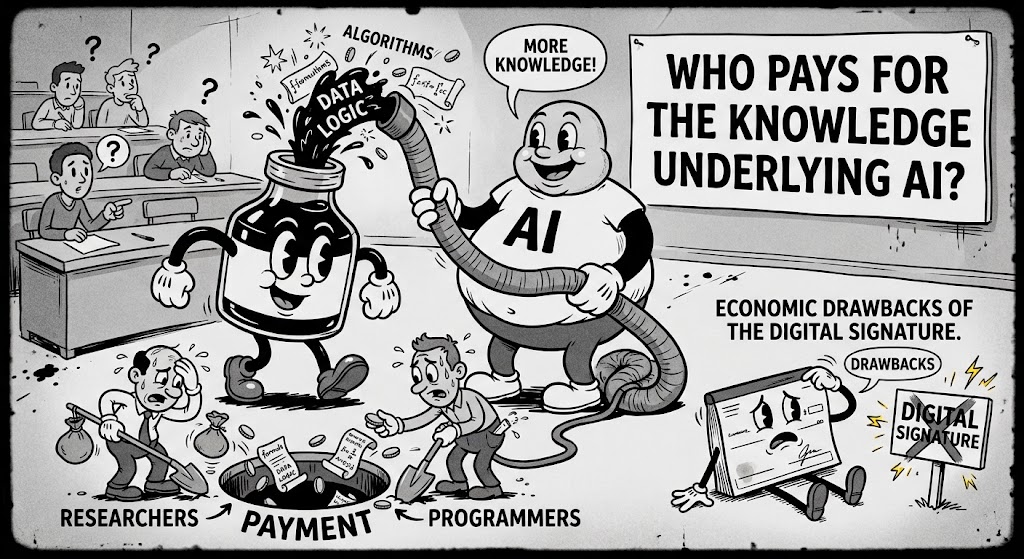
Behind this technical and legal development, however, also lies an economic question: who is entitled to compensation for the human content on which these AI systems have been trained? That is the subject of a subsequent article.


Bitcoin
$62,881.23

Ethereum
$1,672.04

Litecoin
$42.71

Dash
$37.08

Bitcoin Cash
$209.43