MEMORANDUM. PART 3: Geoeconomic Context — Europe as Eternal Bitcoin Importer, China as Architect of a Parallel System, the US Losing Control, BRICS+ as a Battlefield of Architectures, and Russia Between Old Pipes and the New Digital | SforNews
MEMORANDUM. PART 3. GEOECONOMIC CONTEXT: RUSSIA AS AN ENERGY SOVEREIGN
3.1. Europe — the Perpetual Importer of Bitcoin
Diagnosis: Europe closed nuclear power for political reasons. Killed oil refining. Abandoned cheap gas. Renewables do not provide baseload power.
Map: “Energy independence, green transition, cheap energy.”
Territory: Closed factories, dying industry, dependence on imports, gas at historic highs.
Architectural conclusion: Europe cannot return to cheap energy — it is a political taboo. The only way to gain access to “energy” without physical supplies is to buy Bitcoin. It will import it as a “clean asset,” but in reality — energy that it cannot produce itself.
Key fact: Europe pays $700–716 per thousand cubic meters of gas, with storage facilities 53.67% full (15.59 percentage points below average).
3.2. China — the Architect of a Parallel System
Diagnosis: China is not waiting for the old system to collapse. It is building a parallel one. e-CNY. mBridge. Gold for 20 consecutive months. Mining is officially banned, unofficially — one-third of the world’s hashrate.
Map: “The yuan as a global currency, exports, technological leadership.”
Territory: Debt, demographics, conflict with the United States, dependence on energy imports.
Architectural conclusion: China is the architect of its own system. mBridge is not a “SWIFT replacement,” but parallel infrastructure ($69 billion, 95% — in e-CNY). Russia for China is not a partner, but a supplier at a discount. The demand for $50 per thousand cubic meters under “Power of Siberia 2” is not bargaining. It is a diagnosis.
Key fact: China demands a price 5 times lower than the current one and 8 times lower than what other Gazprom clients pay.
3.3. The United States — Losing Control Over Global Liquidity
Diagnosis: The United States is the world’s largest economy, but its financial model is cracking at the seams. National debt — $39.38 trillion. The Fed keeps the rate at 3.5–3.75%, inflation has been above 2% for more than five years. Trust in the dollar is falling.
Map: “The dollar — global currency, Treasuries — risk-free asset, financial dominance.”
Territory: Debt of $40 trillion, declining trust, inflation, fragmentation of the world into currency blocs.
Architectural conclusion: The United States is the defender of the old system, attempting to use new instruments to preserve it. It bans CBDCs until 2030, but accumulates Bitcoin. It leads in mining (37.5–42.5%), but depends on Chinese equipment (97%). It promotes ESG, but ignores it at home.
Key fact: Net interest expenses will reach 13.95% of all federal spending in fiscal year 2026.
3.4. BRICS+ and Gold: An Alternative Circuit
Diagnosis: BRICS+ is not an “anti-Western club.” It is a laboratory in which different models of the future are being tested. China is building its own system. India is promoting CBDC integration. Russia is trying to monetize energy through mining — without a strategy. The UAE and Saudi Arabia bring control over energy capital.
Map: “Multipolarity, de-dollarization, technological sovereignty.”
Territory: Asymmetry within the bloc, lack of a unified strategy, legal vacuum.
Architectural conclusion: BRICS+ possesses enormous energy potential, but cannot coordinate it. Gold is the only asset that unites everyone (more than 6,000 tons, 17.4% of global reserves). But gold is the past. The future belongs to those who can convert energy into digital liquidity.
Key fact: The NDB approved more than 130 projects worth $42 billion over 10 years, but technological exchange does not occur — each country implements its own programs.
3.5. Russia Between Two Worlds: Old Pipelines and New Digital
Diagnosis: Russia is the only country that simultaneously:
- Has the cheapest energy in the world ($0.02–0.04/kWh).
- Ranks 2nd in the world in Bitcoin hashrate (13–17%).
- Has a huge energy surplus (Siberia, the Far East, hydroelectric power plants, nuclear power plants).
- Does not have a systemic strategy for using this resource.
- Is under sanctions that have cut off physical channels for energy exports.
Map: “Energy superpower, oil and gas exports, stable ruble.”
Territory: Pipelines are closed, tankers are under sanctions, refineries are underloaded, domestic fuel crisis, the Central Bank cannot contain inflation (9–12% against a forecast of 4–6%).
Architectural conclusion: Russia is not a “Bitcoin importer,” like Europe. It has its own energy, its own miners, its own reserves. But it does not use this resource systematically. For Russia, Bitcoin is the only available channel for monetizing energy under sanctions. This is not an “investment strategy.” This is a survival tool.
Key fact: The cost of mining 1 BTC in Russia is $35,000–45,000 — the lowest in the world.
3.6. Architectural Conclusion for Part 3
The world is not choosing between the old and new systems. It is redrawing the map along geopolitical lines.
Europe pays dearly for politics.
China demands subsidies through strength.
The United States is losing control over global liquidity.
BRICS+ is seeking an alternative circuit, but cannot agree.
Russia is losing ground due to the absence of alternatives.
Main conclusion: The old system is dead. It did not collapse — it simply stopped working. The new system can only be built around energy. And the only instrument that converts energy into global liquidity is Bitcoin.
The question is not whether the transition will happen. The question is who will be its architect.
APPENDICES TO THE MEMORANDUM
APPENDIX 1. EUROPE
Countries: Germany, United Kingdom, Switzerland, EU as a whole.
Key facts:
| Country | Role | Key fact |
|---|---|---|
| Germany | Victim of policy | Closed nuclear power, imports 95% of gas, stagflation, 0.5% growth |
| United Kingdom | Observer | Brexit, stagflation, debt at 94.3% of GDP, digital pound postponed |
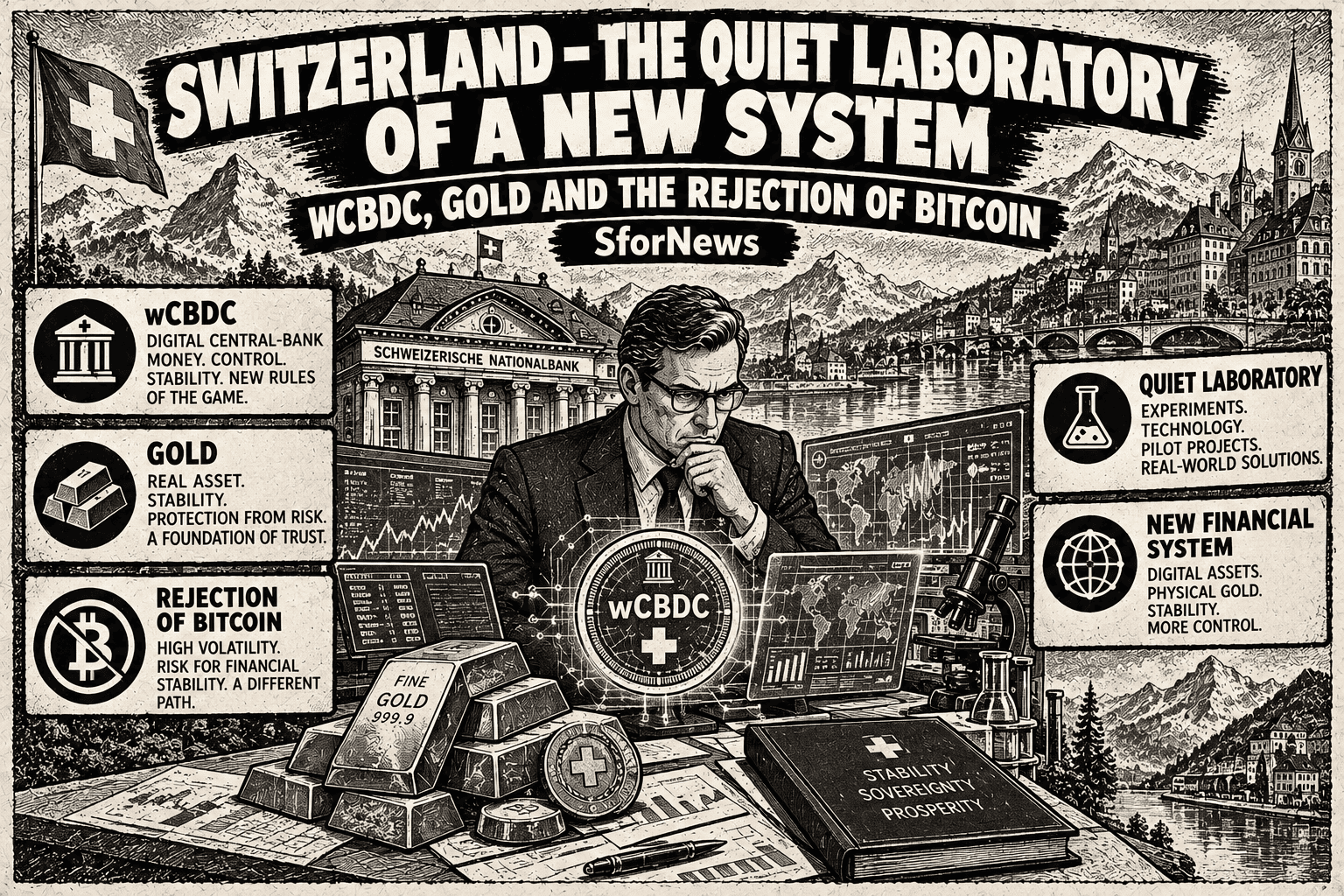
| Switzerland | Quiet laboratory | wCBDC, Crypto Valley, 47% of European blockchain financing |
| EU | Perpetual importer | Gas $700–716, storage 53.67%, industry is dying |
Architectural conclusion: Europe will become a perpetual importer of Bitcoin. It will buy it as a “clean asset,” but in reality — energy that it cannot physically produce.
APPENDIX 2. ASIA
Countries: China, India, Japan, UAE, Saudi Arabia, Kazakhstan, Oman, Turkey, Georgia.
Key facts:
| Country | Role | Key fact |
|---|---|---|
| China | Architect | e-CNY, mBridge $69 billion, gold for 20 consecutive months |
| India | Digital giant in a trap | UPI 10 billion transactions, e-Rupee, energy deficit, gray zone for crypto |
| Japan | Observer | Debt at 250% of GDP, YCC, exit from deflation postponed |
| UAE | Architect | ADGM, VARA, mBridge, mining on cheap gas, PIF $1 trillion |
| Saudi Arabia | Institutional builder | PIF $1 trillion, tokenization, mBridge, CRS 2.0 |
| Kazakhstan | Pragmatic builder | Digital tenge, 10% of mining in reserve, mBridge, 460,000 devices |
| Oman | Bridge and experiment | State pool Omanhash 10 EH/s, Trump threats |
| Turkey | Battlefield | 30% hyperinflation, ban on crypto ATMs, stablecoin limits |
| Georgia | Bridge between worlds | Gold, transit, digital lari, GELT, EU sanctions on 3 platforms |
Architectural conclusion: Asia is a battlefield of three strategies: state CBDC infrastructure (China), regulated private markets (Hong Kong, Singapore, Japan), direct accumulation and mining (UAE, Saudi Arabia, Kazakhstan, Oman).
APPENDIX 3. THE AMERICAS
Countries: United States, Brazil, Paraguay, Venezuela, El Salvador.
Key facts:
| Country | Role | Key fact |
|---|---|---|
| United States | Defender of the old system | Debt $39 trillion, mining leader at 37.5–42.5%, CBDC ban until 2030 |
| Brazil | Green giant | DREX, sugarcane mining, stablecoins 80% |
| Paraguay | Laboratory of success | 4th place by hashrate, 3,480 MW surplus, tariff $0.037–0.050 |
| Venezuela | Anti-example | Mining ban with 10.2 GW potential, destruction of 4,000 ASICs |
| El Salvador | First | Bitcoin reserve, but the IMF confirmed: purchases are from private donations |
Architectural conclusion: The Americas are a micro-model of the global transition. Everything is here: success (Paraguay, Brazil), failure (Venezuela), potential (United States), first experience (El Salvador).
APPENDIX 4. AFRICA
Countries: Ethiopia, Nigeria, South Africa, Kenya, Zambia.
Key facts:
| Country | Role | Key fact |
|---|---|---|
| Ethiopia | Breakthrough | Top-10 by hashrate (2.5%), 600 MW for mining, crypto ban for citizens |
| Nigeria | Second front | 25.9 million users, flared gas, SEC regulates |
| South Africa | Regulatory leader | Crypto assets = financial products, FATF Travel Rule |
| Kenya | Growing market | VASP Bill, mining discussions with Marathon Digital |
| Zambia | Mini-grids | A mining container with 120 ASICs turned an unprofitable hydroelectric plant into a sustainable one |
Architectural conclusion: Africa is a micro-model of the global transition. 90% of hydropower is unused. Mining as a “buyer of last resort” turns unprofitable renewable energy projects into sustainable ones.
APPENDIX 5. THE MIDDLE EAST
Countries: UAE, Saudi Arabia, Oman, Iran.
Key facts:
| Country | Role | Key fact |
|---|---|---|
| UAE | Architect | ADGM, VARA, mBridge, mining on cheap gas |
| Saudi Arabia | Institutional builder | PIF $1 trillion, tokenization, mBridge, CRS 2.0 |
| Oman | Bridge | State pool Omanhash 10 EH/s, Trump threats |
| Iran | Bitcoin as a weapon | Sanctions, $1.3 billion in mining, IRGC controls 50% |
Architectural conclusion: The Middle East is the region where oil meets the digital world. The UAE and Saudi Arabia are consciously building the new system. Iran is building it for survival. Oman is balancing between the United States and Iran.
APPENDIX 6. LATIN AMERICA
Countries: Paraguay, Brazil, Venezuela, Argentina, Colombia.
Key facts:
| Country | Role | Key fact |
|---|---|---|
| Paraguay | Laboratory of success | 4.3% of global hashrate, 3,480 MW surplus |
| Brazil | Green giant | DREX, mining on bagasse, stablecoins 80% |
| Venezuela | Anti-example | Mining ban, destruction of 4,000 ASICs, 2,500 MW deficit |
| Argentina | Loss | Hashrate fell by 42%, Bitfarms left, Vaca Muerta is waiting |
| Colombia | Attempt | Tariff $0.203/kWh — 4 times above profitability |
Architectural conclusion: Latin America is a micro-model of the global transition. Everything is here: success (Paraguay), failure (Venezuela), potential (Argentina), attempt (Colombia).
APPENDIX 7. RUSSIA AND THE POST-SOVIET SPACE
Countries: Russia, Kazakhstan, Georgia.
Key facts:
| Country | Role | Key fact |
|---|---|---|
| Russia | Energy sovereign without a strategy | 2nd place by hashrate, $35,000–45,000 cost, no strategy |
| Kazakhstan | Pragmatic builder | Digital tenge, 10% of mining in reserve, mBridge |
| Georgia | Bridge between worlds | Gold, transit, digital lari, GELT |
Architectural conclusion: The post-Soviet space is a laboratory where different models of transition are being tested. Russia has the resource, but does not have a strategy. Kazakhstan has a strategy and is building. Georgia is seeking its own path between East and West.
APPENDIX 8. COUNTRIES THAT BAN
Countries: Venezuela, Turkey, China (partially).
Key facts:
| Country | Ban | Reason |
|---|---|---|
| Venezuela | Complete mining ban since May 2026 | “Impact on the power grid,” destruction of 4,000 ASICs |
| Turkey | Ban on crypto ATMs, stablecoin limits | “Risks,” use of stablecoins to finance terrorism |
| China | Official mining ban | “Environmental risks,” but unofficially — 3rd place by hashrate |
Architectural conclusion: Bans do not work. Citizens continue to use cryptocurrencies to protect savings from inflation and devaluation. Bans only push them into the shadows.
APPENDIX 9. COUNTRIES THAT OBSERVE
Countries: India, Japan, United Kingdom, Switzerland, Germany.
Key facts:
| Country | Position | Key fact |
|---|---|---|
| India | Observer | UPI, e-Rupee, gray zone for crypto, top-5 by trading volume |
| Japan | Observer | Debt at 250% of GDP, YCC, exit from deflation postponed |
| United Kingdom | Observer | Brexit, stagflation, digital pound postponed |
| Switzerland | Quiet laboratory | wCBDC, Crypto Valley, 47% of European blockchain financing |
| Germany | Victim of policy | Closed nuclear power, imports 95% of gas, stagflation |
Architectural conclusion: Observers are those who have not yet decided. But their choice will determine the future. If they join the new system — it will become global. If they remain in the old one — it will exist in parallel.
APPENDIX 10. COUNTRIES THAT ARE BUILDING
Countries: UAE, Kazakhstan, El Salvador, Paraguay, Georgia, Saudi Arabia.
Key facts:
| Country | Building | Key fact |
|---|---|---|
| UAE | Crypto hub | ADGM, VARA, mBridge, mining on cheap gas |
| Kazakhstan | National crypto reserve | Digital tenge, 10% of mining in reserve, mBridge |
| El Salvador | Bitcoin reserve | First in the world, but the IMF confirmed: purchases are from private donations |
| Paraguay | Mining hub | 4.3% of global hashrate, tariff $0.037–0.050 |
| Georgia | Bridge | Digital lari, GELT, gold, transit |
| Saudi Arabia | Tokenization | PIF $1 trillion, mBridge, CRS 2.0 |
Architectural conclusion: Builders are those who are already creating the new system. They are not waiting for the old one to collapse. They are building in parallel. And their experience is the evidentiary basis of the Memorandum.


Bitcoin
$62,881.23

Ethereum
$1,672.04

Litecoin
$42.71

Dash
$37.08

Bitcoin Cash
$209.43