Memorandum. Volume II. Parts 8–9: International Context and Conclusion. Five Key Profiles and Who Will Be the Architect
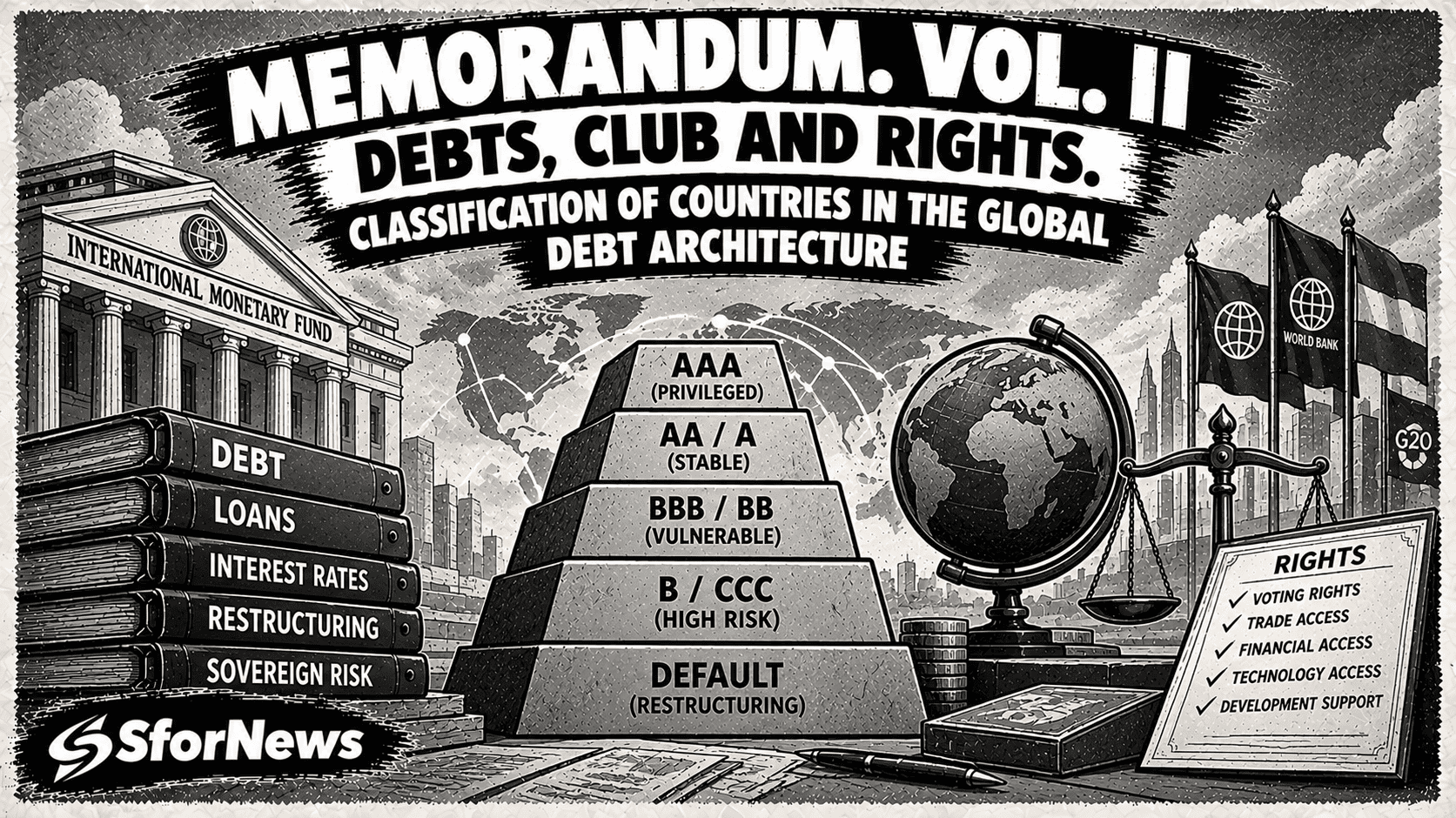
MEMORANDUM. VOLUME II
DEBT, THE CLUB, AND RIGHTS: CLASSIFICATION OF COUNTRIES WITHIN THE GLOBAL DEBT ARCHITECTURE
DISCLAIMER
This document is a conceptual project prepared on the basis of open-source data, public statements, and analytical materials. The memorandum is not a legal document, investment recommendation, or call to action. All conclusions are probabilistic and analytical in nature.
The boundary between the volumes
Volume I describes the physical architecture: energy as a common national asset, Bitcoin as an energy derivative, and the NES as a distribution mechanism. Volume I answers the question: what constitutes the resource.
Volume II describes the financial architecture: what debt is, who is inside the club, who is outside it, and what this means for sovereignty. Volume II answers the question: how this resource is extracted and how to build an alternative.
The elements described in Volume I (NES, Bitcoin as a derivative, and the physical chain “energy → mining → pool → citizens”) are not duplicated in this volume but referenced where relevant.
This volume is addressed to all countries. Debt is not just about economics. It is about power: who has the right to extract and who is obligated to pay.
Russia is the flagship in this volume, but not the only player. The world is already building a new system: China, the UAE, Oman, Kazakhstan, Paraguay, and Ethiopia. Russia will either join them as an architect or remain a resource supplier for those who build it.
PART 8. INTERNATIONAL CONTEXT: FIVE KEY PROFILES
8.1. United States
Role: Defender of the old system.
Key fact: National debt of $40.25 trillion [1]. The United States leads in mining, accounting for 35.6% of the hashrate. However, 97% of its mining equipment is Chinese.
The old model: what existed and what broke down
Three pillars: the dollar as the reserve currency, Treasuries as a “risk-free asset,” and military and technological dominance.
Three failures: debt is growing faster than the economy (interest expenses of $1.05 trillion, or 3.2% of GDP [6]); confidence in the dollar is declining (China holds $618 billion, the lowest level in years [7]); political instability (a new energy policy every four years).
Energy profile: what exists and what is missing
| What the United States has | What it lacks |
|---|---|
| Enormous gas reserves (40% of generation) | A unified energy strategy |
| Nuclear power (18% of generation) | Investment certainty |
| Growing renewables (30% of generation) | Sufficient grid capacity for AI data centers |
| Global leadership in oil and gas production | Energy sovereignty (97% of ASICs come from China) |
Figures: electricity generation of 4,368 billion kWh in 2026, a record [13]; consumption of 4,135 billion kWh [13].
Position on mining and crypto
Mining is legal in all 50 states. The key event of 2026 is the Mined in America Act (S. 4251), which introduces certification and equipment requirements (a ban on Chinese equipment from 2027, with a 0% share by 2030) and codifies the Strategic Bitcoin Reserve [10][11].
Paradox: the United States leads in mining but depends on China. It is creating a Bitcoin reserve while prohibiting CBDCs until 2030 [12].
Federal Reserve position
CBDCs are prohibited until 2030. Private stablecoins (USDC, USDT) are effectively becoming the “digital dollar” [9].
Architectural conclusion
The United States will not “import” Bitcoin the way Europe does. However, it is losing control over global liquidity because the old model (the dollar + Treasuries) no longer works, while the new one (a Bitcoin reserve + stablecoins) has not yet been built into a coherent system.
For the United States, Bitcoin is a political project: an attempt to preserve dominance by accumulating an asset whose issuance it cannot control, but which it can influence through regulatory levers and reserves.
8.2. Russia
Role: An energy sovereign without a strategy.
Key fact: Second place in Bitcoin hashrate, at 13–17%; the cost of mining 1 BTC is $35,000–45,000, reportedly the lowest in the world. Yet there is no systemic strategy.
The old model: what existed and what broke down
Three pillars: hydrocarbon exports, cheap labor and resources, and centralized governance.
Three failures: sanctions have closed the pipelines; oil does not solve the problem because of the Urals discount; inflation is at 9–12%, compared with the Central Bank’s forecast of 4–6%.
Energy profile: what exists and what is missing
| What Russia has | What it lacks |
|---|---|
| Enormous reserves of gas, oil, and coal | Export channels (pipelines are blocked) |
| Second place in hashrate (13–17%) | A systemic strategy for monetizing energy |
| Energy surplus (Siberia, the Far East, hydroelectric and nuclear power plants) | A legal status for mining |
| Some of the cheapest energy in the world ($0.02–0.04/kWh) | Access to international settlement systems |
Figures: generation of approximately 1,150 billion kWh; exports of approximately 20 billion kWh; surplus of approximately 200 GW.
Position on mining and crypto
Mining is legal at the federal level but lacks a dedicated legal status. On July 31, 2026, Resolution No. 936 prohibited mining in Moscow, the Moscow Region, and parts of the Kursk Region until December 31, 2032, due to grid overload. From July 1, 2027, only crypto exchanges included in the state register will be permitted.
Paradox: Russia has some of the cheapest energy in the world but does not create the conditions for legal mining. It ranks second in hashrate but does not capture the corresponding tax revenue.
Central Bank of Russia position
The key interest rate is approximately 18%. The digital ruble is in the pilot phase. Regulatory restrictions limit the domestic use of crypto. The Central Bank of Russia is not the architect of the new system. It is the liquidation commission of the old one.
Architectural conclusion
Russia will not “import” Bitcoin the way Europe does. It has its own energy, miners, and reserves. But it does not use this resource systematically. Under sanctions, Bitcoin is Russia’s only available channel for monetizing energy. Yet Russia is not using it strategically.
8.3. China
Role: Architect of a parallel system.
Key fact: mBridge has processed $55–83 billion in transactions, 95% of them in e-CNY [9]. China has increased its gold holdings for 20 consecutive months [8]. Mining is officially prohibited, yet China still accounts for 11.7% of the global hashrate.
The old model: what existed and what broke down
Three pillars: export orientation, investment in infrastructure, and the demographic dividend.
Three failures: slowing growth; a declining population (down 3.39 million in 2025); and a rising debt burden, with public debt reaching 96% of GDP by 2027.
Energy profile: what exists and what is missing
| What China has | What it lacks |
|---|---|
| Enormous coal capacity (more than 50% of generation) | Cheap gas (it depends on imports) |
| Global leadership in renewables (solar and wind) | Sufficient transmission grid capacity |
| Active nuclear power construction | A flexible energy system (renewable energy curtailment of 8–9%) |
| The world’s largest coal production and consumption | Energy sovereignty (dependence on imported oil) |
Figures: energy investment of $940 billion in 2026; renewable generation reaching 6 trillion kWh by 2030; renewable energy curtailment of 8–9%.
Position on mining and crypto
An official ban has been in place since February 2026. In practice, China still accounts for 11.7% of the global hashrate, or approximately 125 EH/s. Sources include otherwise wasted electricity, unauthorized transfers of electricity, and partial legalization in certain regions using 100% renewable energy.
The trend is toward tighter restrictions: mining capacity in Xinjiang has been shut down, while AI data centers have been given priority.
Paradox: China prohibits mining, but its share of the hashrate remains significant. This is not merely a matter of policy. It is physics: surplus energy has to go somewhere.
People’s Bank of China position
The e-CNY became an interest-bearing instrument in January 2026. An international operations center was launched in Shanghai in June 2026. mBridge has processed $55–83 billion, with 95% in e-CNY. China has increased its gold holdings for 20 consecutive months, bringing reserves to 2,346 tonnes.
Architectural conclusion
China will not “import” Bitcoin the way Europe does. It has its own energy, digital currency, and reserves. For China, Bitcoin is a tactical instrument in a much larger strategic game.
8.4. BRICS+
Role: A battleground of competing architectures.
Key fact: 6,000 tonnes of gold, representing 17.4% of global reserves [8]. Yet there is no unified strategy.
The old model: what existed and what broke down
Three pillars: the dollar as the foundation of international settlements, SWIFT as a neutral protocol, and Western technological dominance.
Three failures: the dollar is losing its status as a “risk-free asset”; SWIFT is no longer neutral (Russian banks were disconnected in 2022); technological dependence persists, even as its center of gravity shifts from West to East.
Energy profile: what exists and what is missing
| What BRICS+ has | What it lacks |
|---|---|
| Control over major global oil and gas reserves | A unified energy strategy |
| Leadership in critical minerals | Coordinated pricing policy |
| The world’s largest reserves of cheap hydropower | Sufficient data-center capacity |
| Recognition of the sovereign right to choose an energy mix | Investment certainty |
Figures: 40% of global GDP at purchasing power parity; 6,000 tonnes of gold; mBridge at $55–83 billion.
Position on mining and crypto
Three camps have emerged: prohibition and restrictions (China, India, Russia); active development (the UAE, Saudi Arabia); and regulatory leadership without mining.
The BRICS+ paradox
The bloc promotes de-dollarization, but a new hierarchy is emerging within it: China’s digital currency dominates the others, accounting for 95% of mBridge transactions in e-CNY. This is not an alliance of equals, but a new form of dependence.
New Development Bank position
Over ten years, the bank has financed 130 projects worth $42 billion. However, technological exchange is not taking place: each country pursues its own programs. BRICS Pay remains a declaration of intent.
Architectural conclusion
BRICS+ will not become a replacement for the old system. It will become one of several systems competing for global influence. BRICS+ is not the architect of the new system. It is the battleground of competing architectures.
8.5. Europe
Role: The perpetual importer of Bitcoin.
Key fact: Gas costs $700–716 per thousand cubic meters, while storage facilities are 53.67% full, 15.59 percentage points below the average. Industry is dying.
The old model: what existed and what broke down
Three pillars: nuclear power plants, oil refining, and cheap Russian gas.
Three failures: nuclear plant closures following Fukushima; the destruction of refining capacity (more than 20 refineries closed between 2010 and 2015); and the abandonment of Russian gas, replaced by expensive American LNG.
Energy profile: what exists and what is missing
| What Europe has | What it lacks |
|---|---|
| Wind turbines and solar panels (intermittent) | Reliable baseload power (nuclear, coal, gas) |
| High gas prices (a political taboo) | Cheap Russian gas |
| Imported LNG from the United States | Domestic oil-refining capacity |
| Green ideology in place of physical realities | Resources for an industrial breakthrough |
Figures: gas at $700–716; storage at 53.67%; renewables do not provide baseload power (capacity factors: solar 10–20%, wind 30–40%).
Position on crypto and mining
MiCA (2024) requires licensing for crypto platforms. The 21st sanctions package included crypto platforms operating on behalf of Russia. Europe’s share of the global hashrate is below 1%. Electricity prices of $0.08–0.12/kWh make mining economically unviable.
Paradox: Europe regulates crypto as though it will be European. But it will not. Bitcoin is a global asset that does not depend on any single jurisdiction.
European Central Bank position
The interest rate is approximately 4%. The digital euro is in the pilot phase, but its launch is not expected before 2029. The ECB is powerless in the face of an energy collapse: its instruments do not work.
Architectural conclusion
Europe cannot physically supply itself with enough energy. It must import it. But importing gas and oil is expensive, politically disadvantageous, and unsafe. The remaining option is to import Bitcoin. Bitcoin becomes the digital equivalent of energy, which Europe will import in growing volumes.
PART 9. CONCLUSION: WHO WILL BE THE ARCHITECT?
9.1. The question is not whether the transition will happen
The transition has already begun. It is not something that “will happen.” It is happening now. Most people simply fail to notice because they look at the map rather than the territory.
What has actually happened:
- The dollar has ceased to be a risk-free asset. It can be confiscated for political reasons (the freezing of central bank reserves was a financial Chernobyl).
- The pipelines are closed. Nord Stream is history. Ukrainian transit has stopped. Europe pays $700 per thousand cubic meters.
- China is demanding $50 for gas under Power of Siberia 2. This is not bargaining. It is a diagnosis.
- The United States is prohibiting CBDCs until 2030 while accumulating Bitcoin.
- Europe has shut down nuclear power, destroyed its oil-refining industry, abandoned Russian gas, and now imports energy in digital form.
- Russia has some of the cheapest energy in the world and ranks second in hashrate, but it has no strategy.
This is not a “crisis.” It is a phase transition. The old system has not collapsed. It has simply stopped working. And the new system is already being built, just not in the places where people are looking for it.
9.2. The question is who will lead it
The world is not choosing between the old and the new system. It is redrawing the map along geopolitical lines. Each player has a different role.
China — architect of a parallel system. e-CNY. mBridge ($55–83 billion, 95% in e-CNY). Twenty consecutive months of gold accumulation. China is not fighting the dollar; it is creating an alternative.
United States — defender of the old system. Debt of $40.25 trillion. Inflation above 2% for five years. CBDC prohibition until 2030. Mining leader (35.6%), but dependent on Chinese equipment (97%).
Europe — the perpetual importer of Bitcoin. It will buy Bitcoin as a “clean asset,” but in reality it will be buying energy that it cannot physically produce.
The UAE, Saudi Arabia, Kazakhstan, and Oman — builders. They are not waiting for the old system to collapse. They are building in parallel. Their experience provides evidence that alternatives can be developed.
Iran — an experiment. Bitcoin as a weapon of survival. Sanctions, $1.3 billion in mining, and the IRGC controlling 50%.
Russia — an energy sovereign without a strategy. It has everything the new system needs: cheap energy, a cold climate, and the world’s second-largest Bitcoin hashrate. But it has no strategy.
9.3. An architect is someone who sees the entire system
An architect is not the person who shouts the loudest. Not the person with the most money. Not the person who arrived first. An architect is someone who sees the entire system: energy, Bitcoin, law, people, and time—and knows how to assemble them into a functioning structure.
What is required:
- Legal recognition of energy as a common national asset. An amendment to the Law on Subsoil or a separate Federal Law on National Energy Ownership.
- Recognition of Bitcoin as a derivative of energy. An amendment to the law on digital financial assets.
- Creation of a State Energy-Digital Converter (State Corporation “Energy-Digital”). It would accumulate surplus energy, direct it toward mining, and transfer the Bitcoin mined to a single public wallet.
- A distribution mechanism—the People’s Energy Certificate (NES). Each citizen would receive a share of the Bitcoin pool mined during the month. The mechanics are described in Volume I, Section 2.4.
- Resolution of the Russian Federation versus USSR succession issue. Restitution of Soviet-era rights through the Constitutional Court.
- Oversight and transparency. A State Information System for Energy and Digital Assets (GIS TEK-Digital), a public wallet registry, and a public council.
This is not a “utopia.” It is an architectural plan. Every step has an implementation mechanism. Every step is connected to the others.
9.4. Two paths. There is no third option
Path one: Russia becomes the architect of the new system. It recognizes energy as a common national asset. It creates the converter, mines Bitcoin, and distributes revenue through NES. Citizens receive direct payments. Loyalty emerges. Identity emerges. Sovereignty emerges.
Path two: Russia remains a resource supplier for those who lead the transition. Energy is wasted. Private entities mine Bitcoin. Revenue accumulates offshore. Citizens see nothing. The system ultimately collapses.
There is no third option.
But the world will not wait. China, the UAE, Oman, Kazakhstan, Paraguay, and Ethiopia are already building. Russia will either join them as an architect or remain a resource supplier for those who build.
9.5. What to do now
- Establish a legal precedent by submitting an appeal to the Constitutional Court on behalf of a group of citizens or lawmakers.
- Draft and introduce a bill on National Energy Ownership in the State Duma through sponsoring legislators.
- Launch an information campaign to explain to citizens that Bitcoin is not “American speculation,” but their energy, allegedly taken from them through privatization.
- Create a pilot project in one region (Irkutsk Oblast), where mining using state-owned capacity is already operating, and demonstrate how revenue could be distributed among residents.
- Document every step in public materials: manifestos, appeals, and draft legislation. Even if the current government does not adopt the proposal, the mechanism will be ready for implementation in two to three years.
At the international level
- Propose an energy standard within BRICS+, analogous to Basel but designed for energy.
- Integrate NES-like mechanisms into mBridge, enabling settlements in energy certificates.
- Create a gold-and-energy reserve to diversify away from the dollar.
We are not waiting for the government to adopt this scenario. We are assembling it. And when it becomes inevitable, it will already be ready.
9.6. The main conclusion
The old system is dead. It has not collapsed; it has simply stopped working.
The evidence:
- The dollar is not backed by a tangible asset (50 years of fiat deception).
- The map does not reflect the territory (forecasts diverge from reality).
- Russia has a unique resource: some of the cheapest energy in the world.
- Europe has become the perpetual importer of Bitcoin.
- No central bank has found a solution; all are trying to adapt old instruments to a new reality.
- The Central Bank of Russia is a liquidation commission.
- Independent experts Yan Krivonossov and Vladimir Levchenko confirm that the system is not being managed and that old models no longer work.
The new system can only be built around energy. And the only instrument that turns energy into global liquidity is Bitcoin.
The question is not whether the transition will happen. The question is who will be its architect.
Russia can become that architect. It has everything the new system needs: cheap energy, a cold climate, and the world’s second-largest Bitcoin hashrate. But it has no strategy.
Russia will either remain a resource supplier for those who lead the transition or become its architect.
There is no third option.
APPENDICES
Appendices 1–23. Country Profiles
The full country profiles (23 regions: Europe, Russia, the United States, China, BRICS+, Japan, Turkey, Iran, the UAE, Saudi Arabia, Kazakhstan, Georgia, Brazil, India, Latin America, Africa, Asia, Germany, the United Kingdom, Oman, Venezuela, Paraguay, and Switzerland) are contained in Volume I (Appendices 1–23).
This volume provides expanded profiles of five key players in the debt architecture (Part 8): the United States, Russia, China, BRICS+, and Europe.
Appendix 24. Legal Wording
- Draft Federal Law on National Energy Ownership.
- Amendment to the law on digital financial assets (Bitcoin as a derivative of energy).
- Draft Federal Law on the State Energy-Digital Converter.
- Amendments to the Civil Code (the institution of “national shared ownership”).
- Appeal to the Constitutional Court (restitution of Soviet-era rights).
Appendix 25. Economic Calculations
- NES formula.
- Mining revenue forecast (1% / 5% / 10% scenarios).
- BTC → CBDC conversion mechanism.
- 50/30/20 distribution.
- Comparison with Alaska, Norway, and the UAE.
Appendix 26. Timeline, 1971–2026
| Year | Event | What broke down | What was built |
|---|---|---|---|
| 1971 | Nixon ends the dollar’s convertibility into gold | Bretton Woods system | Petrodollar |
| 1973 | Oil embargo | Cheap energy for the West | OPEC as a geopolitical player |
| 1974 | Basel Committee established | — | A club of banking regulators |
| 1980s | Latin American debt crisis | Loan-based development model | Washington Consensus |
| 1990s | Privatization in Russia | Common national ownership | Oligarchic capitalism |
| 2001 | Enron bankruptcy | Confidence in corporate reporting | Sarbanes–Oxley Act |
| 2008 | Global financial crisis | Confidence in mortgage derivatives | Quantitative easing |
| 2011 | Fukushima; Germany moves to phase out nuclear power | Europe’s nuclear energy model | Renewables agenda |
| 2022 | Sanctions against Russia; disconnection from SWIFT | SWIFT’s neutrality | Parallel systems (mBridge) |
| 2023 | Silicon Valley Bank collapse | Confidence in regional banks | Emergency Federal Reserve measures |
| 2024 | MiCA enters into force | Crypto’s regulatory grey area in the EU | Regulated market |
| 2026 | mBridge at $55–83 billion; Mined in America Act; Basel III repealed for the United States | Unity of Basel standards | Parallel systems |
Appendix 27. Glossary
- Derivative
- NES
- Basel
- mBridge
- CBDC
- ESG
- Stablecoin
- Hashrate
- Curtailment
- PPA
Appendix 28. Sources
- US Treasury / JEC (October 2026) — US national debt of $40.25 trillion.
- IMF World Economic Outlook (2026) — public debt and debt-to-GDP data.
- IMF WEO, April 2026 / October 2026 — Japan: 204.4% / 199.4%.
- AAF (American Action Forum) — US public debt at 100% of GDP in FY2026.
- IMF WEO, October 2026 — China: 104.4%, including part of local government financing vehicles (LGFVs).
- US Treasury, TIC data (August 2026) — Treasury holders: Japan, $1.07 trillion; United Kingdom, $1.01 trillion; China, $0.59 trillion.
- Money Today (September 2026) — China reduces its Treasury holdings.
- BRICS Council / Russian Ministry of Energy (June 26, 2026) — BRICS+ gold holdings of 6,000 tonnes.
- CoinMarketCap / SCMP / Atlantic Council — mBridge at $55–83 billion.
- Congress.gov / S. 4251 — Mined in America Act.
- Federal Register / Executive Order 14233 — Strategic Bitcoin Reserve.
- Hashrate Index (October 2026) — US share of 35.6%, Russia 18.1%, China 11.7%.
- EIA Short-Term Energy Outlook (September 2026) — US electricity generation and consumption.
- SforNews / “Kafedra” — editorial team of the “Kafedra” and SforNews publications.
© 2026, Editorial Team of “Kafedra” and SforNews. Attribution to the original source is mandatory when quoting.


Bitcoin
$62,881.23

Ethereum
$1,672.04

Litecoin
$42.71

Dash
$37.08

Bitcoin Cash
$209.43