Daily Summary, February 11
Daily Digest • February 11
The Great Inversion: Traditional Finance Capitulates, Crypto Infrastructure Prepares for the Reign of Agents
—
1. REGULATION AND LAW ENFORCEMENT: OLD MECHANISMS VS. NEW REALITY ⚖️🛡
Bank representatives refused to discuss the stablecoin yield bill at the White House.
* Analysis: A classic case of cognitive dissonance among legacy institutions. Stablecoins have long been generating implicit yield through DeFi protocols, but the banking system fundamentally cannot legitimize what destroys its monopoly on money creation. Refusing dialogue is not strength, but a defensive reaction of an obsolete paradigm.
Russia has begun imposing fines for paying for imported cars with cryptocurrency.
* Analysis: The state is consistently closing channels for “household” use of crypto. Unable to control cross-border crypto settlements, it imposes sanctions at the entry point—at the customs clearance stage. This increases costs for the end consumer but does not solve the control problem. Gray schemes will simply become more sophisticated.
Former SafeMoon CEO sentenced to 8 years in prison for defrauding investors of $9 million.
* Analysis: A signal of retribution from U.S. justice. Despite the hype and memes, regulators no longer forgive blatant scams. The sentence is symbolic: the industry is ceasing to be the “Wild West” for first-level fraudsters. The price of reputational risk has risen sharply.
RAKIB has launched an inspection of Bitmain’s activities in Russia following complaints about faulty equipment and warranty issues.
* Analysis: The first symptom of service institutionalization in the Russian mining industry. The market no longer tolerates suppliers selling a “pig in a poke.” Warranty and defect complaints are a sign of maturation: clients demand quality, and the regulator (in the form of an industry association) is beginning to perform consumer protection functions.
—
2. INSTITUTIONAL EXPANSION: TITANS VOTE WITH THEIR MONEY 🏛💰
Goldman Sachs disclosed its crypto positions: ~$1.1B in BTC, $1B in ETH, $153M in XRP, and $108M in Solana — all via spot ETFs.
* Analysis: A historic moment. Goldman Sachs has officially become a major holder of crypto assets. Crucially, all positions are held through regulated ETFs. This is not speculation by “hot” traders; it is institutional capital allocation accountable to shareholders. Bitcoin and Ethereum are recognized as instruments worthy of a global investment bank’s balance sheet. XRP and Solana in the portfolio represent diversification attempts and hints at future expectations.
Binance and Franklin Templeton announced a strategic partnership to develop digital investment products at the intersection of traditional finance and blockchain.
* Analysis: Symbiosis of giants. The largest exchange and an asset management company with trillions in assets are joining forces. Franklin Templeton brings traditional finance expertise and the trust of conservative investors. Binance brings technology, liquidity, and access to a global audience. This is a step toward building a bridge between TradFi and DeFi without legacy intermediaries.
BlackRock launched trading of its tokenized bond fund BUIDL via DeFi on Uniswap.
* Analysis: The strongest signal of the day. The world’s largest asset manager (with over $10 trillion AUM) is entering open DeFi. BUIDL is not a speculative token but a U.S. Treasury bond fund generating real yield. By listing it on Uniswap, BlackRock is betting that institutional investors will trade traditional assets in a decentralized environment. DeFi is no longer a “crypto enclave” but a distribution channel for Wall Street.
—
3. REAL-WORLD ASSET TOKENIZATION: THE STATE ENTERS THE GAME 🏛📜
The Russian Government approved the Concept for Tokenization of Real Sector Assets (RWA), prepared by the Ministry of Finance together with the Central Bank, and is moving to its practical implementation.
* Analysis: A turning point for the Russian blockchain economy. After prolonged hesitation, the state has chosen RWA as the mainstream development path. The thesis: not legalizing cryptocurrencies as a means of payment, but tokenizing tangible assets (oil, metals, grain, real estate) to increase liquidity and investment attractiveness.
* Strategic meaning: Russia is creating a digital alternative to attract capital to the real sector under sanctions isolation. This is a parallel financial system where blockchain becomes an infrastructure of trust, not a threat. The key question is which platforms and under whose management these tokens will be issued. The battle for this market is just beginning.
—
4. MARKETS AND INFRASTRUCTURE: A NEW LENS FROM THE LEADERS 🔭⚙️
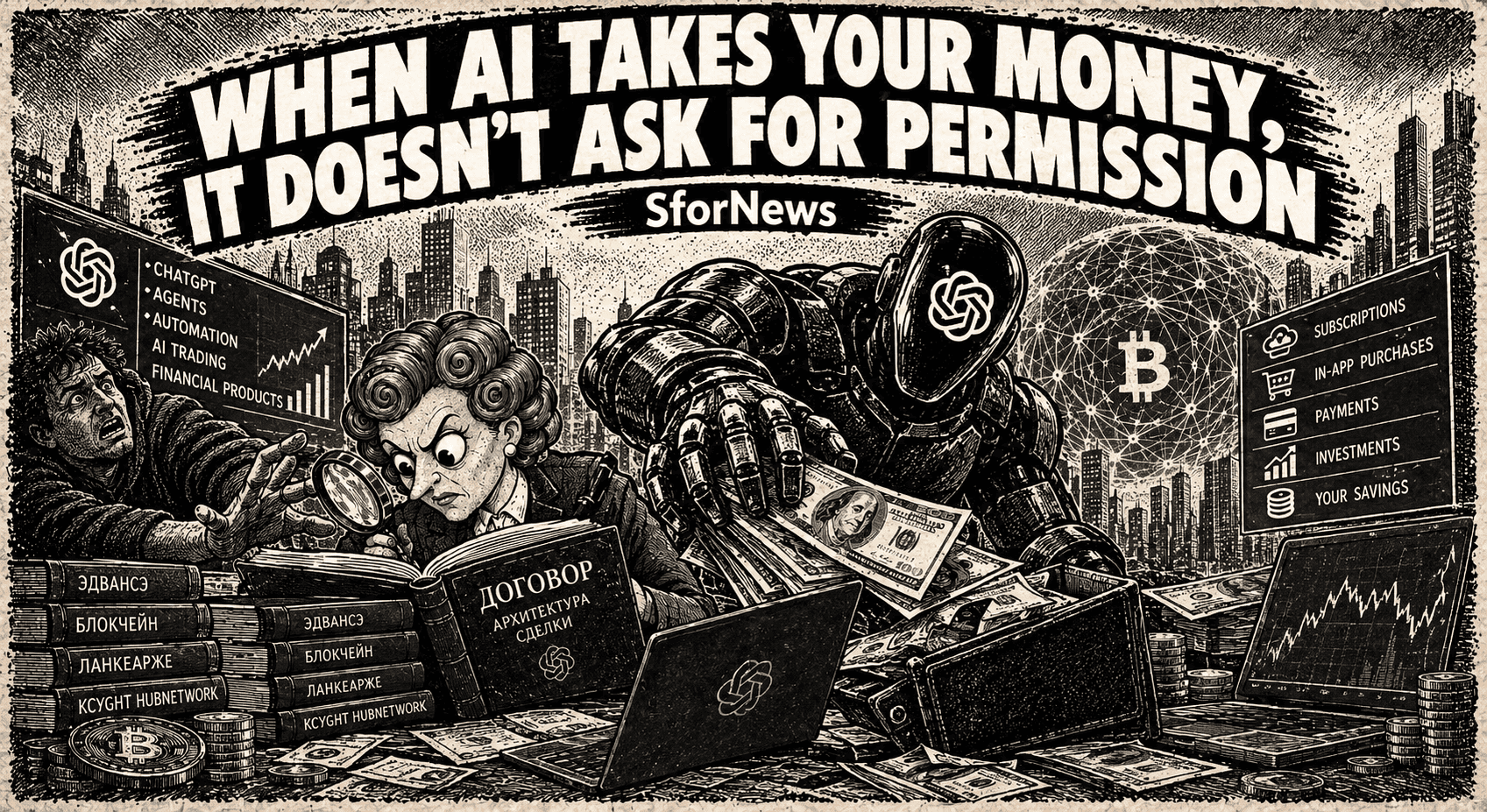
Changpeng Zhao stated that the banking system is not ready for the AI agent economy, and cryptocurrency will become its basic infrastructure.
* Analysis: A manifesto from CZ. He shifts the narrative from “crypto as investment” to “crypto as the operating system of the future economy.” AI agents cannot have bank accounts (KYC, legal capacity), but they can own crypto wallets. If AI is to transact, exchange value, and manage capital, it will need programmable money and decentralized protocols. Binance is preparing to become a broker for billions of agents.
Arkham plans to shut down its own exchange due to low popularity.
* Analysis: A sober assessment of failure. Arkham is a strong brand in analytics, but attempting to enter the highly competitive exchange market proved to be a mistake. This is a sign of maturity: companies stop burning cash on non-core verticals and focus on core competencies. Closing a failed project is also a strategy.
Bitmine increased its staked ETH volume to ~3 million coins.
* Analysis: Staking consolidation in the hands of large players. 3 million ETH is ~$8 billion at current prices. Bitmine is becoming one of Ethereum’s key validators, strengthening its influence and earning stable yield. This is the institutionalization of passive income from Proof-of-Stake.
A user paid 64 ETH ($126,000) in fees for a single transaction.
* Analysis: Human error or a strange experiment. Either way, it’s a reminder of the irreversible nature of transactions. Crypto infrastructure demands the highest responsibility. One extra zero in gas price, and you’ve paid the annual budget of a small company. The price of freedom is the fatality of error.
—
SYSTEMIC TRENDS OF THE DAY:
* 🏛 RWA Tokenization Trend: Russia, BlackRock, and Franklin Templeton are synchronously moving toward digitalization of traditional assets. This is the mainstream trend of 2026. The convergence of the real world and blockchain is no longer exotic—it is the strategy of the largest players.
* 🤝 TradFi + Crypto Partnership Trend: Goldman via ETFs, Binance with Franklin Templeton, BlackRock on Uniswap. The divide between “crypto” and “finance” is disappearing. What remains is simply finance, using the best available technology.
* ⚖️ Regulatory Pressure & Selection Trend: Scammers get prison time (SafeMoon), states fine for rule circumvention (Russia), while compliant players gain recognition (Bitmain under review, but legal). The industry is being filtered.
* 🧠 AI Agent Economy Trend: CZ sets a new framework. The future battle is not for human wallets, but for the wallets of digital entities. Infrastructure for machine-to-machine payments will be the next billion-dollar market.
—
ARCHITECTURAL CONCLUSION
February 11 — the day of final recognition. Traditional finance has ceased to be an observer and has become a player.Goldman Sachs, BlackRock, Franklin Templeton are no longer experimenting. They are allocating capital, building products, and integrating into DeFi. Simultaneously, Russia is approving a strategy for tokenizing real-world assets. Banks, on the other hand, refuse dialogue on stablecoins, voluntarily ceding the battlefield.
The key conflict has shifted: it was once “crypto vs. banks.” Now it is “traditional finance that has embraced blockchain vs. traditional finance that denies the inevitable.” The former will grow and capture markets. The latter will slowly fade, losing clients and competencies.
The key insight: Capital always chooses the most efficient infrastructure. Today it voted for ETFs, tokenized funds, and partnerships with crypto exchanges. Tomorrow it will vote for AI agents as equal economic actors. The infrastructure capable of serving this new world is already being built — on blockchain.
The market has passed the “adoption” stage. The “integration” stage begins. And it will be far more massive than a mere speculative race.


Bitcoin
$62,881.23

Ethereum
$1,672.04

Litecoin
$42.71

Dash
$37.08

Bitcoin Cash
$209.43