The Russian economic paradox: how war growth shifts the bill to tomorrow
The Russian economic paradox: how war growth shifts the bill to tomorrow
By Antonio Georgopalis
Expert Financial European Affairs
August 13, 2026
Anyone looking solely at Russian economic statistics from the past war years can easily draw the wrong conclusion. Western sanctions were supposed to isolate Russia and break it economically, but the economy continued to grow. Unemployment is exceptionally low, defense factories continue to operate, and wages rose sharply in some sectors.
That picture is not fabricated. The Russian war economy has indeed created jobs, orders, and incomes. But it is no proof that war generates sustainable prosperity. The fundamental question is not only how much Russia produces today, but what it produces, what resources are sacrificed for it, and what remains when the exceptional war expenditures decrease.
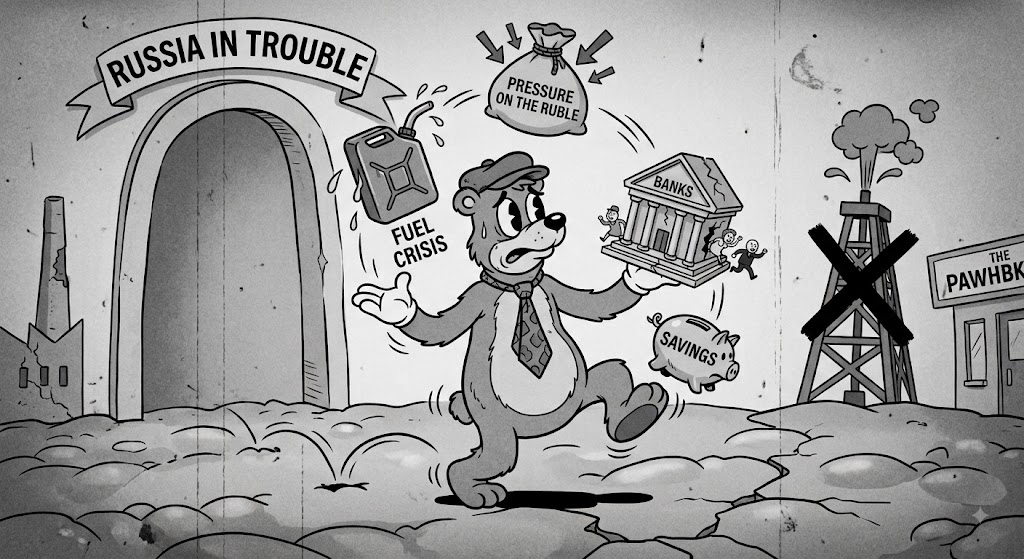
Therein lies the Russian paradox. The war has not simply protected the economy from a recession. It has created a form of growth that is largely driven by government spending, military production, and credit. At the same time, that same war is siphoning labor, capital, fiscal space, and innovation away from the civilian economy. This process can be called economic cannibalism: the military sector feeds on resources that would otherwise be available for productive civilian investments.
The economic hangover is therefore not exclusively something for after a potential peace. It is already visible in the sharp slowdown in growth, high financing costs, and increasing pressure on the government budget.
Russia is not in a deep recession, but the growth engine has almost stalled.
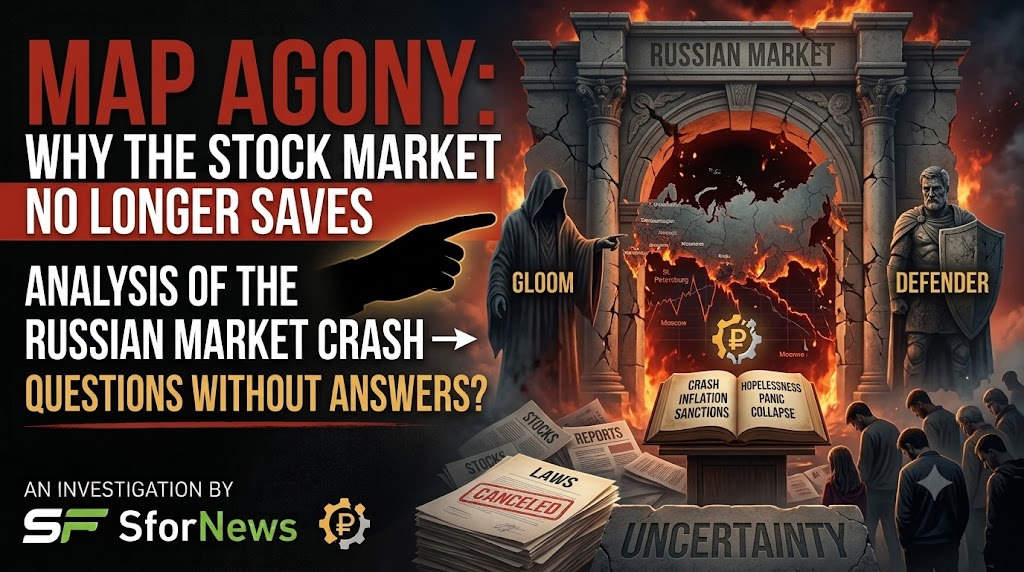
Caution is necessary. Russia will not be demonstrably in a deep recession in August 2026. The Russian central bank still expects growth between 0 and 1 percent for the whole of 2026. The International Monetary Fund is slightly more optimistic and estimates 1.1 percent growth. Those are low, but not negative figures.
The contrast with the war years is sharp, however. According to the IMF, the Russian economy still grew by 4.9 percent in 2024 and by 1 percent in 2025. The transition from nearly 5 percent growth to around 0 to 1 percent means that the expansion driven by war spending has lost considerable momentum.
The central bank itself adjusted its growth forecast downwards to 0 to 1 percent in July. This occurred while it indicated that businesses had lowered their expectations for demand and production. The official message is therefore not “crisis over,” but rather: the economy is running much slower than during the earlier military stimulus.
That is the first correction to the popular portrayal of Russia as economically indestructible. The war has not made the economy independent of economic laws. Above all, it has artificially increased demand in a country where personnel, technology, and capital are scarce.
The war economy: high production, but not necessarily more prosperity
War expenditures are economically misleading. They are included in the gross domestic product because a factory producing shells, drones, or armored vehicles uses labor, energy, steel, and parts. However, that production does not necessarily yield the same future prosperity as an investment in a railway, hospital, school, energy grid, or modern civilian factory.
A new production machine can contribute to exports and productivity for years. A well-maintained railway reduces transport costs for decades. Education and healthcare strengthen human capital. Ammunition consumed at the front, on the other hand, disappears from the economy without generating income or productivity later.
That does not mean that every military expenditure is economically useless. Defense can create technological knowledge, industrial capacity, and employment. However, in the Russian context, the scale of the shift is the determining factor. SIPRI estimates military spending in the Russian budget for 2026 at 14.9 trillion rubles, or approximately 6.3 percent of GDP. For 2025, the military burden amounted to 7.5 percent of GDP using the same method.
That is no longer an ordinary budgetary priority. It is an economic restructuring.
Labor: the defense sector draws workers away from the rest of the country
The most visible form of economic cannibalism takes place in the labor market. Russia is struggling with particularly low unemployment and a structural shortage of personnel. Mobilization, war casualties, emigration, demographic decline, and the expansion of defense production have combined to create a tight labor market.
According to the Russian figures referred to by the IMF, unemployment stood at only 2.1 percent in February 2026. For those seeking work, this is favorable in the short term. Employers must offer higher wages, bonuses, and better conditions to retain staff. For workers in defense, heavy industry, logistics, and certain industrial cities, the war economy can therefore yield real income gains.
But not all companies can bid.
A defense company with state orders and government support can offer higher wages than a small producer, a supermarket chain, a transport company, an agricultural enterprise, or a local service provider. The consequence is that the civilian economy loses personnel to the sector that is given priority before the war.
For the average Russian, this can paradoxically be both beneficial and harmful at the same time. Someone might find work more easily or receive a higher wage, but simultaneously notice that shops have fewer staff, medical care is becoming harder to access, transport is becoming more expensive, or local businesses are functioning less effectively.
The war therefore not only creates jobs. It redistributes scarce personnel to the sector that the state deems most urgent.
High interest rates: the military economy gets oxygen, the civilian economy pays.
A war economy creates high demand. The state orders materials, pays wages, and distributes benefits. If the supply of personnel and goods does not rise at the same rate, inflation sets in.
The Russian central bank is trying to curb that inflation with high interest rates. On July 24, 2026, it lowered the policy rate to 14 percent. That is significantly lower than the peak of 21 percent in 2025, but still a very high level for households and businesses that need to borrow. The bank forecasts inflation of 6 to 7 percent for 2026, clearly above its official target of 4 percent.
That interest is one of the harshest ways in which the war impacts the civilian economy.
Defense companies can count on state orders, subsidies, guarantees, and political priority. An ordinary company, on the other hand, must be able to find a profitable project that compensates for very high borrowing costs. For a baker who wants to replace an oven, a transport company that needs trucks, or a manufacturer who wants to automate, investing becomes more difficult.
It is too absolute to say that all civil investments have completely collapsed. The sectors differ too much for that. But the direction is clear: high interest rates inhibit investment and particularly affect companies that do not benefit from subsidized financing. The Finnish research institution BOFIT warned in July that high interest rates put pressure on investments and profits, especially for enterprises without access to state aid.
This creates a skewed economy. One sector grows because the state feeds it; the other pays higher costs to survive.
Inflation and purchasing power: the average Russian is not a uniform loser
The picture of a population already becoming massively impoverished is not entirely accurate either. The most recent expectations of analysts consulted by the Russian central bank still forecast a nominal wage increase of 10.2 percent and a real wage increase of 4.1 percent for 2026. This means that, according to that forecast, average purchasing power will continue to increase.
But averages mask large differences.
An employee in a defense factory, a military family, or someone in a region with many state orders can benefit significantly. A pensioner, someone with debts, the self-employed, or an employee in a weak civilian sector experiences the economy differently. For them, food prices, energy, rent, transport, and credit costs are more important than average wage statistics.
Inflation is therefore not just a number. It determines how much leeway a household has after fixed costs have been paid. Moreover, high interest rates make mortgages, consumer credit, and business financing more expensive. This limits the options not only for entrepreneurs but also for families wishing to purchase a home, car, or durable goods.
So the short term looks mixed for the average Russian:
The budget: room for war means less room for the future
The Russian state can still finance the war, but the financial margin is shrinking. Analysts in the central bank’s most recent survey expect a consolidated budget deficit of 3.2 percent of GDP for 2026. That is higher than previously expected.
The central tension is simple: the more the state spends on defense, security, and war-related expenditures, the less room remains for other priorities, unless taxes, debt, or oil revenues offset that difference.
That does not mean that every hospital budget is immediately replaced by a grenade. Budgets work in a more complex way. But in the long term, a government cannot simultaneously finance unlimited high military spending, social programs, infrastructure, tax cuts, and cheap credit.
The pressure is visible in the railway sector, for example. Russian Railways approved an investment program of 713.6 billion rubles for 2026, a lower level than in previous years. Lower investments in rolling stock, maintenance, and expansion affect the entire economy in the long run: producers pay more for transport, consumers face higher prices, and regions become harder to reach.
Infrastructure is the silent bill of a war economy. The damage usually does not appear immediately in a quarterly figure, but years later in breakdowns, delays, and lower productivity.
What happens if the war becomes less intense?
The biggest test comes when war production declines. This does not necessarily have to happen on the day of a peace agreement. Even after a ceasefire, Russia can continue to produce weapons, replenish stocks, and retain military personnel. An abrupt mass layoff wave is therefore not a foregone conclusion.
But the transition remains dangerous.
If government orders decline, a major source of demand disappears. Companies that have aligned staffing, production, and loans with wartime levels must then find new civilian markets. Returning soldiers must find work in an economy that has underinvested in productive civilian capacity for years.
The crucial question then becomes not only how many soldiers return, but whether Russia has sufficient economic alternatives.
Can defense factories produce competitive civilian products?
Can workers switch to other professions? Can small and medium-sized enterprises borrow affordably? Are there modern technologies, export markets, and reliable trade links?
It is precisely there that sanctions and international isolation weigh heavily. Russia has adapted, primarily through trade with Asia and alternative payment and import channels. However, adaptation is not the same as full access to advanced technology, capital, and markets.
The long-term price : lower productivity, less choice, more dependence
The greatest economic damage of the war probably does not lie in a spectacular, sudden collapse. It lies in a slow impoverishment.
A country that structurally diverts labor and capital to defense invests less in the sources of civilian productivity: education, health, innovation, modern machinery, competition, and entrepreneurship. This makes the economy more dependent on state orders and raw material revenues.
For the average Russian, that means fewer economic choices in the long term. Not necessarily immediate poverty, but a society in which stable incomes and opportunities depend increasingly on the state, the defense sector, or politically protected companies.
That is the essence of war cannibalism . The war does not make Russia poor overnight. It makes the country dependent on a model that only works as long as the state can continue to channel enormous resources into military production.
The Russian economy has proven more robust than many forecasters expected in 2022. But robustness is not the same as health. The figures for 2026 point to an economy that is still standing, but growing much more slowly, with high interest rates, persistent inflationary pressure, and an increasingly unequal distribution of resources.
The war buys time. The question is how much economic future Russia is giving up for this.
Sources in this article are: Bank of Russia , central bank analyst survey , July IMF update , SIPRI budget analysis , and BOFIT .


Bitcoin
$62,881.23

Ethereum
$1,672.04

Litecoin
$42.71

Dash
$37.08

Bitcoin Cash
$209.43