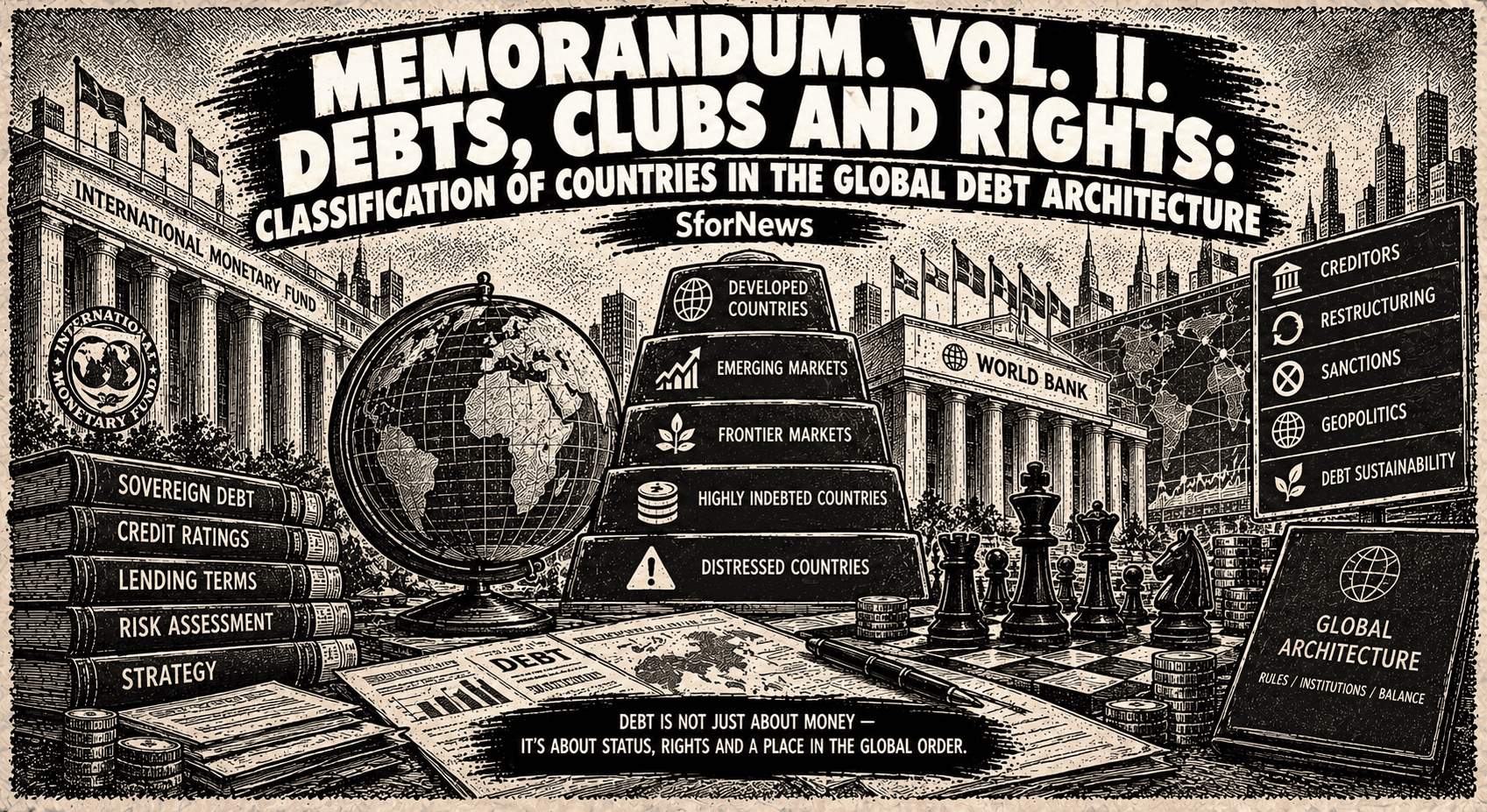
Memorandum. Volume II. Debts, the Club and Rights. Classification of Countries in the Global Debt Architecture
MEMORANDUM. VOLUME II
DEBT, THE CLUB AND RIGHTS: CLASSIFYING COUNTRIES WITHIN THE GLOBAL DEBT ARCHITECTURE
PART 3. THE INTERSECTION: ENERGY vs. DEBT
3.1. The Fundamental Contradiction
Energy is a physical resource. It cannot be “printed.” It can only be extracted, purchased, or seized. Debt is a financial derivative. It is backed by nothing but a promise. When trust declines, debt becomes a toxic asset. A chain reaction then begins. One default triggers another. One collapse leads to another. And the system falls apart.
This is not an “economic cycle.” It is a collision between reality and illusion. Energy is reality. It exists regardless of whether people believe in it. Debt is an illusion. It exists only as long as everyone believes it will be repaid. When that belief disappears, debt disappears with it—and so does the system built upon it.
Why energy is the only real asset. Gold is just a metal. Its value is a social convention. If everyone decided tomorrow that gold was worthless, it would be worthless. Land is a resource, but it can be seized, covered with concrete, or destroyed. Water is a resource, but it can be poisoned, evaporated, or polluted. And energy? Energy cannot be “seized” or “destroyed.” It can only be transformed, purchased, or stolen. But it always exists. It is the foundation of life. It is the law of conservation. It is something that cannot be circumvented.
Why Bitcoin is a tool, not speculation. Volume I, Section 2.3, explains that Bitcoin is an energy derivative: its production cost is linked to kilowatt-hours (kWh). Here, the key point is that Bitcoin makes it possible to export energy in digital form without pipelines, tankers, or intermediaries. Oil and gas are “energy with impurities”: their prices depend on logistics, sanctions, and politics. Electricity cannot be transmitted over distances exceeding 2,000 km without losses. Bitcoin is a global resource. It is “clean energy.”
3.2. The Anatomy of the Debt Pyramid
Debt is not simply “I owe you.” It is an obligation that must be serviced. And servicing it requires income. Without income, debt becomes toxic. A chain reaction then begins. This is not an “economic cycle.” It is architecture—an architecture designed to enrich some while forcing others to pay.
First level: Sovereign debt. Governments borrow money from banks, other countries, and their own citizens. They promise to repay it with interest. But repayment requires income. Income comes from taxes. Taxes depend on the economy. The economy depends on production. Production depends on energy. If the economy grows, the government can service its debt. If the economy contracts, it cannot. It must then either cut spending (austerity), print money (inflation), or default (collapse). All three paths lead to the same outcome: a loss of sovereignty.
Historical perspective. In 2008, Greece defaulted. Why? Because its economy was not growing, its production was declining, and its energy sector was inefficient. It could no longer service its debt. It then lost its sovereignty. Others began managing its budget, its economy, and its life. This is not a “tragedy.” It is architecture—an architecture designed so that some pay while others collect.
Second level: Corporate debt. Companies borrow money to invest. They promise to repay it with interest. But repayment requires income. Income comes from sales. Sales depend on demand. Demand depends on money. Money depends on energy. When demand falls, companies can no longer service their debt. They must either cut costs (layoffs) or declare bankruptcy (collapse).
Historical perspective. In 2001, Enron declared bankruptcy. Why? Because its business model was built on debt, its revenues were illusory, and its energy business was fictitious. When the illusion collapsed, the company collapsed with it. Thousands of people lost their jobs, and thousands lost their savings.
Third level: Personal debt. People borrow money to buy homes, cars, and education. They promise to repay it with interest. But repayment requires income. Income comes from wages. Wages depend on employment. Employment depends on energy. When people lose their jobs, they can no longer service their debt. They lose everything.
Historical perspective. In 2008, millions of people in the United States lost their homes. Why? Because their mortgages were based on an illusion, their incomes were insufficient, and their employment was unstable. When the illusion collapsed, their homes were lost as well.
Conclusion. The three levels of debt are not “three different things.” They are one system: a system in which some create debt and others pay it. And this system is collapsing because energy is reality, while debt is an illusion. When reality collides with illusion, illusion collapses.
3.3. How Energy Becomes Debt—and Debt Becomes a Trap
Stage One: Extracting energy. Countries with energy surpluses—Russia, Kazakhstan, Iran, the UAE, and Saudi Arabia—can produce energy at lower costs than others. They can sell it on the global market, receive revenue, direct that revenue into the budget, use the budget for development, turn development into growth, and use growth to service debt.
That is the theory. In practice, energy is wasted, appropriated by corporations, or sold at undervalued prices. Revenue does not reach the budget. The budget does not fund development. Development does not generate growth. Growth does not support debt servicing. Debt increases, and the country falls into a debt trap.
Historical perspective. In the 1970s, OPEC countries raised oil prices. It was a shock and a crisis—but also an opportunity. Countries with energy surpluses had a chance to escape the debt trap. They failed to do so. Why? Because their energy was wasted, corporations appropriated the profits, and their budgets were not directed toward development. They remained trapped in debt.
Stage Two: Converting energy into debt. Countries facing energy shortages—Europe, Japan, and South Korea—are forced to import energy. They pay for it, and that money leaves their economies. Their economies weaken, their debt grows, and they fall into a debt trap.
Historical perspective. In 1973, Arab countries imposed an oil embargo against the United States and Europe. It was a shock and a crisis, but also a lesson for Europe: it was too dependent on imported energy. Europe failed to learn that lesson. It continued importing, continued paying, and continued weakening. It is now a permanent importer.
Stage Three: The debt trap. Once a country falls into a debt trap, it cannot escape. To repay debt, it needs income. To generate income, it needs energy. To obtain energy, it needs money. To obtain money, it needs debt. And there it is: a closed loop. A trap with no exit—unless the architecture changes, a new system is created, and the country leaves the club.
Historical perspective. In the 1980s, Latin American countries fell into a debt trap. They borrowed to develop, but their incomes did not grow, their energy systems were inefficient, and their economies were not competitive. They could no longer service their debt. They became trapped and could not escape. To escape, they would have needed to change the architecture. But the architecture was not theirs. It belonged to the club—and they were outside it.
3.4. Why Energy Is the Only Real Asset (Continued)
In Volume I, we argued that energy is a physical resource. It cannot be “printed.” It can only be extracted, purchased, or seized.
Energy is not a “commodity.” It is the foundation of life. Everything we do requires energy. A home requires energy. Food requires energy. Transportation requires energy. Communications require energy. Even thought requires energy. This is not a “metaphor.” It is physics. It is the law of conservation of energy.
Energy is not an “asset.” It is reality. The dollar is not an “asset.” It is a promise. A share is not an “asset.” It is a stake in a promise. Bitcoin is not an “asset.” It is a record of energy consumption. But energy is an asset. It is reality. It cannot be “printed,” created from nothing, or “cancelled.” It can only be transformed, seized, purchased, or stolen.
Energy is not a “resource.” It is power. Whoever controls energy controls everything: production, transportation, communications, and life itself. This is not economics. It is an architecture of power in which some control energy while others pay for it and cannot leave. There is no exit. There is only an entrance—and it is closed.
Comparison: Gold / Land / Water / Energy
| Asset | Can it be printed? | Can it be destroyed? | Can it be seized? | Resilience |
|---|---|---|---|---|
| Gold | No | No | Yes | Social convention |
| Land | No | Yes (covered with concrete) | Yes | Vulnerable |
| Water | No | Yes (evaporated) | Yes | Vulnerable |
| Energy | No | No (only transformed) | Yes (but it always exists) | Physics |
3.5. Who Pays for Everything: The Architecture of Debt Extraction
Debt is not a “problem.” It is a tool—a tool for extracting value, energy, and life. This is not a “conspiracy.” It is architecture: an architecture designed so that some extract while others pay.
Who pays? Those outside the club. Those who cannot refinance. Those who have no access to the “gates.” Those who cannot issue their own currency, control their own energy, leave the system, change the rules, or become captains. Those who can do nothing except pay.
How do they pay? They pay with energy, resources, lives, the future, their children, health, freedom, and sovereignty. They pay with everything. This is not a “sacrifice.” It is architecture—an architecture designed so that some live while others pay for that life.
Why do they pay? Because they do not know. They do not know that things could be different, that an exit exists, that they can build their own system, leave the club, create a new architecture, become architects, become captains, and be free.
And this is where the most important point begins. Do not “fight” the club. Do not try to “prove” anything to it. Do not “ask” it for permission. Build your own system. Create your own architecture. Then you will no longer have to pay. You will no longer be “cargo.” You will be the captain of your own ship.
3.6. Three Scenarios for the Debt Pyramid
| Scenario | What happens | Who wins | Who loses |
|---|---|---|---|
| Soft landing | Debt is restructured, inflation erodes some obligations, and interest rates gradually decline | The United States, China, the UAE | Countries outside the club (Argentina, Sri Lanka) |
| Hard landing | A sharp rise in interest rates, a wave of defaults, and a credit crisis | Holders of gold and Bitcoin | All debtors except the United States |
| Collapse | Trust in the dollar disappears, Treasuries are sold off, and the system collapses | No one (except those who exited in advance) | Everyone |
PART 4. THE ALTERNATIVE: AN ENERGY STANDARD
4.1. The Principle: Capital Must Be Backed by Energy, Not Debt
The Basel Committee protects capital against “modelled” risks. But models do not reflect reality. When a model collapses, there is not enough capital. It is like building a house on sand.
The alternative: capital must be backed by a real asset—energy. Not by “modelled” risks, but by physical kilowatt-hours.
The logic:
- Energy is a physical resource. It cannot be “printed.” It can only be extracted, purchased, or seized. It is not a “promise.” It is physics.
- Bitcoin is an energy derivative (see Volume I, Section 2.3). Its production cost is linked to kWh. It is not a “financial bubble.” It is a real asset.
- NES is a right to a share of energy (see Volume I, Section 2.4). It is not a speculative asset but a measure. It is not a “token.” It is a share in a real resource.
This is not a “utopia.” It is architecture—an architecture designed to ensure that capital is backed by reality rather than illusion. And this is not a “new system.” It is a return to an older one, in which money was backed by gold, energy, or another real asset—not by promises, belief, or illusion.
Historical perspective. In 1971, Nixon detached the dollar from gold. It was a decision that allowed the United States to print money without limits. It created the modern financial system—a system in which money is backed by nothing. And the system worked because everyone believed in the dollar. But belief is not architecture. Belief is an illusion. When the illusion collapses, everything collapses, because there is nothing else. No real assets. No real architecture. Only belief—and that belief has ended.
4.2. The Mechanism: An Energy Reserve Instead of a Capital Reserve
Basel: a bank holds capital against risks.
The alternative: a bank holds an energy reserve against its obligations.
How it works
- A bank receives a deposit in digital rubles. This is not “fiat.” It is a digital record. But it is backed by a real asset: real energy and real production.
- The bank must convert part of the deposit into an energy equivalent (Bitcoin or NES). This is not an “investment.” It is a reserve backed by a real asset.
- The energy equivalent is held on the bank’s balance sheet. It is a reserve that can be sold at any time.
- If the bank experiences deposit outflows, it sells the energy equivalent. This is not “panic.” It is a mechanism designed to preserve stability.
- The price of the energy equivalent is linked to the real cost of energy. This is not “speculation.” It is reality—reality independent of trust.
A Bank’s Energy Reserve: The Process
| Step | What happens | Result |
|---|---|---|
| 1 | The bank receives a deposit | A digital record |
| 2 | It converts part of the deposit into an energy equivalent | The reserve is backed by a real asset |
| 3 | It holds the reserve on its balance sheet | The reserve can be sold at any time |
| 4 | When deposits flow out, it sells the reserve | Stability is maintained |
| 5 | The price is linked to the real cost of energy | No speculation |
What does this achieve? Stability. Energy is a real asset. It cannot be “printed” or created from nothing. It can only be extracted. This means that a bank cannot “go bankrupt” in its own currency; it can only devalue it. But if it is backed by energy, it will not lose value, because energy is reality—and reality does not lose value.
Historical perspective. In 2008, banks collapsed. Why? Because their capital was backed by “modelled” risks, and the models did not reflect reality. When reality collapsed, the banks collapsed too, and millions of people lost their savings. This is not a “tragedy.” It is architecture—an architecture designed so that some grow rich while others pay. The energy standard is an alternative: an architecture in which capital is backed by reality rather than illusion.
4.3. Basel vs. the Energy Standard
| Parameter | Basel | Energy Standard |
|---|---|---|
| What backs capital | Modelled risks | Physical kWh |
| Foundation | Trust | Energy |
| Who sets the rules | The club (28 jurisdictions) | An open protocol (BRICS+) |
| Who must comply | Everyone except the United States | All who join |
| What happens in a crisis | The model collapses; capital is insufficient | The reserve is sold; stability is maintained |
| Who pays | Countries outside the club | No one—the reserve is backed by reality |
| Who benefits | The club | All participants |
This is not a “utopia.” It is architecture designed to ensure that capital is backed by reality rather than illusion.
4.4. How It Works for All Countries, Not Just Russia
The energy standard is not a “Russian” system. It is a global architecture. It works for everyone because every country either has energy or does not—but every country is part of the system.
Countries with energy surpluses
Russia, Kazakhstan, Iran, the UAE, Saudi Arabia, Paraguay, and Ethiopia
- Monetize surplus energy through mining. This is not merely “extraction.” It is the monetization of a real asset: real energy and real production.
- Back capital with a real asset. This is not merely a “reserve.” It is reality independent of trust, belief, or illusion.
- Create an alternative to Basel. This is not “rebellion.” It is architecture designed to ensure that capital is backed by reality rather than illusion. This is not a “new system,” but a return to an older one in which money was backed by gold, energy, or another real asset.
Countries with energy deficits
Europe, Japan, and South Korea
- Import Bitcoin as a “digital equivalent of energy.” This is not merely a “purchase.” It is the import of a real asset: real energy and real production.
- Back capital with an energy reserve. This is reality independent of trust, belief, or illusion.
- Create an alternative to Basel. This is not “rebellion,” but an architecture designed to ensure that capital is backed by reality rather than illusion.
Countries outside the club
Argentina, Sri Lanka, Zambia, Ghana, and Ethiopia
- Gain access to the energy standard. This is not a “gift.” It is an opportunity to escape the debt trap, leave the club, leave the system, and leave the illusion.
- Refinance debt through an energy reserve. This is not debt “forgiveness.” It is substitution: replacing illusion with reality, debt with energy, and belief with physics.
- Exit the debt pyramid. This is not a “victory.” It is liberation from debt, illusion, the system, and the club.
4.5. Roadmap: Moving from Debt to Energy
The transition is not a “revolution.” It is architecture, and it has stages. Each stage is a mechanism, a reality, and a step toward energy.
Step 1. Legal recognition (0–6 months)
Recognize energy as a common public resource. This is not a “slogan.” It is a law designed to establish reality.
Current status: Expert opinions are being developed. An appeal to the Constitutional Court is being prepared. Draft legislation is being developed.
Step 2. Recognizing Bitcoin as a derivative of energy (3–9 months)
Amend the law “On Digital Financial Assets.” This is not “legalization.” It is recognition of reality.
Tasks: Prepare amendments, consult experts, and identify parliamentary sponsors to introduce the bill to the State Duma.
Step 3. Establishing the Energo-Digital Group of Companies (6–12 months)
The group will aggregate surplus energy and direct it toward mining. The Bitcoin mined will be transferred to a single public wallet. This is not a “corporation.” It is a mechanism.
Work already underway: The group’s structure is being developed, draft legislation is being prepared, and a public council is being formed.
Step 4. Distribution mechanism: NES (6–12 months)
Every citizen receives a share in the Bitcoin pool. This is not a “gift.” It is a right: a right to a share in a real asset, real energy, and real production. (The NES mechanism is described in Volume I, Section 2.4.)
Work plan: Design the IT infrastructure, prepare the legal framework, and test the mechanism in a pilot region.
Step 5. An energy standard for banks (6–18 months)
Banks hold an energy reserve instead of a capital reserve. This is not a “reform.” It is architecture designed to ensure that capital is backed by reality rather than illusion.
Tasks: Prepare the regulatory framework, consult the Central Bank and commercial banks, and develop the conversion mechanism.
Step 6. International recognition (12–24 months)
Recognize the energy standard at the BRICS+ level. This is not “expansion.” It is an alternative backed by reality.
Areas of work: Prepare international agreements, negotiate with partners, and build a coalition of countries.
Why will this work? Because energy is reality. It cannot be “bankrupted,” devalued, or cancelled. It can only be transformed. This is the key distinction between reality and illusion, between energy and debt. When reality collides with illusion, illusion collapses. And that is already happening.
4.6. The Main Conclusion: Who Will Be the Architect?
Basel is a financial derivative of the real economy. It determines how much capital a bank must hold against modelled risks. But models do not reflect reality. When a model collapses, there is not enough capital. It is like building a house on sand: it stands while the weather is good, but collapses when the storm arrives. And the storm has already begun. Most people simply do not see it because they are looking at the map rather than the territory.
The energy standard is the alternative. Capital is backed by a real asset—energy—not by modelled risks but by physical kWh. This is not a “utopia.” It is architecture designed to ensure that capital is backed by reality rather than illusion.
The question is not whether the transition will happen. The question is who will be its architect. The energy standard is not a “utopia.” It is an architectural plan. Every step has a mechanism for implementation, and every step is connected to the others.
Russia could become that architect. It has everything the new system requires: cheap energy, a cold climate, and the world’s second-largest Bitcoin hashrate. But it lacks a strategy.
Russia can remain a resource supplier for those leading the transition—or become its architect.
There is no third option.
Summary Table by Country
| Country | Debt ($ trillions) | Debt/GDP | Basel membership | Energy | Strategy |
|---|---|---|---|---|---|
| United States | 40.25 | 125.8%** | Inside; does not comply | Available | Defender of the old system |
| China | 22.3 | 106.9%*** | Inside; building | Enormous surplus | Architect of a parallel system |
| Japan | 8.9 | 204.4%* | Inside; trapped | Deficit | Observer |
| United Kingdom | 4.4 | 94.3% | Inside | Deficit | Observer |
| France | 4.3 | 118.4% | Inside | Deficit | Trapped |
| Italy | 3.8 | 138.4% | Inside | Deficit | Trapped |
| Germany | 3.5 | 65.9% | Inside | Deficit | Victim of policy |
| India | 3.5 | 80.0% | Inside; observer | Deficit | Observer |
| Canada | 2.8 | 110.7% | Inside | Available | Observer |
| Brazil | 2.5 | 90.0% | Inside; experimenting | Enormous surplus | Green giant |
| Russia | ~0.4 | ~20% | Inside; no voice | Enormous surplus | Energy sovereign without a strategy |
| Saudi Arabia | ~0.3 | ~30% | Inside; builder | Enormous surplus | Institutional builder |
| UAE | ~0.2 | ~30% | Inside; builder | Enormous surplus | Architect |
| Argentina | ~0.4 | ~85% | Inside; debtor | Available | Outside the club |
| Sri Lanka | ~0.1 | ~120% | Outside | Deficit | 2022 default |
| Zambia | ~0.03 | ~120% | Outside | Available | 2020 default |
| Ghana | ~0.06 | ~90% | Outside | Available | 2021 default |
| Ethiopia | ~0.06 | ~60% | Outside | Available | 2022 default |
* Japan: IMF WEO, April 2026 — 204.4%; October 2026 — 199.4% [3].
** United States: 125.8% is gross debt/GDP according to IMF WEO; public debt (Treasury) is approximately 100% of GDP [4].
*** China: IMF WEO, October 2026 — 104.4%; includes part of local government financing vehicle (LGFV) debt [5].
Sources
[1] US Treasury / JEC (October 2026) — US national debt: $40.25 trillion.
[2] IMF World Economic Outlook (2026) — public debt and debt-to-GDP data.
[3] IMF WEO, April 2026 / October 2026 — Japan: 204.4% / 199.4%.
[4] AAF (American Action Forum) — US public debt at 100% of GDP in FY2026.
[5] IMF WEO, October 2026 — China: 104.4% (including part of LGFV debt).
[6] US Treasury, TIC data (August 2026) — holders of US Treasuries: Japan, $1.07 trillion; United Kingdom, $1.01 trillion; China, $0.59 trillion.
[7] Money Today (September 2026) — China reduces its Treasury holdings.
[8] BRICS Council / Russian Ministry of Energy (June 26, 2026) — BRICS+ gold holdings: 6,000 tonnes.
[9] CoinMarketCap / SCMP / Atlantic Council — mBridge: $55–83 billion.
[10] Congress.gov / S. 4251 — Mined in America Act.
[11] Federal Register / Executive Order 14233 — Strategic Bitcoin Reserve.
[12] Hashrate Index (October 2026) — US share: 35.6%; Russia: 18.1%; China: 11.7%.
[13] EIA Short-Term Energy Outlook (September 2026) — US generation and consumption.
[14] SforNews / “Kafedra” — editorial teams of the “Kafedra” and SforNews journals.
© 2026, editorial teams of the “Kafedra” and SforNews journals. A link to the original source is mandatory when quoting.


Bitcoin
$62,881.23

Ethereum
$1,672.04

Litecoin
$42.71

Dash
$37.08

Bitcoin Cash
$209.43